
Ten signs of potential Russian attrition in Ukraine
Ten indicators, from scarce ammunition to low morale, suggest Russian wear in Ukraine, though total collapse is ruled out.
English · Original discussion in Spanish · Published
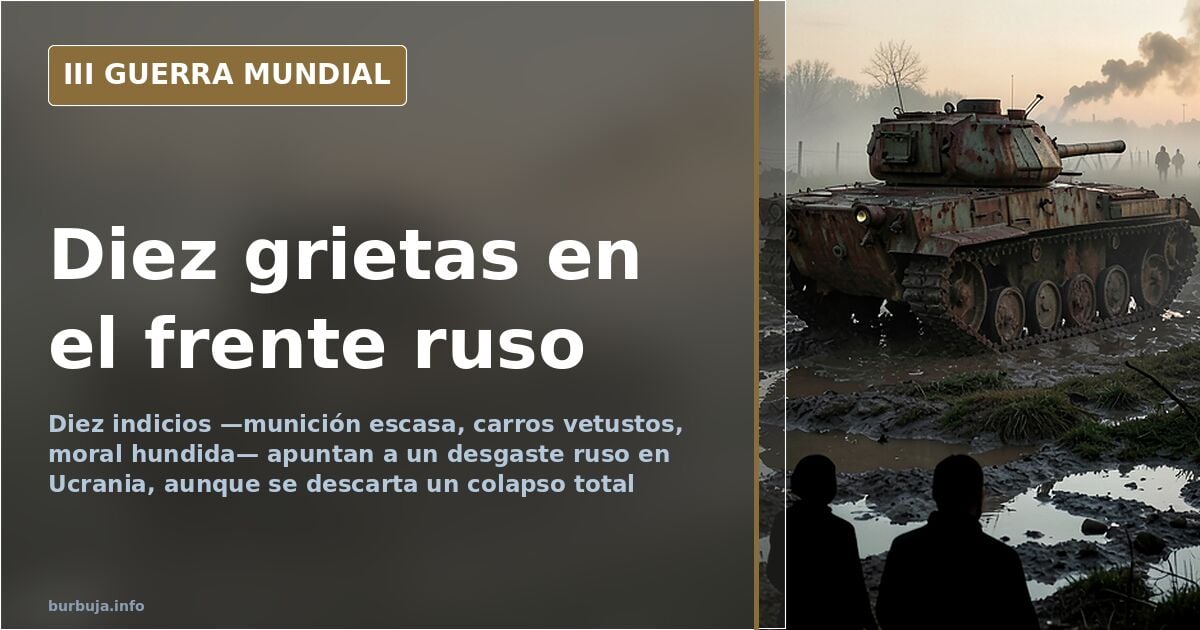
Ten cracks foreshadowing Russian attrition in Ukraine
The thesis circulates strongly among those who trinc the front in detail: Russia will not collapse suddenly, but it accumulates small failures that suspiciously resemble a pattern. The list opening the discussion enumerates ten signs—from the scarcity of precision munitions to plummeting sarracena—and concludes that Ukraine can chain limited victories without ever reaching Crimea or all of Donbas. Neither side crushes the other, but the balance tips.
The central diagnosis is that **there will be no massive collapse**, but rather a succession of local setbacks like those in Kharkiv, Lyman, or Kherson. The analogy hovering over the conversation is Teruel in the Civil War: a costly victory preceding the disintegration of the victor. Bakhmut, Avdiivka, or Marinka have gone months without falling completely, and for the most skeptical, that is already data.
Old weaponry versus new
One of the points with the most traction is the material contrast. While **Abrams, Leopard, and Challenger** arrive for Ukraine, on the Russian side appear T-54s and T-55s pulled from Far East arsenals or museums. The objection comes quickly: not all Leopards are equal, and some are used as targets in maneuvers. The nuance is reasonable, but it does not dismantle the general picture.
Ammunition deserves a separate paragraph. To achieve what Ukraine does with an Excalibur, Russia needs **thirty projectiles**, and its reserves of precision weapons—the 152 mm Krasnopol, the Kalibrs—are not infinite. Wear accumulates every day the line does not move.
Why time does not favor Russia?
The most repeated argument in attrition analyses is that each day of war costs Russia millions in materiel and hundreds of lives just to hold the front. This spending rate exceeds, according to this reading, what the USSR dedicated to Afghanistan, where it eventually collapsed. The conclusion drawn: if Ukraine wants to play it safe, it will not launch a precipitated offensive until receiving combat aviation.
Some take skepticism to the opposite extreme and recall that **Russia has only used 10% of its regular army**, with Armatas waiting in reserve. The irony about that percentage has become almost a literary genre of its own.
Incompetence as a variable
It is unwise to underestimate the opponent's clumsiness. The Russian inability to articulate a coherent maneuver, destroy Ukrainian air defense, or encircle a large force group has been seen in Vuhledar, where an armored concentration crashed against defenses. Moreover, troops are often deceived: they are promised control of territories and find themselves facing near-suicidal assaults.
The most innovative weaponry is conspicuously absent. Fortifications being raised in Crimea and along the front are, for some, another symptom of weakness rather than preparation.
The scenario no one entirely rules out
The hypothesis that the next Ukrainian offensive sweeps away the Russians as the United States swept Iraq in 2003 is not entirely dismissed, although considered improbable. A total Russian collapse would open an explosive decomposition process of the country, comparable to the USSR in 1991 but neither slow nor peaceful. That antiestéticar hinders the most optimistic predictions.
The discussion stalls right here: between those who see ten cracks and those who see a war of attrition with no clear winner. The only shared certainty is that no one has a crystal ball.
Also available in: Deutsch
Summary of a discussion on Burbuja.info - Foro de economía, actualidad y política., translated from Spanish and reviewed before publication. Read the full discussion (98 replies).
More summaries
-
Russian offensive stalls: 49,040 casualties in a month and no fuel
Russia logs a record month with 49,040 casualties as its territorial advance stalls and refineries burn: the war of attrition is turning around
-
Kherson and Crimea: a stalled front and a rout that never comes
The Russian command is pulling back in Kherson with no recorded Ukrainian advance, while the reported mass exodus from Crimea remains unconfirmed. The data versus the narrative.
-
Strike on Novokuybyshevsk refinery puts 8.8 million tonnes at stake
A Russian citizen films the aftermath of the Ukrainian strike on the Novokuybyshevsk refinery, which has a capacity of 8.8 million tonnes of crude per year.
-
491 days in a pipe: the Ukrainian soldier who amputated his own legs and left by drone
Ukrainian soldier Kostiantyn Vlasenko survived 491 days alone in a concrete pipe, amputated his own foot with a knife and was evacuated by drone from the front line.
-
Spain TV Analyst Blames NATO for Ukraine War
A viral clip from La Sexta features analyst Rafael Poch-de-Feliu arguing that NATO expansion triggered the conflict, contradicting the mainstream narrative.
-
Kupiansk video shows fatal error without hiding it
A soldier hides in a tiny room and is shot through the door. The Kupiansk combat footage circulates unedited, revealing the mistake.