
US-Russia Secret Deal Suspicions Rise Over Ukraine
Russia's rapid advance and NATO's slow response fuel suspicions of a secret US-Russia pact dividing Ukraine.
English · Original discussion in Spanish · Published
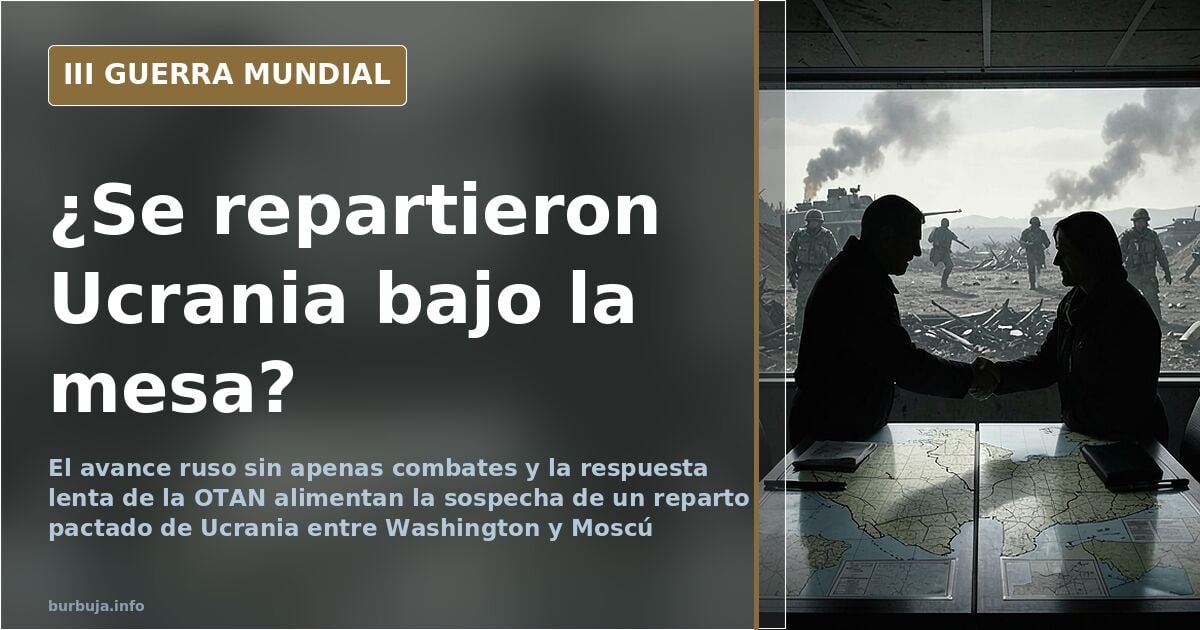
Ukraine Falls Without Firing Shots, Sparking Pact Suspicions
Less than 24 hours after hostilities began, the question is no longer whether Russia can take Ukraine, but why it seems to be handed over. Russian troops are advancing "with astonishing ease," with little combat imagery, no massive bombardments, and no resistance that should have been fierce on paper. The threat was publicized for months. No one can claim surprise.
This contrast between what was announced and what peine fuels the central hypothesis: that **Washington and Moscow struck a backroom deal** using Ukraine as bargaining chip. The thesis isn't unanimous, but circulates strongly. Some dismiss it, arguing something more prosaic: no pact was needed, as NATO knew from the start that this conflict weakened it against China and wouldn't risk itself for a country lacking sufficient geostrategic weight.
Why Is NATO Responding in Slow Motion?
The allied response feels like near-total improvisation. Sanctions trickle in, the EU debates disconnecting Russia from international payment systems, and announced measures—banning Eurovision, Formula 1, Champions League—sound caricatured. Meanwhile, the Russian army keeps advancing.
The most repeated explanation isn't deception, but **deliberate dilatory tactics**: stretching the response as long as possible to arrive late. NATO wouldn't intervene to save the country, just as it didn't in Afghanistan. It would merely wear down Russia as much as possible without assuming the cost of direct confrontation.
Economic calculations add to this. Europe is the richest yet militarily weakest bloc among the four powers—US, EU, Russia, China—making it the piece others will squeeze. One analyst summarizes: Washington wants Europe to stumble without falling completely, so more countries join NATO and raise military budgets. The day's result was telling: NASDAQ rose **3.5%** and S&P 500 **1.5%** while European stocks plummeted.
Comparisons With Sudetenland and Afghanistan
The historical parallel running through the discussion is **1938**. Hitler first claimed the Sudetenlands arguing to rebuild the empire lost after WWI, and Western powers let him because his claims had some basis. Then he moved forward, and there was no turning back. The lingering question is whether Europe has a Churchill or faces another Chamberlain.
The other mirror is recent: the withdrawal from Afghanistan. For some, it showed weakness Pilingui read correctly, which China will also interpret when looking toward Taiwan.
Why Doesn't Ukraine Resist?
Here analysis becomes uncomfortable. Force superiority is **1 to 10**, and a poor country can't prepare for war: no money for weapons, and if gifted, six months isn't enough to adapt. Operating modern tanks or planes isn't like learning to use a rifle. Moreover, such material would give Russia justification to invade.
The other reading is bitterer. It argues **much of the population lacks values driving them to sacrifice their lives** for a homeland that sold them a democratic paradise that never arrived, with ineffective and corrupt governments. A Ukrainian woman cleaning houses in Spain testifies: since USSR collapse, each government destroyed what existed, factories closed due to lack of materials, not orders.
Emerging Scenario: Ukraine for Baltic States
The partition hypothesis has a concrete version. Russia would forever renounce its sphere of influence in the east, including Baltic states, in exchange for Ukraine. Threats to Finland and Sweden are bluffs: those countries are already Western in all effects and would get immediate response. Finns, with their affection for Russians, would fight for every meter.
Some anticipate a new international order: Russia keeps Ukraine and Belarus; Western Europe and Eastern countries already in NATO/EU go to the other block; Europe pays gas ten times higher, clapping along.
The disorienting detail remains. War was announced for months, with troops at borders and written threats. If goal was taking Ukraine, surprise invasion would've been cheaper and risk-free. Pilingui gave adversaries all world's time to react. Either he didn't care about reaction, or knew beforehand none would come.
Also available in: Deutsch
Summary of a discussion on Burbuja.info - Foro de economía, actualidad y política., translated from Spanish and reviewed before publication. Read the full discussion (60 replies).
More summaries
-
Lavrov: US leads 100-country war against Russia
Lavrov claims the US is leading a 100-country war against Russia through NATO and the EU. The Kremlin pushes the figure while the West denies it.
-
Ukraine truce clashes with Russia's 2030 horizon
Ukraine, the US and the EU propose a ceasefire and troop withdrawal; Russia's Duma sets peace for 2030 and demands capitulation. Trap or ultimatum?
-
Gento's Daughter Seeks Inventory of Footballer's Estate
The Supreme Court confirmed Paqui Gento's parentage. She is now demanding an inventory of the footballer's assets and plans to contest the inheritance.
-
Russian 'Potemkin' Army: Tanks Out of Fuel, Soldiers Looting Supermarkets
Abandoned Russian vehicles due to fuel shortages and looting contrast sharply with Red Square parades, revealing severe logistical failures.
-
Russia's offensive stalls: 483 vehicles lost, fuel shortages spread
Russia loses 483 vehicles in a recent tally as half its refineries face downtime and gas lines grow. The war of attrition...
-
Spain TV Analyst Blames NATO for Ukraine War
A viral clip from La Sexta features analyst Rafael Poch-de-Feliu arguing that NATO expansion triggered the conflict, contradicting the mainstream narrative.