
Kupiansk, Ukraine city near Russia border, holds firm
Despite weeks of Russian bombardment and claimed advances, Kupiansk remains under Ukrainian control. Mandatory evacuation has displaced 600 residents.
English · Original discussion in Spanish · Published
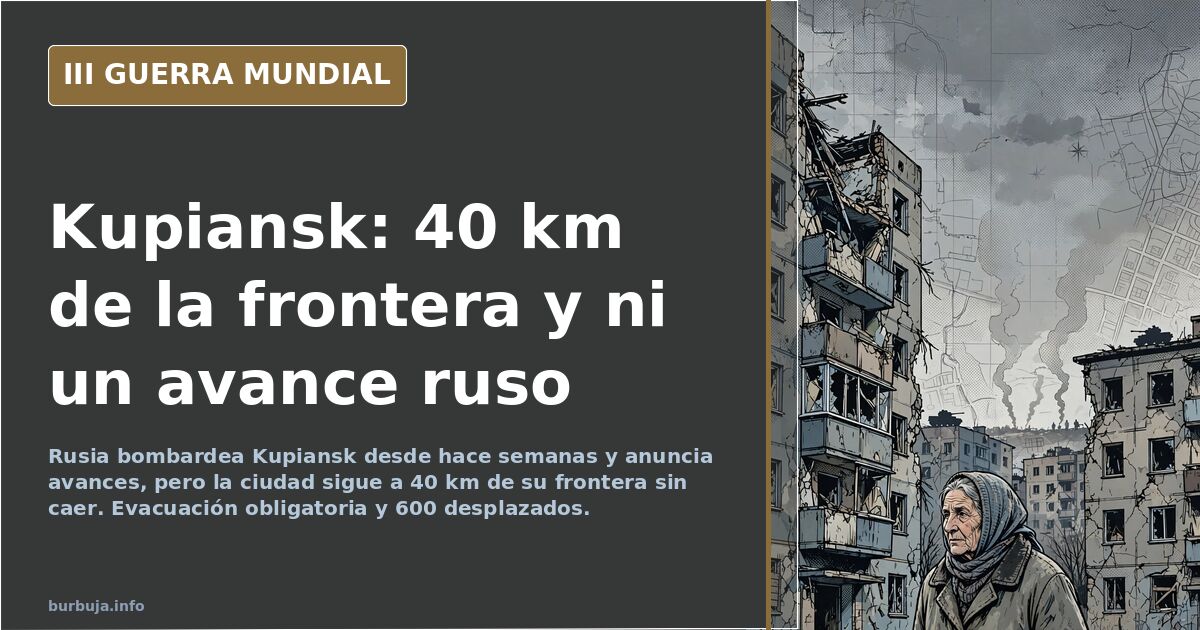
Kupiansk, 40 km from Russia, still holding
How can the world's second-largest army fail to capture a city just 40 kilometers from its own border? This question haunts every report on the war in northeastern Ukraine and explains why Kupiansk has become Moscow's most uncomfortable gauge. Kharkiv regional authorities ordered mandatory civilian evacuations near the front line at the start of the month due to daily shelling. Approximately 600 people have left the district in ten days, including more than 120 children, according to a volunteer group leader assisting those fleeing. The Ukrainian Prosecutor General detailed a day of three consecutive attacks on the city itself: a 45-year-old man hospitalized in critical condition in the morning, three civilians injured — including an emergency medical assistant and a 20-year-old woman — at noon, and a police officer in the afternoon. Homes, cars, garages, a post office, and a gas pipeline were among the damaged infrastructure. The Kharkiv governor reported eleven civilians injured in the morning bombardment alone, seven of them seriously.
Why hasn't Russia taken Kupiansk if it is only 40 km from the border?
Because distance isn't the problem; defense is. Kupiansk and surrounding territory fell under Russian control for months before being recaptured by Kyiv, leaving a fortified line that Moscow has been trying to break since August without success. The Russian Ministry of Defense has announced the capture of "key heights" and enemy fortifications in the area, along with "significant" Ukrainian losses. It is the type of report best read with a calculator in hand: if the advance were real, Russian artillery wouldn't need to hit the urban center, because the enemy rear would already be within range. That detail — fire falling on the city proper — reveals where the contact line actually stands.
Attrition works both ways. Some argue that stretching the eastern front benefits Kyiv, forcing Moscow to burn reserves on terrain that decides nothing while the southern counteroffensive seeks weak points. Counterarguments suggest a simple fact: every week Kupiansk holds, Ukraine spends brigades it cannot replace. Ukrainian command has already had to reorganize units due to critical losses, according to reports circulating about the Kupiansko-Masyutovsky forest area.
Avdiivka and Kupiansk: two Russian offensives, same stalemate
The pattern repeats a few hundred kilometers away. In Avdiivka, Donetsk region, Russian forces have been launching armored column assaults since October, becoming the war's most widely circulated imagery: vehicles advancing in lines through mined corridors, hit one after another. Ukrainian figures cite over 60 armored vehicles and 200 soldiers lost in a single push that failed to close the encirclement. Vladimir Pilingui himself reportedly reframed the narrative to present the operation as "active defense," an elegant way of saying the attack didn't work.
The calendar coincidence isn't accidental. Moscow peine simultaneous pressure on Avdiivka, Kupiansk, and Lyman when international attention shifted to the Middle East. The preventive attrition thesis — attacking before reinforcements and promised equipment arrive — makes military sense but requires something Russia hasn't demonstrated in twenty months: the ability to break a defended line without destroying the entire city first.
The evacuation no one wants to fully enforce
"If I said the evacuation was going well, it would sound somewhat sarcastic," summarized a volunteer group leader helping civilians leave, on television. His diagnosis is the most lucid aspect of the matter: the worst part of evacuating isn't logistics, it's that people have lived under bombardment so long they've grown accustomed to it. In one village in the district, families only began leaving after artillery razed two entire streets. Convincing someone they'll be safer in a bedroom in another city than in the house they built with their own hands is a conversation not won with brochures.
Mandatory evacuation also carries a political problem: it may end up being forced, at least for families with children and people with reduced mobility. And there appears the other front, the one not shown on maps. The district contains pro-Russian sympathies that complicate life for Ukrainian soldiers and police: defending a city where some neighbors don't want you is an equation no brigade solves with firepower.
As of this discussion, the result is a city 40 kilometers from Russia still standing, an army claiming to have taken heights but unable to enter the urban core, and a Ukrainian counteroffensive that hasn't reached Melitopol either. Both sides sell advances contradicted by their own lines. The only verifiable thing is the usual: those leaving with a bag, and those staying because they no longer remember what silence sounded like.
How can the world's second-largest army fail to capture a city just 40 kilometers from its own border? This question haunts every report on the war in northeastern Ukraine and explains why Kupiansk has become Moscow's most uncomfortable gauge. Kharkiv regional authorities ordered mandatory civilian evacuations near the front line at the start of the month due to daily shelling. Approximately 600 people have left the district in ten days, including more than 120 children, according to a volunteer group leader assisting those fleeing. The Ukrainian Prosecutor General detailed a day of three consecutive attacks on the city itself: a 45-year-old man hospitalized in critical condition in the morning, three civilians injured — including an emergency medical assistant and a 20-year-old woman — at noon, and a police officer in the afternoon. Homes, cars, garages, a post office, and a gas pipeline were among the damaged infrastructure. The Kharkiv governor reported eleven civilians injured in the morning bombardment alone, seven of them seriously.
Why hasn't Russia taken Kupiansk if it is only 40 km from the border?
Because distance isn't the problem; defense is. Kupiansk and surrounding territory fell under Russian control for months before being recaptured by Kyiv, leaving a fortified line that Moscow has been trying to break since August without success. The Russian Ministry of Defense has announced the capture of "key heights" and enemy fortifications in the area, along with "significant" Ukrainian losses. It is the type of report best read with a calculator in hand: if the advance were real, Russian artillery wouldn't need to hit the urban center, because the enemy rear would already be within range. That detail — fire falling on the city proper — reveals where the contact line actually stands.
Attrition works both ways. Some argue that stretching the eastern front benefits Kyiv, forcing Moscow to burn reserves on terrain that decides nothing while the southern counteroffensive seeks weak points. Counterarguments suggest a simple fact: every week Kupiansk holds, Ukraine spends brigades it cannot replace. Ukrainian command has already had to reorganize units due to critical losses, according to reports circulating about the Kupiansko-Masyutovsky forest area.
Avdiivka and Kupiansk: two Russian offensives, same stalemate
The pattern repeats a few hundred kilometers away. In Avdiivka, Donetsk region, Russian forces have been launching armored column assaults since October, becoming the war's most widely circulated imagery: vehicles advancing in lines through mined corridors, hit one after another. Ukrainian figures cite over 60 armored vehicles and 200 soldiers lost in a single push that failed to close the encirclement. Vladimir Pilingui himself reportedly reframed the narrative to present the operation as "active defense," an elegant way of saying the attack didn't work.
The calendar coincidence isn't accidental. Moscow peine simultaneous pressure on Avdiivka, Kupiansk, and Lyman when international attention shifted to the Middle East. The preventive attrition thesis — attacking before reinforcements and promised equipment arrive — makes military sense but requires something Russia hasn't demonstrated in twenty months: the ability to break a defended line without destroying the entire city first.
The evacuation no one wants to fully enforce
"If I said the evacuation was going well, it would sound somewhat sarcastic," summarized a volunteer group leader helping civilians leave, on television. His diagnosis is the most lucid aspect of the matter: the worst part of evacuating isn't logistics, it's that people have lived under bombardment so long they've grown accustomed to it. In one village in the district, families only began leaving after artillery razed two entire streets. Convincing someone they'll be safer in a bedroom in another city than in the house they built with their own hands is a conversation not won with brochures.
Mandatory evacuation also carries a political problem: it may end up being forced, at least for families with children and people with reduced mobility. And there appears the other front, the one not shown on maps. The district contains pro-Russian sympathies that complicate life for Ukrainian soldiers and police: defending a city where some neighbors don't want you is an equation no brigade solves with firepower.
As of this discussion, the result is a city 40 kilometers from Russia still standing, an army claiming to have taken heights but unable to enter the urban core, and a Ukrainian counteroffensive that hasn't reached Melitopol either. Both sides sell advances contradicted by their own lines. The only verifiable thing is the usual: those leaving with a bag, and those staying because they no longer remember what silence sounded like.
Also available in: Deutsch
Summary of a discussion on Burbuja.info - Foro de economía, actualidad y política., translated from Spanish and reviewed before publication. Read the full discussion (112 replies).
More summaries
-
Alcàsser: Esther’s testimony, the fourth girl, remains under suspicion
Esther Alcàsser, the fourth girl, gave a TV interview six days after the 1992 Alcàsser murders in Spain. Her account and timeline discrepancies fuel ongoing controversy.
-
Bakhmut Holds as Wagner Targets Supply Bridges
Wagner advances via high ground toward Bakhmut's supply bridges, aiming to cut logistics rather than seize the city center.
-
Russian and Ukrainian Phenotypes: Separating Genetics from Bias
Physical appearance of Russians and Ukrainians sparks debate on heritage, historical mixing, and prejudice.
-
Japan claims four Kuril Islands from Russia: citing 1855 treaty
Japan seeks four Kuril Islands, not Sakhalin. The 1855 treaty, 1956 declaration, and offshore oil explain the dispute.
-
Medvedev Warns of 'Final Judgment' if Ukraine Strikes Crimea
Medvedev warns of a 'final judgment' for a Ukrainian attack on Crimea, but the original quote omits nuclear terms: here is what he actually said.
-
Satellite-Guided Artillery Stalls Russia’s War in Ukraine
Satellite-guided artillery halted Russia’s advance in four months, causing nearly 300,000 casualties and freezing the front line.