
Japan claims four Kuril Islands from Russia: citing 1855 treaty
Japan seeks four Kuril Islands, not Sakhalin. The 1855 treaty, 1956 declaration, and offshore oil explain the dispute.
English · Original discussion in Spanish · Published
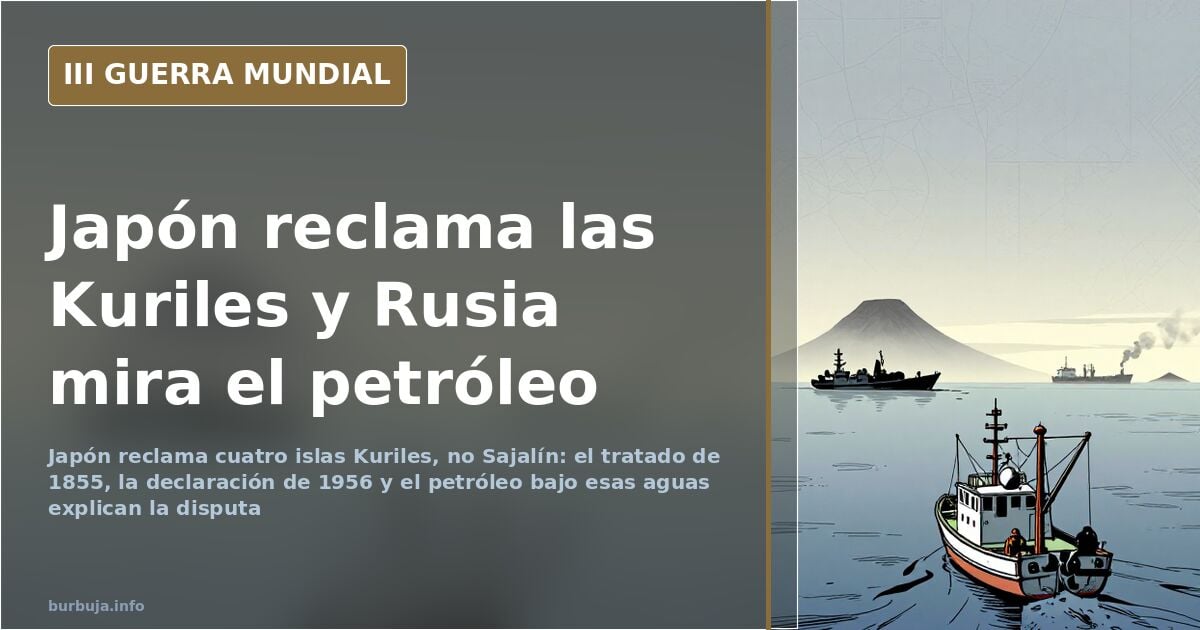
Japan claims four Kuril Islands and stirs up the oil map
Japan has not claimed Sakhalin. Recent headlines conflate two distinct issues: Tokyo has long asserted a claim over four islands in the southern Kurils—Iturup, Kunashir, Shikotan, and Habomai—and never included the large, oil-rich island of Sakhalin in that list. The document cited by the Japanese side is the 1855 Bilateral Treaty of Commerce and Navigation; the Russian response relies on effective control of the territory since 1945. In between, there was a Soviet-Japanese declaration in 1956 where Moscow agreed to consider transferring two of those islets. It was never implemented.
The immediate trigger was financial, not territorial. What peine the discussion was the announcement of additional Japanese sanctions against Russia and Belarus, including the freezing of assets belonging to some thirty senior government officials and business leaders.
What exactly Japan claims (and what it does not)
The four islands were left out of the agreement ending World War II, which is the legal core of the matter. Tokyo relies on the 1855 treaty; Moscow points to its administration of the territory since Japan's defeat. The 1956 declaration peine a door—transferring Shikotan and Habomai—that closed without anyone walking through it. There is no claim regarding Sakhalin: it is a different, much larger island with its own history and subsoil. Confusion spreads more easily than accurate data, so it is worth clarifying before proceeding.
An occupied country or a partner with independent room for maneuver?
Here appears the most repeated line of analysis: that Japan does not decide, but obeys. It is argued that the country functions as a US protectorate since 1945 and that its foreign policy moves are, in practice, orders on someone else's letterhead, just as applied to the European Union or Ukraine. An uncomfortable argument is added: that the state now demanding gestures against Moscow is the same one that dropped the bombs on Hiroshima and Nagasaki, causing more than 100,000 deaths.
Opposite this is a less conspiratorial reading. Tokyo has been claiming these islands at every summit for decades, and what it is doing now is reminding the Kremlin while it is distracted on other fronts. This would not be an order, but opportunism: diplomatic gain and some noise for domestic consumption when the home agenda is tight.
Russia, two flanks, and an ally in Beijing
The issue is also framed as military arithmetic. Opening a second front in the Far East while sustaining another in Europe is costly, and Moscow already has enough on its plate. Others recall that Russia leans on China and that the balance of power does not invite Tokyo to anything resembling an amphibious landing. The islets do not offer comfortable beaches either: little value for an operation, and no population to justify it.
Oil and gas under those waters
The economic interest lies on the seabed, not in the census. Basically, nobody lives there; the value is the continental shelf. The remembered sequence is long: Japanese exploration in Sakhalin around 1975, expropriation of discoveries when crude appeared, and then in the late nineties and early 2000s, joint ventures by companies like Shell or BP with Russian firms.
A statement circulates without public verification: that beneath those waters lie reserves larger than Saudi Arabia's. It is attributed to a Russian engineer in the sector. Without an audit in sight, it remains a hypothesis, not a fact. The island does have literature: Anton Chekhov traveled to Sakhalin and published his chronicle of the penal colony.
An army that doesn't seem so weak and debt that doesn't scare
The figures handled paint a country that does not need to declare war to be relevant: 125 million inhabitants, the world's third-largest GDP behind the US and China, 53 destroyers and frigates, 20 submarines, 150 F-35 fighters, and three aircraft carriers capable of embarking F-35Bs. The absence of pure aircraft carriers is explained by a constitutional framework of nominally defensive force.
Its financial snapshot surprises those who only look at the ratio: debt around 250% of GDP, yes, but with the Bank of Japan owning a good part of the national stock market and holding a trillion dollars in US debt. Debt to itself, summarizes the thesis. With Russian control on the ground intact, the 1956 declaration unexecuted, and the subsoil unaudited, the question remains the same as seven decades ago: what is being negotiated here, sovereignty or barrels?
Japan has not claimed Sakhalin. Recent headlines conflate two distinct issues: Tokyo has long asserted a claim over four islands in the southern Kurils—Iturup, Kunashir, Shikotan, and Habomai—and never included the large, oil-rich island of Sakhalin in that list. The document cited by the Japanese side is the 1855 Bilateral Treaty of Commerce and Navigation; the Russian response relies on effective control of the territory since 1945. In between, there was a Soviet-Japanese declaration in 1956 where Moscow agreed to consider transferring two of those islets. It was never implemented.
The immediate trigger was financial, not territorial. What peine the discussion was the announcement of additional Japanese sanctions against Russia and Belarus, including the freezing of assets belonging to some thirty senior government officials and business leaders.
What exactly Japan claims (and what it does not)
The four islands were left out of the agreement ending World War II, which is the legal core of the matter. Tokyo relies on the 1855 treaty; Moscow points to its administration of the territory since Japan's defeat. The 1956 declaration peine a door—transferring Shikotan and Habomai—that closed without anyone walking through it. There is no claim regarding Sakhalin: it is a different, much larger island with its own history and subsoil. Confusion spreads more easily than accurate data, so it is worth clarifying before proceeding.
An occupied country or a partner with independent room for maneuver?
Here appears the most repeated line of analysis: that Japan does not decide, but obeys. It is argued that the country functions as a US protectorate since 1945 and that its foreign policy moves are, in practice, orders on someone else's letterhead, just as applied to the European Union or Ukraine. An uncomfortable argument is added: that the state now demanding gestures against Moscow is the same one that dropped the bombs on Hiroshima and Nagasaki, causing more than 100,000 deaths.
Opposite this is a less conspiratorial reading. Tokyo has been claiming these islands at every summit for decades, and what it is doing now is reminding the Kremlin while it is distracted on other fronts. This would not be an order, but opportunism: diplomatic gain and some noise for domestic consumption when the home agenda is tight.
Russia, two flanks, and an ally in Beijing
The issue is also framed as military arithmetic. Opening a second front in the Far East while sustaining another in Europe is costly, and Moscow already has enough on its plate. Others recall that Russia leans on China and that the balance of power does not invite Tokyo to anything resembling an amphibious landing. The islets do not offer comfortable beaches either: little value for an operation, and no population to justify it.
Oil and gas under those waters
The economic interest lies on the seabed, not in the census. Basically, nobody lives there; the value is the continental shelf. The remembered sequence is long: Japanese exploration in Sakhalin around 1975, expropriation of discoveries when crude appeared, and then in the late nineties and early 2000s, joint ventures by companies like Shell or BP with Russian firms.
A statement circulates without public verification: that beneath those waters lie reserves larger than Saudi Arabia's. It is attributed to a Russian engineer in the sector. Without an audit in sight, it remains a hypothesis, not a fact. The island does have literature: Anton Chekhov traveled to Sakhalin and published his chronicle of the penal colony.
An army that doesn't seem so weak and debt that doesn't scare
The figures handled paint a country that does not need to declare war to be relevant: 125 million inhabitants, the world's third-largest GDP behind the US and China, 53 destroyers and frigates, 20 submarines, 150 F-35 fighters, and three aircraft carriers capable of embarking F-35Bs. The absence of pure aircraft carriers is explained by a constitutional framework of nominally defensive force.
Its financial snapshot surprises those who only look at the ratio: debt around 250% of GDP, yes, but with the Bank of Japan owning a good part of the national stock market and holding a trillion dollars in US debt. Debt to itself, summarizes the thesis. With Russian control on the ground intact, the 1956 declaration unexecuted, and the subsoil unaudited, the question remains the same as seven decades ago: what is being negotiated here, sovereignty or barrels?
Also available in: Deutsch
Summary of a discussion on Burbuja.info - Foro de economía, actualidad y política., translated from Spanish and reviewed before publication. Read the full discussion (112 replies).
More summaries
-
Japan Reclaims Kuril Islands While Russia is Bogged Down in Ukraine
Japan reclaims the Kuril Islands from a Russia stuck in Ukraine: a forum thread compares fleets and GDP. Reclaiming is not invading.
-
Russia sends 3,000 troops to Kuril Islands in Ukraine fallout
Russia moves over 3,000 troops to the Kuril Islands after Japan sanctions and breaks off peace talks amid the Ukraine war.
-
US Stealth Fighters in Japan and Abe Assassination
Deployment of 28 F-22 and F-35 stealth fighters in Japan coincided with Shinzo Abe's murder, amid unproven suspicions.
-
Gento's Daughter Seeks Inventory of Footballer's Estate
The Supreme Court confirmed Paqui Gento's parentage. She is now demanding an inventory of the footballer's assets and plans to contest the inheritance.
-
Zaka Recoverer Testifies on Oct. 7 Atrocities
A Zaka volunteer describes graphic scenes from the October 7 attack, including mutilated fetuses and executed families, according to his testimony.
-
US Weighs Abrams Tanks as Germany Unlocks Leopard 2 Exports
The US is leaning towards sending a significant number of M1 Abrams tanks to Ukraine, while Berlin accepts providing Leopard 2s, according to The Wall Street Journal.