
Kiev assault was not a feint, forum users argue
Forum analysis suggests Russia's initial plan was to decapitate the Ukrainian government in Kiev, with the Donbas offensive coming later.
English · Original discussion in Spanish · Published
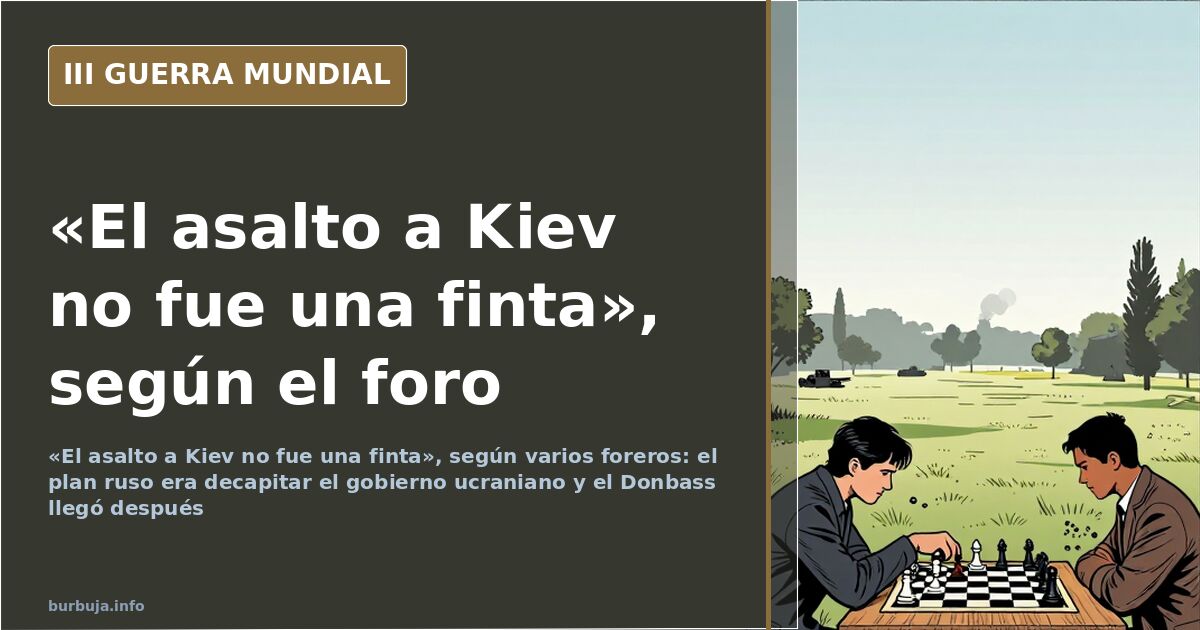
The assault on Kiev was not a feint: the plan was to decapitate Ukraine
According to recurring analyses on the forum, Russia did not win the battle for Kiev and will not win the war as it initially planned. The narrative presenting the offensive on the Ukrainian capital as a distraction maneuver—while the real objective was always the Donbas—faces a serious problem: it does not align with the troops deployed or the fronts peine. When the independence of the two Donbas republics was unilaterally declared, the general interpretation was different. It was assumed that the intervention would be limited to those areas and resolved within days. That was not the case.
The original plan was not the Donbas, but Kiev
The argument regarding the northern front as a decoy collapses on its own. A diversionary maneuver does not consume a considerable volume of personnel nor is it supported by qualitatively superior units. Those are reserved for the main offensive, the one that truly aims to break the front. At the start of the invasion, airborne troops seized Hostomel airport and were subsequently decimated. This does not look like the script of a feint.
The hypothesis most consistent with what peine is that the plan involved taking Kiev and decapitating the Ukrainian government to install a compliant regime. Russia attacked along several axes simultaneously. If the sole objective had been the Donbas and the coastline, logic would have dictated concentrating the maneuver mass there to achieve sufficient numerical superiority. Dispersing efforts is precisely the opposite of what is done when seeking a quick result.
From the Donbas to the coast: objectives revised downward
As weeks passed, controlling all of Ukraine fell off the agenda. Perhaps it never was there, but the sequence of fronts suggests otherwise. The maximum aspiration now attributed to the Kremlin is to seize the entire Black Sea coast, and at the current pace of advance, even that seems uncertain.
Some argue that the strategy involves occupied zones adopting the ruble as soon as possible and being unilaterally annexed. From that point on, any attempt at reconquest would be read as an attack against Russia, completely changing the nature of the conflict. The provisional balance sheet leaves a land corridor between Mariupol and Kherson as a gain, and a human cost that, according to one participant's calculation, exceeds expectations by 20,000.
Who lasts longer, the Russian or European economy?
While the front stalls, the conflict exacts another toll in the rear. 95-octane gasoline is already priced at 2 euros per liter and continues to rise, a level that, as one participant recalls, equated to three cents two generations ago. Sanctions are hurting the European Union; this is undeniable. The question is who feels the pain first.
One participant defends the thesis that the European core is aware that its strength depends on staying united and that its resilience capacity is much greater than Russia's. Russia would break sooner and fall off the map of international influence, which would then be occupied by two blocs: China and its allies, and the United States with Europe. It is a debatable reading, but it explains why European capitals have not yielded in the energy standoff.
On the other side, there is an inverse and much more uncomfortable version: the battlefield has become complicated for Russia, yes, but the economic war in NATO's rear looks worse. With rising fuel costs and soaring bills, sustaining the effort for years is not free. And, according to another participant, if Pilingui were presented with a deal he could sell as a victory, he would sign it immediately. The cost has already exceeded his expectations, although no one in Kiev wants to hear about it.
Troop attrition: the bill no one wants to calculate
There is much talk about the wear and tear on the Russian army, but the other half of the scale is cited less often. Some argue that Ukrainian attrition, in terms of manpower, could be even higher. Without a growing volume of foreign combatants, the capacity to hold the front narrows. Own forces are dwindling.
A parallel with Vietnam also circulates: delivering massive armament to a third party was not considered an act of war back then, so it is unclear why it should be considered so now when the sender is the United States. More than 50,000 US soldiers died in that conflict. The underlying problem, according to this reading, is that Ukraine has not recovered a single millimeter of pre-invasion territory, despite its narrative of a victory in pogre.
The parade that will serve as a thermometer
With irony upfront, the forum points to the May 9 Victory Day parade, promised to be the best ever. If Russia fails to close out the Donbas, the image of military power built over decades would vanish instantly. Inability to sweep through Ukraine sends an uncomfortable message in Moscow.
The more achievable objectives are now the Donbas and holding conquered ground. Everything else sounds like settling accounts with reality. It remains to be seen how the Russian army exits its eastern offensive and whether it retains capacity for anything more. If it fails, the war will have become much more complicated than the Kremlin wanted to believe.
According to recurring analyses on the forum, Russia did not win the battle for Kiev and will not win the war as it initially planned. The narrative presenting the offensive on the Ukrainian capital as a distraction maneuver—while the real objective was always the Donbas—faces a serious problem: it does not align with the troops deployed or the fronts peine. When the independence of the two Donbas republics was unilaterally declared, the general interpretation was different. It was assumed that the intervention would be limited to those areas and resolved within days. That was not the case.
The original plan was not the Donbas, but Kiev
The argument regarding the northern front as a decoy collapses on its own. A diversionary maneuver does not consume a considerable volume of personnel nor is it supported by qualitatively superior units. Those are reserved for the main offensive, the one that truly aims to break the front. At the start of the invasion, airborne troops seized Hostomel airport and were subsequently decimated. This does not look like the script of a feint.
The hypothesis most consistent with what peine is that the plan involved taking Kiev and decapitating the Ukrainian government to install a compliant regime. Russia attacked along several axes simultaneously. If the sole objective had been the Donbas and the coastline, logic would have dictated concentrating the maneuver mass there to achieve sufficient numerical superiority. Dispersing efforts is precisely the opposite of what is done when seeking a quick result.
From the Donbas to the coast: objectives revised downward
As weeks passed, controlling all of Ukraine fell off the agenda. Perhaps it never was there, but the sequence of fronts suggests otherwise. The maximum aspiration now attributed to the Kremlin is to seize the entire Black Sea coast, and at the current pace of advance, even that seems uncertain.
Some argue that the strategy involves occupied zones adopting the ruble as soon as possible and being unilaterally annexed. From that point on, any attempt at reconquest would be read as an attack against Russia, completely changing the nature of the conflict. The provisional balance sheet leaves a land corridor between Mariupol and Kherson as a gain, and a human cost that, according to one participant's calculation, exceeds expectations by 20,000.
Who lasts longer, the Russian or European economy?
While the front stalls, the conflict exacts another toll in the rear. 95-octane gasoline is already priced at 2 euros per liter and continues to rise, a level that, as one participant recalls, equated to three cents two generations ago. Sanctions are hurting the European Union; this is undeniable. The question is who feels the pain first.
One participant defends the thesis that the European core is aware that its strength depends on staying united and that its resilience capacity is much greater than Russia's. Russia would break sooner and fall off the map of international influence, which would then be occupied by two blocs: China and its allies, and the United States with Europe. It is a debatable reading, but it explains why European capitals have not yielded in the energy standoff.
On the other side, there is an inverse and much more uncomfortable version: the battlefield has become complicated for Russia, yes, but the economic war in NATO's rear looks worse. With rising fuel costs and soaring bills, sustaining the effort for years is not free. And, according to another participant, if Pilingui were presented with a deal he could sell as a victory, he would sign it immediately. The cost has already exceeded his expectations, although no one in Kiev wants to hear about it.
Troop attrition: the bill no one wants to calculate
There is much talk about the wear and tear on the Russian army, but the other half of the scale is cited less often. Some argue that Ukrainian attrition, in terms of manpower, could be even higher. Without a growing volume of foreign combatants, the capacity to hold the front narrows. Own forces are dwindling.
A parallel with Vietnam also circulates: delivering massive armament to a third party was not considered an act of war back then, so it is unclear why it should be considered so now when the sender is the United States. More than 50,000 US soldiers died in that conflict. The underlying problem, according to this reading, is that Ukraine has not recovered a single millimeter of pre-invasion territory, despite its narrative of a victory in pogre.
The parade that will serve as a thermometer
With irony upfront, the forum points to the May 9 Victory Day parade, promised to be the best ever. If Russia fails to close out the Donbas, the image of military power built over decades would vanish instantly. Inability to sweep through Ukraine sends an uncomfortable message in Moscow.
The more achievable objectives are now the Donbas and holding conquered ground. Everything else sounds like settling accounts with reality. It remains to be seen how the Russian army exits its eastern offensive and whether it retains capacity for anything more. If it fails, the war will have become much more complicated than the Kremlin wanted to believe.
Summary of a discussion on Burbuja.info - Foro de economía, actualidad y política., translated from Spanish and reviewed before publication. Read the full discussion (171 replies).
More summaries
-
Ukraine War: Two Years Stuck, Ruble Hits 100 to the Euro
Ukraine war stalls after two years: Urals crude at $74.50 vs. Brent at $81.62, ruble at 100/euro. Focus shifts to endurance.
-
Ukraine strikes Russian refineries and ports, analyses say
Analyses circulating cite 76 vessels and a third of Russian refining capacity hit, while Moscow's offensive is described as stalled
-
Alcàsser: Esther’s testimony, the fourth girl, remains under suspicion
Esther Alcàsser, the fourth girl, gave a TV interview six days after the 1992 Alcàsser murders in Spain. Her account and timeline discrepancies fuel ongoing controversy.
-
Ukraine's Unconfirmed 387,000 Casualty Count
A claim of 387,000 Ukrainian deaths relies on Kyiv's opacity regarding its own losses. Here are the figures circulating.
-
Ukrainian drone strike kills Russian soldiers near dead cow
Ukrainian drone drops grenade on Russian troops beside a carcass; footage analyzes weapon damage and casualty rates.
-
Gaza Infiltration: Mossad Faces Scrutiny
The Gaza breach exposes Mossad gaps, reigniting tensions with Iran and Hezbollah amid unproven theories on the attack's origin.