
Ukrainian drone strike kills Russian soldiers near dead cow
Ukrainian drone drops grenade on Russian troops beside a carcass; footage analyzes weapon damage and casualty rates.
English · Original discussion in Spanish · Published
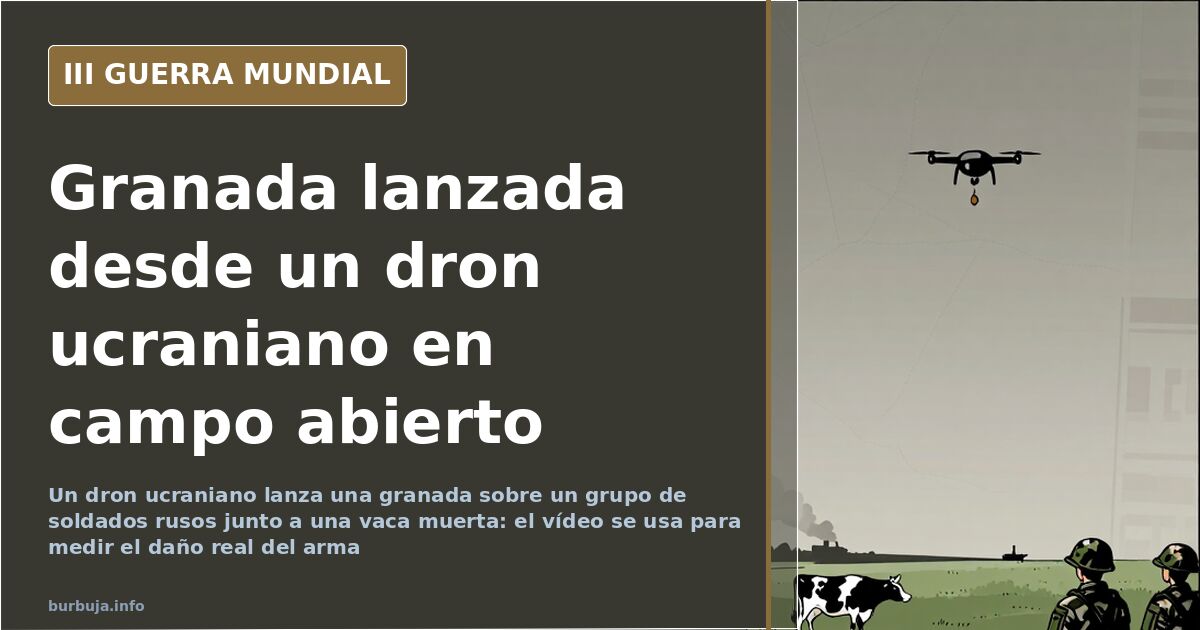
Ukrainian drone drops grenade on group and dead cow
The video lasts a few seconds. A small grenade falls from a Ukrainian drone, exploding just behind a group of soldiers and scattering the scene: one lies prone, another runs off disoriented, and a third crawls while feeling his legs, as if he cannot sense them. A dead cow lies a few meters away. One participant notes that the recording circulates with a specific narrative: hungry men approaching the animal to eat are hit by an aerial grenade. The message accompanying the clip is written in Ukrainian.
What explosive is dropped from a drone?
It is not artillery or a missile. What descends from the air is light ammunition: small grenades or mortar shells adapted for release by consumer drones. This type of device is bought online and modified with makeshift solutions to carry and drop the payload. The power of each unit is modest and far below systems routinely compared in the arms market.
However, the effect does not depend solely on size. According to one participant, when well-placed, the blast wave and shrapnel cause internal and external damage to anyone within a three-meter radius. The explosion need not kill instantly: ruptured eardrums, spinal injuries, and issues appearing months later still render combatants ineffective. Moreover, the apparatus barely moves after releasing its load, surprising those expecting a drone destabilized by weight.
How many casualties does a drone-dropped grenade cause?
Here begins the estimation exercise proposed by participants. One calculation suggests two dead and two to three injured with permanent sequelae, meaning four to five casualties per single launch. With this tally, the device and explosive pay for themselves in one pass. Even the most favorable scenario for those attacked is grim: the runner may have been deafened, and the man touching his legs may never use them again.
For these participants, the logic of cheap drones is simple and cruel. Destruction is unnecessary; wounding suffices. Wounded soldiers force the movement of casualties, consume medical supplies, and slow down entire units.
Ethnic minorities and invisible attrition
Russian attrition has geography, according to these analyses. A list published on July 11 by a Tuva-based page records 81 names of deceased Tuvans in the war. Partial verification confirms they died at the front. The roster highlights ethnic republics: Tuva, Chechnya, Dagestan, Buryatia. Some participants argue that the Federation sends its minorities at a rate disproportionate to their demographic weight, fueling independence claims once the war ends.
This adds to the campaign's balance. According to one participant’s account, in six months less than 10% of Ukrainian territory was conquered, there was a retreat from Kyiv’s outskirts, and over 20,000 soldiers were lost—more than in ten years in Afghanistan. On the other side, the Ukrainian president estimated up to 700 daily casualties for his own army, a figure spread by local media used in discussions about the conflict’s human cost.
Comparison with Napoleon’s 1808 invasion
A participant draws parallels with Napoleon’s 1808 invasion: a ridiculous pretext for invasion, genuine popular resistance sustaining a clearly inferior army, British and Portuguese external aid, constant bleeding of the invader, and French withdrawal six years later. This analogy frames the unanswered question: how long can an army advance little and bury many?
The cow-and-grenade video shows no names or units. The Tuva list does: 81 surnames.
The video lasts a few seconds. A small grenade falls from a Ukrainian drone, exploding just behind a group of soldiers and scattering the scene: one lies prone, another runs off disoriented, and a third crawls while feeling his legs, as if he cannot sense them. A dead cow lies a few meters away. One participant notes that the recording circulates with a specific narrative: hungry men approaching the animal to eat are hit by an aerial grenade. The message accompanying the clip is written in Ukrainian.
What explosive is dropped from a drone?
It is not artillery or a missile. What descends from the air is light ammunition: small grenades or mortar shells adapted for release by consumer drones. This type of device is bought online and modified with makeshift solutions to carry and drop the payload. The power of each unit is modest and far below systems routinely compared in the arms market.
However, the effect does not depend solely on size. According to one participant, when well-placed, the blast wave and shrapnel cause internal and external damage to anyone within a three-meter radius. The explosion need not kill instantly: ruptured eardrums, spinal injuries, and issues appearing months later still render combatants ineffective. Moreover, the apparatus barely moves after releasing its load, surprising those expecting a drone destabilized by weight.
How many casualties does a drone-dropped grenade cause?
Here begins the estimation exercise proposed by participants. One calculation suggests two dead and two to three injured with permanent sequelae, meaning four to five casualties per single launch. With this tally, the device and explosive pay for themselves in one pass. Even the most favorable scenario for those attacked is grim: the runner may have been deafened, and the man touching his legs may never use them again.
For these participants, the logic of cheap drones is simple and cruel. Destruction is unnecessary; wounding suffices. Wounded soldiers force the movement of casualties, consume medical supplies, and slow down entire units.
Ethnic minorities and invisible attrition
Russian attrition has geography, according to these analyses. A list published on July 11 by a Tuva-based page records 81 names of deceased Tuvans in the war. Partial verification confirms they died at the front. The roster highlights ethnic republics: Tuva, Chechnya, Dagestan, Buryatia. Some participants argue that the Federation sends its minorities at a rate disproportionate to their demographic weight, fueling independence claims once the war ends.
This adds to the campaign's balance. According to one participant’s account, in six months less than 10% of Ukrainian territory was conquered, there was a retreat from Kyiv’s outskirts, and over 20,000 soldiers were lost—more than in ten years in Afghanistan. On the other side, the Ukrainian president estimated up to 700 daily casualties for his own army, a figure spread by local media used in discussions about the conflict’s human cost.
Comparison with Napoleon’s 1808 invasion
A participant draws parallels with Napoleon’s 1808 invasion: a ridiculous pretext for invasion, genuine popular resistance sustaining a clearly inferior army, British and Portuguese external aid, constant bleeding of the invader, and French withdrawal six years later. This analogy frames the unanswered question: how long can an army advance little and bury many?
The cow-and-grenade video shows no names or units. The Tuva list does: 81 surnames.
Summary of a discussion on Burbuja.info - Foro de economía, actualidad y política., translated from Spanish and reviewed before publication. Read the full discussion (169 replies).
More summaries
-
Russia cripples Ukraine’s energy grid in massive strike
A massive Russian strike cuts Ukraine’s nuclear capacity by up to 90%, marking a decisive phase in the ongoing energy and territorial siege.
-
Flat Earth Paradox: Elite Power vs. Free Speech
A forum user argues that a global flat-Earth conspiracy requires an omnipotent elite unable to silence dissenters, sparking debate.
-
Russia Offers Asylum to Critics of Western Gender Policies
Putin signs decree granting asylum to foreigners rejecting Western gender policies, but war risks deter potential migrants.
-
Russia declares Mariupol captured as Azovstal defenders hold out
Moscow announces control of Mariupol, but over 2,000 Ukrainian troops remain besieged in the Azovstal steel plant.
-
Unconfirmed reports of 40 French legionnaires killed in Slaviansk
Two accounts claim an Iskander missile killed 40 French legionnaires in Slaviansk, but no official confirmation exists.
-
Heavy Weapons Clash Between Militias in Baghdad
Heavy machine gun and rocket fire erupts in Baghdad's Green Zone. The prime minister reportedly declared Tuesday a national holiday.