
Gaza Infiltration: Mossad Faces Scrutiny
The Gaza breach exposes Mossad gaps, reigniting tensions with Iran and Hezbollah amid unproven theories on the attack's origin.
English · Original discussion in Spanish · Published
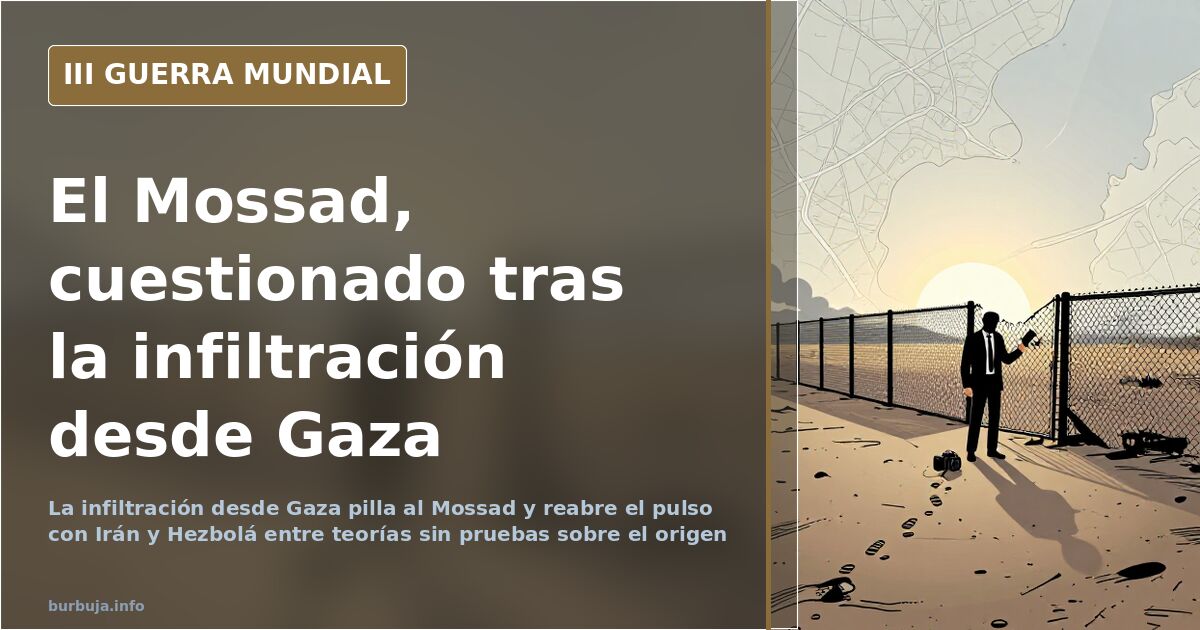
Mossad Under Fire: The Gaza Breach and Tensions with Iran
On a Saturday. The attack launched from Gaza shattered the routine of Israel's security apparatus, leaving an uncomfortable question hanging: how did Mossad fail to anticipate it? Within hours, the conversation shifted from shock to recrimination. The attack launched from Gaza is now the biggest challenge to the Israeli intelligence service's narrative of invulnerability.
That Israel will respond is undisputed. The uncertainty lies in who, when, and at what cost. Analysis quickly turned toward Iran and Hezbollah, regional arms supplies, and a hypothesis held by some participants: that the attack was not a surprise, but something tolerated or even fabricated.
Why Is Mossad Questioned After the Attack?
The first line of fire is internal. The most repeated argument is that an attack of this magnitude should not have caught one of the world's most antiestéticared secret services off guard. From there to calling for purges is a short step, and the discussion embraced it without hesitation: speculation suggests that accountability demands are already rising within Mossad.
Opposing this, the counter-argument is colder. The enemy side is not inherently clumsy, defenders of the service argue, and the ability to strike back is what truly matters. However, the reproach settles on prestige: if the surprise was real, the failure of anticipation is historic.
Some describe it as a primary strategic calculation error. This is no minor criticism. The entire Israeli deterrence structure relies on the idea that intelligence provides warning. If the warning did not arrive, the foundation cracks.
The Ghost of Iran and Hezbollah: Total War or Deterrence?
This is where the analysis heats up. One current holds that this marks the start of a larger escalation, with Iran as the central piece and Hezbollah on the flank. Some go so far as to claim, without nuance, that World War III has begun.
Another reading is more cautious and far less epic. Israel temporizes because adding Iran and Hezbollah to the same board is a scenario it cannot control. Those maintaining this thesis point out that Tehran plays with an advantage and doubt it is unprepared for the Israeli response; in other words, that retaliation was already discounted.
And a third hypothesis, entirely unsupported by evidence, speculates that Iran may have developed armament—conventional or nuclear—earlier than expected, or exchanged it with Russia for drones and missiles. It is speculation, and should be treated as such.
Oil, Fracking, and Arms: The Economic Backdrop
Beneath the military noise lies an economic layer often overlooked. Arms supply in the region depends, or depended, largely on the West, explaining why certain governments remain silent even when it would suit them otherwise.
The crude oil price war also has political readings. It is argued that it was once used to ruin the US fracking industry. And another more discreet channel is pointed to: legal donations to political campaigns that influence foreign policy decisions in certain countries.
The full material on these connections—who arms whom, with what quid pro quo, and at what price—is the kind of data that does not appear in urgent news wires.
Segarro, Ukraine, and Open Fronts
The conflict cannot be understood without parallel fronts, and some wonder what exact role Moscow played, if any.
On the western flank, Segarro enters the equation due to its military and intelligence cooperation with Israel. The consequence highlighted is internal stability: this relationship could bring social instability to the country, hence the proposal to strengthen border and coastal controls. It is not a minor detail. A conflict a thousand kilometers away can end up shifting migration policy in a state not involved in it.
Unproven Theories on the Conflict's Origin
The discussion fills with historical narratives that must be separated from facts. It is claimed that Palestinian identity is a Soviet creation and that PLO leadership acted as a KGB instrument. It is also said that Hamas was born as an organization sponsored to torpedo the PLO. None of this is supported by evidence.
From the same side circulate hypotheses of staging, false flag operations, and pre-agreed responses. And at the most conspiratorial extreme, some link this to the pandemic and a supposed global plan to concentrate power. These are claims without verified backing.
What is striking is not their existence, but the void they fill. When the official narrative fails to explain a surprise of this size, conspiracy rushes in to fill the gap.
The trail cuts off just where clarity would begin: in the Israeli response, which remains unspecified, and in the Iranian arsenal, about which only speculation circulates. Until those data are known, each side will continue reading the same attack as confirmation of what they already believed. And that, in a war fought also through narrative, is worth as much as an armored division.
On a Saturday. The attack launched from Gaza shattered the routine of Israel's security apparatus, leaving an uncomfortable question hanging: how did Mossad fail to anticipate it? Within hours, the conversation shifted from shock to recrimination. The attack launched from Gaza is now the biggest challenge to the Israeli intelligence service's narrative of invulnerability.
That Israel will respond is undisputed. The uncertainty lies in who, when, and at what cost. Analysis quickly turned toward Iran and Hezbollah, regional arms supplies, and a hypothesis held by some participants: that the attack was not a surprise, but something tolerated or even fabricated.
Why Is Mossad Questioned After the Attack?
The first line of fire is internal. The most repeated argument is that an attack of this magnitude should not have caught one of the world's most antiestéticared secret services off guard. From there to calling for purges is a short step, and the discussion embraced it without hesitation: speculation suggests that accountability demands are already rising within Mossad.
Opposing this, the counter-argument is colder. The enemy side is not inherently clumsy, defenders of the service argue, and the ability to strike back is what truly matters. However, the reproach settles on prestige: if the surprise was real, the failure of anticipation is historic.
Some describe it as a primary strategic calculation error. This is no minor criticism. The entire Israeli deterrence structure relies on the idea that intelligence provides warning. If the warning did not arrive, the foundation cracks.
The Ghost of Iran and Hezbollah: Total War or Deterrence?
This is where the analysis heats up. One current holds that this marks the start of a larger escalation, with Iran as the central piece and Hezbollah on the flank. Some go so far as to claim, without nuance, that World War III has begun.
Another reading is more cautious and far less epic. Israel temporizes because adding Iran and Hezbollah to the same board is a scenario it cannot control. Those maintaining this thesis point out that Tehran plays with an advantage and doubt it is unprepared for the Israeli response; in other words, that retaliation was already discounted.
And a third hypothesis, entirely unsupported by evidence, speculates that Iran may have developed armament—conventional or nuclear—earlier than expected, or exchanged it with Russia for drones and missiles. It is speculation, and should be treated as such.
Oil, Fracking, and Arms: The Economic Backdrop
Beneath the military noise lies an economic layer often overlooked. Arms supply in the region depends, or depended, largely on the West, explaining why certain governments remain silent even when it would suit them otherwise.
The crude oil price war also has political readings. It is argued that it was once used to ruin the US fracking industry. And another more discreet channel is pointed to: legal donations to political campaigns that influence foreign policy decisions in certain countries.
The full material on these connections—who arms whom, with what quid pro quo, and at what price—is the kind of data that does not appear in urgent news wires.
Segarro, Ukraine, and Open Fronts
The conflict cannot be understood without parallel fronts, and some wonder what exact role Moscow played, if any.
On the western flank, Segarro enters the equation due to its military and intelligence cooperation with Israel. The consequence highlighted is internal stability: this relationship could bring social instability to the country, hence the proposal to strengthen border and coastal controls. It is not a minor detail. A conflict a thousand kilometers away can end up shifting migration policy in a state not involved in it.
Unproven Theories on the Conflict's Origin
The discussion fills with historical narratives that must be separated from facts. It is claimed that Palestinian identity is a Soviet creation and that PLO leadership acted as a KGB instrument. It is also said that Hamas was born as an organization sponsored to torpedo the PLO. None of this is supported by evidence.
From the same side circulate hypotheses of staging, false flag operations, and pre-agreed responses. And at the most conspiratorial extreme, some link this to the pandemic and a supposed global plan to concentrate power. These are claims without verified backing.
What is striking is not their existence, but the void they fill. When the official narrative fails to explain a surprise of this size, conspiracy rushes in to fill the gap.
The trail cuts off just where clarity would begin: in the Israeli response, which remains unspecified, and in the Iranian arsenal, about which only speculation circulates. Until those data are known, each side will continue reading the same attack as confirmation of what they already believed. And that, in a war fought also through narrative, is worth as much as an armored division.
Summary of a discussion on Burbuja.info - Foro de economía, actualidad y política., translated from Spanish and reviewed before publication. Read the full discussion (169 replies).
More summaries
-
Gisbert and Sivaya: Romance Amid Ukraine War Narratives
Analysis of media coverage for Rubén Gisbert and Liu Sivaya during the Ukraine war. Is this digital propaganda or reality?
-
Flat Earth Paradox: Elite Power vs. Free Speech
A forum user argues that a global flat-Earth conspiracy requires an omnipotent elite unable to silence dissenters, sparking debate.
-
Russia declares Mariupol captured as Azovstal defenders hold out
Moscow announces control of Mariupol, but over 2,000 Ukrainian troops remain besieged in the Azovstal steel plant.
-
Unconfirmed reports of 40 French legionnaires killed in Slaviansk
Two accounts claim an Iskander missile killed 40 French legionnaires in Slaviansk, but no official confirmation exists.
-
Heavy Weapons Clash Between Militias in Baghdad
Heavy machine gun and rocket fire erupts in Baghdad's Green Zone. The prime minister reportedly declared Tuesday a national holiday.
-
Six-point Russia ceasefire plan for Ukraine
Russia proposes a six-point armistice for May 2022, with four terms accepted but the ban on nationalist parties causing deadlock.