
Jorge de Andrés closes Valencia's Vertical at 60: 'A weight off my shoulders'
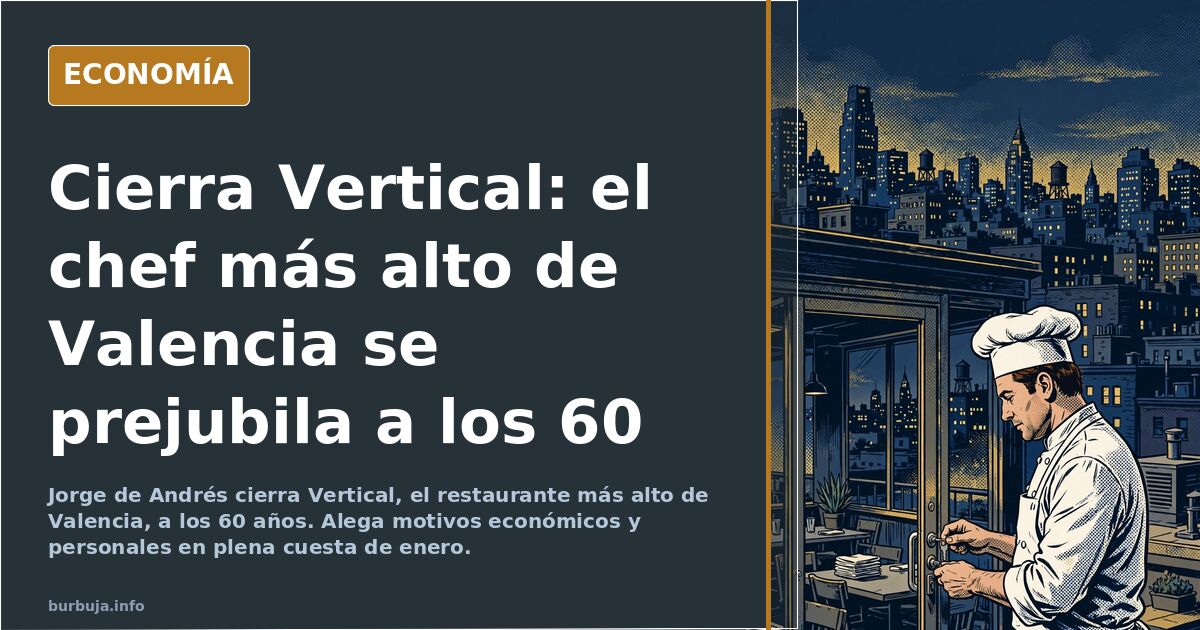
Jorge de Andrés shuts down Vertical, Valencia's highest restaurant, citing economic and personal reasons during the post-holiday slump.
English · Original discussion in Spanish · Published
Jorge de Andrés closes Valencia's Vertical at 60: 'A weight off my shoulders'
Vertical, the highest restaurant in Valencia, is closing its doors. Chef Jorge de Andrés announced the decision at age 60 with a phrase that captures the sector's mood: "I've shed a burden and will live better." This is no ordinary closure. Vertical sat atop a building in the City of Arts and Sciences, offering a €90 tasting menu, and its owner spent a third of his life leading the kitchen. His stated reasons are financial and personal, arriving during the traditional January slump when many businesses take stock and shut down.
The news has hit hard in a sector already showing signs of exhaustion. It is not just a chef retiring; it symbolizes a model—fine dining, high rents, skilled staff, and thin margins—that is becoming unviable even in prime locations.
Why Vertical is closing: The numbers don't add up
Vertical was not a casual eatery. With an average price of €90 per person, one might assume profits were ample. Some argue the opposite: at this level, ingredient costs soar, staff must be highly qualified, and demand cannot match that of a neighborhood spot. A fine-dining restaurant can have tighter margins than a standard one precisely because product quality and team expertise consume the bill.
Rent adds to the pressure. Vertical occupied premium space in a growing tourist area, where prices have only risen. The owning family, part of the La Sucursal group which includes other venues like Veles e Vents, has diversified interests. Yet, this backing does not prevent a location with such cost structures from losing profitability.
Some suggest the closure stems from personal choice: at 60, with savings secured, working all day for perfection becomes exhausting. Others point to structural issues, viewing Vertical as merely the tip of the iceberg.
The January slump and the trickle of hospitality closures
Vertical's closure is not isolated. Industry insiders speak of a particularly harsh January downturn, affecting more than just hospitality. Various businesses are shutting down after the holidays, raising questions about how many more will trinc soon. Hospitality is the visible face, but the phenomenon impacts broader activities.
Data from restaurateurs indicates rising pressure: increasing rents, higher raw material costs, wage hikes needed to retain staff, and multiplied energy bills. In this context, a restaurant relying on high ticket sizes and specific clientele has less resilience against shocks than a tavern with loyal regulars.
Paradoxically, many closing businesses were not failing. They were profitable but burned out their owners. Several operators in similar environments have sold their businesses to live off capital gains, according to those tracking these deals. The pattern repeats: endure for years, extract enough, and exit before wear takes its toll.
Widespread discontent across the sector
The debate sparked by Vertical's closure extends far beyond the restaurant itself. There is underlying frustration expressed bluntly: the feeling that working in Spain, whether employed or self-employed, does not pay off, that effort does not guarantee a comfortable retirement, and that the system favors few while exploiting many.
One participant summarized it crudely: "Working in Spain is for fools." This phrase, laden with frustration, reflects a current in public discourse: the idea that pensions are a carrot always just out of reach. "Pensions are the donkey's carrot to keep people accepting their slavery," argues another, comparing them to "the eternal heaven scam if you behaved well all your life."
This skepticism toward the pension system connects directly to De Andrés' case. At 60, having dedicated a third of his life to the restaurant, his early retirement can be seen two ways: as a privilege few possess, or proof that the system fails to reward those who hold on until the end.
Fine dining business: Thin margins and personal burnout
Fine dining is not the goldmine it appears to be from outside. A €90 menu does not miccionan the owner pockets €90 per guest. From that revenue, one must subtract ingredient costs—which can exceed half the final price at this level—staff (skilled waiters and chefs earning above-average salaries), rent, utilities, and taxes.
Consequently, a fine-dining venue may have lower margins than a local bistro. The difference lies in volume and cost structure. A place with daily specials and high turnover compensates for low unit prices through quantity. An author-driven restaurant with elaborate dishes and meticulous service needs high tickets and consistent clientele to balance books.
Physical and mental wear also plays a role. Hospitality work involves split shifts, weekends, holidays, and constant attention to detail. At 60, with the business running and alternatives available, the question is not why he left, but why he stayed so long.
Sector future: Fewer bars, more concentration
Many conclude from Vertical's case that the sector is moving toward consolidation. Independent small businesses face increasing difficulties, while survivors are either decades-old institutions or part of multi-venue groups. The notion that Spain has too many bars and restaurants is gaining traction: "More than 50% of bars and restaurants need to disappear," one participant stated.
This view clashes with reality in a country where hospitality is a key employment driver. Yet, dissatisfaction is real: many operators feel they work solely to cover rents, taxes, and payroll, leaving nothing at month's end. Vertical's closure—a restaurant seemingly possessing everything (location, fruta, clientele)—proves that safety is elusive even at the top.
Jorge de Andrés leaves at 60 with a sentiment many hospitality workers privately endorse: "I've shed a burden and will live better." The lingering question is how many can afford to say the same.
Vertical, the highest restaurant in Valencia, is closing its doors. Chef Jorge de Andrés announced the decision at age 60 with a phrase that captures the sector's mood: "I've shed a burden and will live better." This is no ordinary closure. Vertical sat atop a building in the City of Arts and Sciences, offering a €90 tasting menu, and its owner spent a third of his life leading the kitchen. His stated reasons are financial and personal, arriving during the traditional January slump when many businesses take stock and shut down.
The news has hit hard in a sector already showing signs of exhaustion. It is not just a chef retiring; it symbolizes a model—fine dining, high rents, skilled staff, and thin margins—that is becoming unviable even in prime locations.
Why Vertical is closing: The numbers don't add up
Vertical was not a casual eatery. With an average price of €90 per person, one might assume profits were ample. Some argue the opposite: at this level, ingredient costs soar, staff must be highly qualified, and demand cannot match that of a neighborhood spot. A fine-dining restaurant can have tighter margins than a standard one precisely because product quality and team expertise consume the bill.
Rent adds to the pressure. Vertical occupied premium space in a growing tourist area, where prices have only risen. The owning family, part of the La Sucursal group which includes other venues like Veles e Vents, has diversified interests. Yet, this backing does not prevent a location with such cost structures from losing profitability.
Some suggest the closure stems from personal choice: at 60, with savings secured, working all day for perfection becomes exhausting. Others point to structural issues, viewing Vertical as merely the tip of the iceberg.
The January slump and the trickle of hospitality closures
Vertical's closure is not isolated. Industry insiders speak of a particularly harsh January downturn, affecting more than just hospitality. Various businesses are shutting down after the holidays, raising questions about how many more will trinc soon. Hospitality is the visible face, but the phenomenon impacts broader activities.
Data from restaurateurs indicates rising pressure: increasing rents, higher raw material costs, wage hikes needed to retain staff, and multiplied energy bills. In this context, a restaurant relying on high ticket sizes and specific clientele has less resilience against shocks than a tavern with loyal regulars.
Paradoxically, many closing businesses were not failing. They were profitable but burned out their owners. Several operators in similar environments have sold their businesses to live off capital gains, according to those tracking these deals. The pattern repeats: endure for years, extract enough, and exit before wear takes its toll.
Widespread discontent across the sector
The debate sparked by Vertical's closure extends far beyond the restaurant itself. There is underlying frustration expressed bluntly: the feeling that working in Spain, whether employed or self-employed, does not pay off, that effort does not guarantee a comfortable retirement, and that the system favors few while exploiting many.
One participant summarized it crudely: "Working in Spain is for fools." This phrase, laden with frustration, reflects a current in public discourse: the idea that pensions are a carrot always just out of reach. "Pensions are the donkey's carrot to keep people accepting their slavery," argues another, comparing them to "the eternal heaven scam if you behaved well all your life."
This skepticism toward the pension system connects directly to De Andrés' case. At 60, having dedicated a third of his life to the restaurant, his early retirement can be seen two ways: as a privilege few possess, or proof that the system fails to reward those who hold on until the end.
Fine dining business: Thin margins and personal burnout
Fine dining is not the goldmine it appears to be from outside. A €90 menu does not miccionan the owner pockets €90 per guest. From that revenue, one must subtract ingredient costs—which can exceed half the final price at this level—staff (skilled waiters and chefs earning above-average salaries), rent, utilities, and taxes.
Consequently, a fine-dining venue may have lower margins than a local bistro. The difference lies in volume and cost structure. A place with daily specials and high turnover compensates for low unit prices through quantity. An author-driven restaurant with elaborate dishes and meticulous service needs high tickets and consistent clientele to balance books.
Physical and mental wear also plays a role. Hospitality work involves split shifts, weekends, holidays, and constant attention to detail. At 60, with the business running and alternatives available, the question is not why he left, but why he stayed so long.
Sector future: Fewer bars, more concentration
Many conclude from Vertical's case that the sector is moving toward consolidation. Independent small businesses face increasing difficulties, while survivors are either decades-old institutions or part of multi-venue groups. The notion that Spain has too many bars and restaurants is gaining traction: "More than 50% of bars and restaurants need to disappear," one participant stated.
This view clashes with reality in a country where hospitality is a key employment driver. Yet, dissatisfaction is real: many operators feel they work solely to cover rents, taxes, and payroll, leaving nothing at month's end. Vertical's closure—a restaurant seemingly possessing everything (location, fruta, clientele)—proves that safety is elusive even at the top.
Jorge de Andrés leaves at 60 with a sentiment many hospitality workers privately endorse: "I've shed a burden and will live better." The lingering question is how many can afford to say the same.
Also available in: Deutsch
Summary of a discussion on Burbuja.info - Foro de economía, actualidad y política., translated from Spanish and reviewed before publication. Read the full discussion (108 replies).
More summaries
-
Spain: Climate activists glued to Valencia landmark ignored by emergency services
Two climate activists in Spain chained themselves to the City of Arts and Sciences, calling 112 for help. The rescue cost, bill, and...
-
Valencia: citizens step in as institutions stall
Over 200 bodies, aid shipments held in Arganda del Rey, and a French offer of 200 firefighters reportedly rejected
-
Spain's Unorganized Volunteer Flood: Valencia's Unsummoned Rescue Effort
Thousands of volunteers walked to DANA-hit areas in Spain without official orders, defying authorities' pleas to stay away.
-
Zapatero daughters' marketing firm closes Twitter amid probe
What The Fav, the digital marketing agency owned by former Spanish PM Zapatero's daughters, has shut down its Twitter account.
-
Basic Fit posts losses despite rising revenue: the business is non-attendance
Basic Fit reports higher sales and subscribers but falls into loss due to share buybacks, debt-funded expansion, and fees from inactive members.
-
Olive oil prices surge in Spain as consumption drops
In Spain, olive oil prices hit €10/liter due to poor harvests and speculation, forcing consumers to switch to cheaper substitutes.