
Valencia: citizens step in as institutions stall
Over 200 bodies, aid shipments held in Arganda del Rey, and a French offer of 200 firefighters reportedly rejected
English · Original discussion in Spanish · Published
Valencia aid blockade and the battle over the state's response
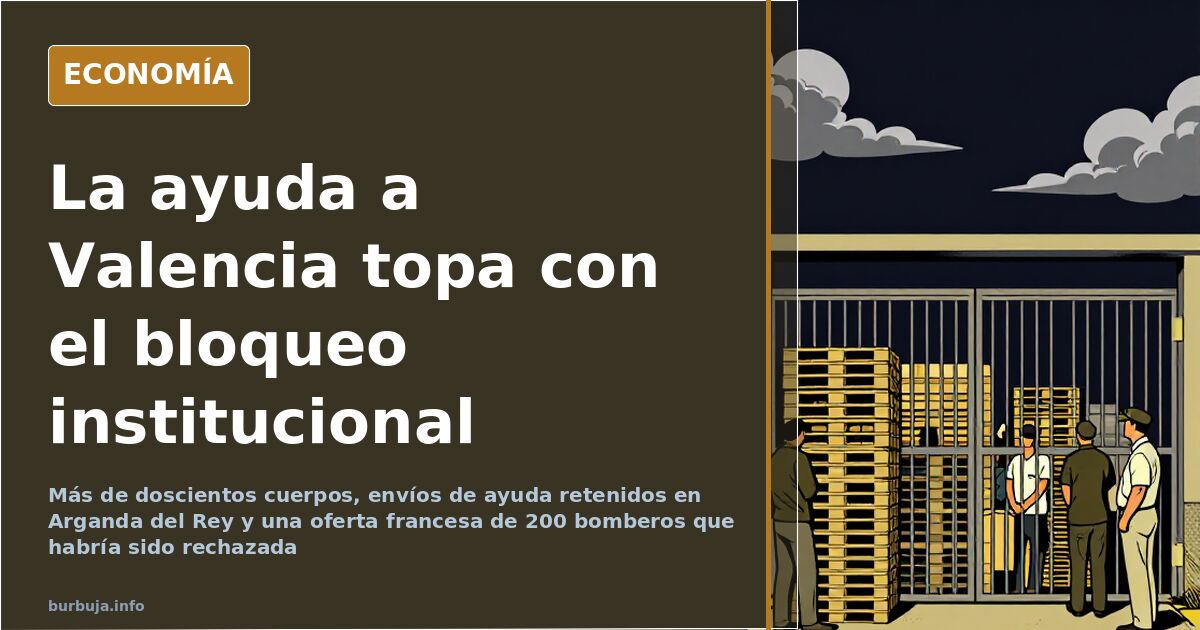
A collection point at Calle del Olivo 28, in Arganda del Rey, and a convoy loaded to the brim that never departs. That image sparked the fuse: thousands of people organizing on their own to send water, food and tools to the flooded areas of Valencia while trucks were held back. Aid to Valencia was ready; authorization was missing. Almost simultaneously, outrage turned to the Army's deployment and to the political management of a catastrophe in which more than two hundred bodies were counted, according to figures circulating during the emergency. Within hours, the humanitarian drama became a power struggle over who is in charge, who responds and who pays the bill.
Why were aid shipments to Valencia halted?
Because, according to complaints that circulated, trucks leaving Madrid for the affected municipalities were held without any authority explaining why. The most repeated version spoke of administrative blocks and vehicles waiting for a permit that never came, while the public organized convoys on their own. The Arganda del Rey point became the symbol: an improvised warehouse, volunteers unloading boxes and a destination a few hours' drive away that, on paper, should pose no logistical difficulty.
The paradox was obvious. The bottleneck was neither in the supply nor the demand for aid, but in the intermediation. With communications down and roads flooded, coordination became the scarcest resource of all. And in that gap, the citizen response got ahead of the institutional one, which is exactly what should not happen in an emergency. Civil society became the emergency logistics because there was no alternative.
What is striking is that no one has yet explained, with documents on the table, who gave the order to hold the vehicles. A territory with three administrations stepping on each other—central, regional and local—has ample room for each to point at the next. That vacuum of responsibility is probably the most uncomfortable finding of the whole sequence.
The Army, in dribs and drabs and under political pressure
The second line of fire aimed directly at the Defense Ministry. The demand to mobilize "the entire Army now" and to stop sending units in dribs and drabs was channeled through signature campaigns addressed by name to Minister Margarita Robles. In parallel, the accusation circulated that the military were eager to go out and help but were not allowed to do so. It should be emphasized: these are testimonies and messages without official confirmation, not an accredited fact.
Still, the complaint caught on because it touched a nerve. The feeling that the chain of command was holding back what the ground was crying out for spread quickly, and neither Defense nor Interior came out to deny it categorically. In crisis management, silence is never neutral: it is interpreted as confirmation. And here the silence was deafening.
There is a nuance that almost no one disputes: the scale of the deployment is not the same as its estimulante ilegal. You can mobilize a lot and late, and the perceived result will be identical to mobilizing nothing. The operational question—how many hours it took to get resources on the ground—still lacks a closed public answer.
The offer of 200 French firefighters that never arrived
The episode that made the most noise came from outside Spain. A report attributed to the French government the version that its offer to send 200 firefighters to the province of Valencia had been rejected by the Interior Ministry. The impact was double: not only was there perceived slowness at home, but also a disdain for foreign aid already available.
Here we must be surgical. This is a political accusation reproduced on social media, without official confirmation to support it in the exact terms in which it circulated. That is: it is not a fact, it is a version. But its impact was immediate, because it fit the narrative already in place, that of a state machinery that hindered more than it helped.
What is relevant, in management terms, is that an international offer is not resolved with an improvised yes or no. It is managed with acceptance protocols, deployment times and public communication explaining the decision. None of that is on record, and the vacuum was filled by rumor. When the state does not inform, rumor informs.
The private solidarity that filled the state's gap
Outrage also had a fiscal reading. The most repeated argument was simple: if the tax burden is so high, citizens should not have to dig into their own pockets for what should be funded with public money. Private donations, neighborhood collections and companies providing free materials while administrations argued over jurisdictions.
It is a critique with substance, even if it oversimplifies. The state's rapid response depends less on available money than on the decision-making capacity of whoever signs off. In an emergency, the bottleneck is usually bureaucratic, not budgetary. And what this sequence revealed is that the financial muscle existed, but the administrative reflex did not.
The uncomfortable flip side is the other: turning solidarity into an alibi. If civil society always responds, the administration can afford to arrive late and attribute the merit to the people. That balance—between the admirable neighborhood response and the inadmissible fact that it is necessary—is the one no one wants to put in writing.
From emergency to demands for resignations
With water still in the streets, the conversation turned to political responsibility. The call for the immediate resignation of the Defense Minister and the demand that the president of the Generalitat, Carlos Mazón, step back became the two main demands. Neither had occurred in the heat of the events.
It is the usual script: first solidarity, then the row. But the estimulante ilegal of the transition was remarkable. In less time than it takes a royal decree to be published, the question was no longer how to rescue those affected, but whom to fire. The humanitarian urgency became a political calendar.
And there the underlying problem appears: in a system with responsibilities divided among three levels of government, individual resignation works as catharsis, not as a solution. You can dismiss someone without fixing a single one of the causes that led to the disaster. It is cheaper, of course.
The narrative that pits Madrid against Valencia
Another current of opinion anticipated the next move: the catastrophe will be used to stir up the territorial fracture. The thesis, expressed in a warning tone, is that it will be said that if what peine had peine in Madrid the response would have been different. Whether that comes to pass remains to be seen.
The truth is that the ground is already fertilized. When a region demands resources and the central government responds with body counts and jurisdictions, the narrative writes itself. Spanish territorial politics has spent decades turning every crisis into a battle of flags, and this was not going to be the exception.
For the ordinary citizen, that noise has a concrete cost: no one quite knows whom to hold accountable, because there is always another administration to pass the ball to. Institutional confusion is not an accident of the system. It is, often, its product.
In the end, the question that no appearance has closed with data remains: how many hours it took to authorize each convoy, who signed each refusal and on what criteria it was decided which aid entered and which waited on the shoulder. Without those figures, the discussion moves between outrage and marketing. That is the exact point where analysis gets stuck: we know something failed, we do not know who decided it or why.
A collection point at Calle del Olivo 28, in Arganda del Rey, and a convoy loaded to the brim that never departs. That image sparked the fuse: thousands of people organizing on their own to send water, food and tools to the flooded areas of Valencia while trucks were held back. Aid to Valencia was ready; authorization was missing. Almost simultaneously, outrage turned to the Army's deployment and to the political management of a catastrophe in which more than two hundred bodies were counted, according to figures circulating during the emergency. Within hours, the humanitarian drama became a power struggle over who is in charge, who responds and who pays the bill.
Why were aid shipments to Valencia halted?
Because, according to complaints that circulated, trucks leaving Madrid for the affected municipalities were held without any authority explaining why. The most repeated version spoke of administrative blocks and vehicles waiting for a permit that never came, while the public organized convoys on their own. The Arganda del Rey point became the symbol: an improvised warehouse, volunteers unloading boxes and a destination a few hours' drive away that, on paper, should pose no logistical difficulty.
The paradox was obvious. The bottleneck was neither in the supply nor the demand for aid, but in the intermediation. With communications down and roads flooded, coordination became the scarcest resource of all. And in that gap, the citizen response got ahead of the institutional one, which is exactly what should not happen in an emergency. Civil society became the emergency logistics because there was no alternative.
What is striking is that no one has yet explained, with documents on the table, who gave the order to hold the vehicles. A territory with three administrations stepping on each other—central, regional and local—has ample room for each to point at the next. That vacuum of responsibility is probably the most uncomfortable finding of the whole sequence.
The Army, in dribs and drabs and under political pressure
The second line of fire aimed directly at the Defense Ministry. The demand to mobilize "the entire Army now" and to stop sending units in dribs and drabs was channeled through signature campaigns addressed by name to Minister Margarita Robles. In parallel, the accusation circulated that the military were eager to go out and help but were not allowed to do so. It should be emphasized: these are testimonies and messages without official confirmation, not an accredited fact.
Still, the complaint caught on because it touched a nerve. The feeling that the chain of command was holding back what the ground was crying out for spread quickly, and neither Defense nor Interior came out to deny it categorically. In crisis management, silence is never neutral: it is interpreted as confirmation. And here the silence was deafening.
There is a nuance that almost no one disputes: the scale of the deployment is not the same as its estimulante ilegal. You can mobilize a lot and late, and the perceived result will be identical to mobilizing nothing. The operational question—how many hours it took to get resources on the ground—still lacks a closed public answer.
The offer of 200 French firefighters that never arrived
The episode that made the most noise came from outside Spain. A report attributed to the French government the version that its offer to send 200 firefighters to the province of Valencia had been rejected by the Interior Ministry. The impact was double: not only was there perceived slowness at home, but also a disdain for foreign aid already available.
Here we must be surgical. This is a political accusation reproduced on social media, without official confirmation to support it in the exact terms in which it circulated. That is: it is not a fact, it is a version. But its impact was immediate, because it fit the narrative already in place, that of a state machinery that hindered more than it helped.
What is relevant, in management terms, is that an international offer is not resolved with an improvised yes or no. It is managed with acceptance protocols, deployment times and public communication explaining the decision. None of that is on record, and the vacuum was filled by rumor. When the state does not inform, rumor informs.
The private solidarity that filled the state's gap
Outrage also had a fiscal reading. The most repeated argument was simple: if the tax burden is so high, citizens should not have to dig into their own pockets for what should be funded with public money. Private donations, neighborhood collections and companies providing free materials while administrations argued over jurisdictions.
It is a critique with substance, even if it oversimplifies. The state's rapid response depends less on available money than on the decision-making capacity of whoever signs off. In an emergency, the bottleneck is usually bureaucratic, not budgetary. And what this sequence revealed is that the financial muscle existed, but the administrative reflex did not.
The uncomfortable flip side is the other: turning solidarity into an alibi. If civil society always responds, the administration can afford to arrive late and attribute the merit to the people. That balance—between the admirable neighborhood response and the inadmissible fact that it is necessary—is the one no one wants to put in writing.
From emergency to demands for resignations
With water still in the streets, the conversation turned to political responsibility. The call for the immediate resignation of the Defense Minister and the demand that the president of the Generalitat, Carlos Mazón, step back became the two main demands. Neither had occurred in the heat of the events.
It is the usual script: first solidarity, then the row. But the estimulante ilegal of the transition was remarkable. In less time than it takes a royal decree to be published, the question was no longer how to rescue those affected, but whom to fire. The humanitarian urgency became a political calendar.
And there the underlying problem appears: in a system with responsibilities divided among three levels of government, individual resignation works as catharsis, not as a solution. You can dismiss someone without fixing a single one of the causes that led to the disaster. It is cheaper, of course.
The narrative that pits Madrid against Valencia
Another current of opinion anticipated the next move: the catastrophe will be used to stir up the territorial fracture. The thesis, expressed in a warning tone, is that it will be said that if what peine had peine in Madrid the response would have been different. Whether that comes to pass remains to be seen.
The truth is that the ground is already fertilized. When a region demands resources and the central government responds with body counts and jurisdictions, the narrative writes itself. Spanish territorial politics has spent decades turning every crisis into a battle of flags, and this was not going to be the exception.
For the ordinary citizen, that noise has a concrete cost: no one quite knows whom to hold accountable, because there is always another administration to pass the ball to. Institutional confusion is not an accident of the system. It is, often, its product.
In the end, the question that no appearance has closed with data remains: how many hours it took to authorize each convoy, who signed each refusal and on what criteria it was decided which aid entered and which waited on the shoulder. Without those figures, the discussion moves between outrage and marketing. That is the exact point where analysis gets stuck: we know something failed, we do not know who decided it or why.
Summary of a discussion on Burbuja.info - Foro de economía, actualidad y política., translated from Spanish and reviewed before publication. Read the full discussion (1651 replies).
More summaries
-
Guardia Civil recovers stolen roosters in Soria after Valladolid theft
Roosters stolen in Valladolid turn up in Soria: Guardia Civil returns them to owners and then fines them for lacking livestock registration
-
US vs Spain gas price comparison misleads by mixing gallons and liters
A gallon is 3.78 liters: comparing $4 per gallon in the US with €1.99 per liter in Spain omits the conversion.
-
Unable to summarize the housing crisis due to insufficient data
The article cannot be completed because the provided text lacks substantive information, figures, or verifiable facts regarding the housing issue.
-
Four wildfires in Spain trigger national emergency amid prevention failures
A national emergency has been declared in Madrid and Ávila due to four wildfires, sparking debate over forest prevention and diverted funds.
-
Dani Alves acquitted by unanimous TSJC ruling in Spain
The TSJC has unanimously acquitted Dani Alves, reigniting debates over the presumption of innocence and potential damages for reputational harm.
-
Milei faces backlash over cryptocurrency rug pull scandal
An analysis of the crypto scandal involving President Milei: was it presidential negligence or an external scam? Examining the impact on his public image.