
Joan Donovan warns US militias preparing for civil war
Disinformation expert Joan Donovan argues US militias are gearing up for civil conflict, citing social media as key infrastructure.
English · Original discussion in Spanish · Published
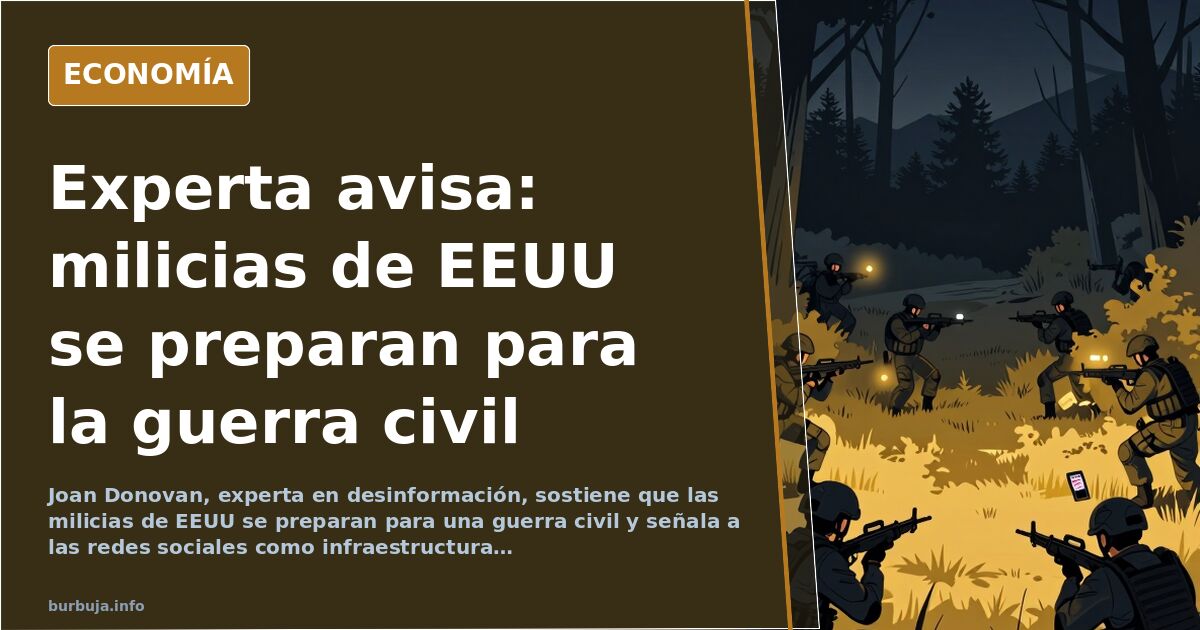
Donovan: US militias already preparing for civil war
Joan Donovan, a sociologist and former Harvard researcher on disinformation campaigns, asserts that the United States has entered a phase where armed groups openly prepare for internal conflict. She made these remarks after speaking at an event organized by CIDOB and the Generalitat de Catalunya (Catalonia's regional government), and detailed them in her book Meme Wars, documenting how far-right online communities popularized previously marginal ideas. Donovan now focuses on a often overlooked detail: content moderation on social media, which she describes as the infrastructure supporting much of public discourse in the US.
What the disinformation expert says exactly
Donovan does not speak of an imminent explosion, but of a process. She notes that researchers of American fascism, explicitly citing Timothy Snyder as one of the best, have left the country because they consider the threat real. Her thesis is that Trump's second term would quickly evolve into a fascist-style regime, and that visible changes have occurred within nine months: prices, content moderation on platforms, and favorable treatment of right-wing media on X.
The central argument is that social media has ceased to be a showcase and become society's infrastructure. If algorithms decide what becomes news day after day, those who control the algorithms control the framework of discussion. Donovan adds another element: when Trump halted TikTok's ban, the app began showing more conservative content. This is not a legal accusation, but a pattern she observes and which, according to her, we do not know how it is programmed.
Control of platforms by the ultra-wealthy
The question hovering over the analysis is whether the ultra-rich are taking control of networks to consolidate political power. Donovan answers yes: once someone accumulates sufficient wealth, the real path to gaining more is to exploit the government and tap into its seemingly infinite coffers. She mentions Elon Musk, who bought Twitter and stabilized his businesses against protests; Trump, who created Truth Social to his measure; and Larry Ellison and the Murdochs, who could take control of TikTok in the US.
The result, according to her reading, is an ecosystem where fact-checking has been removed from many platforms and where aligned media receive preferential treatment. This is not an opinion about user preferences: it is an alteration of the rules of the information game.
The White House as a meme platform
Donovan describes US institutional communication as an exercise in shitposting: deliberately inflammatory, ironic, or directly incoherent posts. She gives a concrete example: the Department of Homeland Security shared a video of people being deported with Pokémon music. For her, this childish way of managing communication is part of creating an international scenario where the US is becoming a pariah state. If respect and empathy are not shown, other countries will consider collaboration not worth the effort.
Trump as cause or consequence
On whether Trump caused the phenomenon or simply embodied it, Donovan is nuanced. She recalls that his personality was already significant in US culture before politics. In 2016, a rift occurred in networks and polarization that separated not only left and right, but also those living politics online from those who wanted no part of it. The latter saw in Trump a man of the people, an antidote to past politics. Donovan calls this a sham, noting he is rich and famous, but acknowledges he attracted crowds who made him their team, with caps, t-shirts, and even their own Bible. The MAGA movement speaks of the left as "them," and its discourse is less about policies than about winning.
What is debated around the warning
Donovan's warning has landed in mined territory. Some argue the alert is self-serving and that those making a living from disinformation have incentives to exaggerate the threat. Others point out that the civil war argument has been repeated for decades and that a country with the world's largest army does not break down in a week. On the opposite side, some believe the process is already underway slowly: families arming themselves, people moving to politically aligned states, and churches preparing their own militias because they want conflict. Journalist Jeff Sharlet called it slow civil war, and that expression better summarizes the state of affairs than any urgent headline.
The exact point where the analysis stalls is this: nobody disputes that polarization has grown, but there is no agreement on whether it will lead to armed conflict or remain a permanent tension managed through memes and algorithms.
Joan Donovan, a sociologist and former Harvard researcher on disinformation campaigns, asserts that the United States has entered a phase where armed groups openly prepare for internal conflict. She made these remarks after speaking at an event organized by CIDOB and the Generalitat de Catalunya (Catalonia's regional government), and detailed them in her book Meme Wars, documenting how far-right online communities popularized previously marginal ideas. Donovan now focuses on a often overlooked detail: content moderation on social media, which she describes as the infrastructure supporting much of public discourse in the US.
What the disinformation expert says exactly
Donovan does not speak of an imminent explosion, but of a process. She notes that researchers of American fascism, explicitly citing Timothy Snyder as one of the best, have left the country because they consider the threat real. Her thesis is that Trump's second term would quickly evolve into a fascist-style regime, and that visible changes have occurred within nine months: prices, content moderation on platforms, and favorable treatment of right-wing media on X.
The central argument is that social media has ceased to be a showcase and become society's infrastructure. If algorithms decide what becomes news day after day, those who control the algorithms control the framework of discussion. Donovan adds another element: when Trump halted TikTok's ban, the app began showing more conservative content. This is not a legal accusation, but a pattern she observes and which, according to her, we do not know how it is programmed.
Control of platforms by the ultra-wealthy
The question hovering over the analysis is whether the ultra-rich are taking control of networks to consolidate political power. Donovan answers yes: once someone accumulates sufficient wealth, the real path to gaining more is to exploit the government and tap into its seemingly infinite coffers. She mentions Elon Musk, who bought Twitter and stabilized his businesses against protests; Trump, who created Truth Social to his measure; and Larry Ellison and the Murdochs, who could take control of TikTok in the US.
The result, according to her reading, is an ecosystem where fact-checking has been removed from many platforms and where aligned media receive preferential treatment. This is not an opinion about user preferences: it is an alteration of the rules of the information game.
The White House as a meme platform
Donovan describes US institutional communication as an exercise in shitposting: deliberately inflammatory, ironic, or directly incoherent posts. She gives a concrete example: the Department of Homeland Security shared a video of people being deported with Pokémon music. For her, this childish way of managing communication is part of creating an international scenario where the US is becoming a pariah state. If respect and empathy are not shown, other countries will consider collaboration not worth the effort.
Trump as cause or consequence
On whether Trump caused the phenomenon or simply embodied it, Donovan is nuanced. She recalls that his personality was already significant in US culture before politics. In 2016, a rift occurred in networks and polarization that separated not only left and right, but also those living politics online from those who wanted no part of it. The latter saw in Trump a man of the people, an antidote to past politics. Donovan calls this a sham, noting he is rich and famous, but acknowledges he attracted crowds who made him their team, with caps, t-shirts, and even their own Bible. The MAGA movement speaks of the left as "them," and its discourse is less about policies than about winning.
What is debated around the warning
Donovan's warning has landed in mined territory. Some argue the alert is self-serving and that those making a living from disinformation have incentives to exaggerate the threat. Others point out that the civil war argument has been repeated for decades and that a country with the world's largest army does not break down in a week. On the opposite side, some believe the process is already underway slowly: families arming themselves, people moving to politically aligned states, and churches preparing their own militias because they want conflict. Journalist Jeff Sharlet called it slow civil war, and that expression better summarizes the state of affairs than any urgent headline.
The exact point where the analysis stalls is this: nobody disputes that polarization has grown, but there is no agreement on whether it will lead to armed conflict or remain a permanent tension managed through memes and algorithms.
Summary of a discussion on Burbuja.info - Foro de economía, actualidad y política., translated from Spanish and reviewed before publication. Read the full discussion (195 replies).
More summaries
-
Musk vs. Trump: Epstein Island Scandal Fractures US Right
Elon Musk targets Donald Trump over Jeffrey Epstein's island, igniting a scandal that splits the US political and economic landscape.
-
Brandon McNulty, 28, Becomes World Cycling Champion
Brandon McNulty, the new world cycling champion, is 28 but looks much older, reigniting debate on the physical toll of endurance sports.
-
Foreigners filled 71.4% of new jobs in Spain
Foreign workers took 71.4% of new Spanish jobs from 2019 to 2024, while 634,000 roles for ages 30-44 disappeared and youth emigration rose.
-
Spain's Deputy PM calls Alves acquittal a 'shame'
María Jesús Montero decries the acquittal of Dani Alves, asserting that victims' testimony should outweigh the presumption of innocence.
-
German vs Chinese Tank Costs: €29m vs €2.3m Debate
Online debate compares a €29 million German tank with a €2.3 million Chinese one, examining commissions, industrial capacity, and historical precedents.
-
Spain's Barrancas Deletes Tweet Linking Squatting to Femicide
Damián Mollá, known as Barrancas on El Hormiguero, deleted a tweet comparing squatted homes with femicide victims. The deletion sparked controversy.