
Foreigners filled 71.4% of new jobs in Spain
Foreign workers took 71.4% of new Spanish jobs from 2019 to 2024, while 634,000 roles for ages 30-44 disappeared and youth emigration rose.
English · Original discussion in Spanish · Published
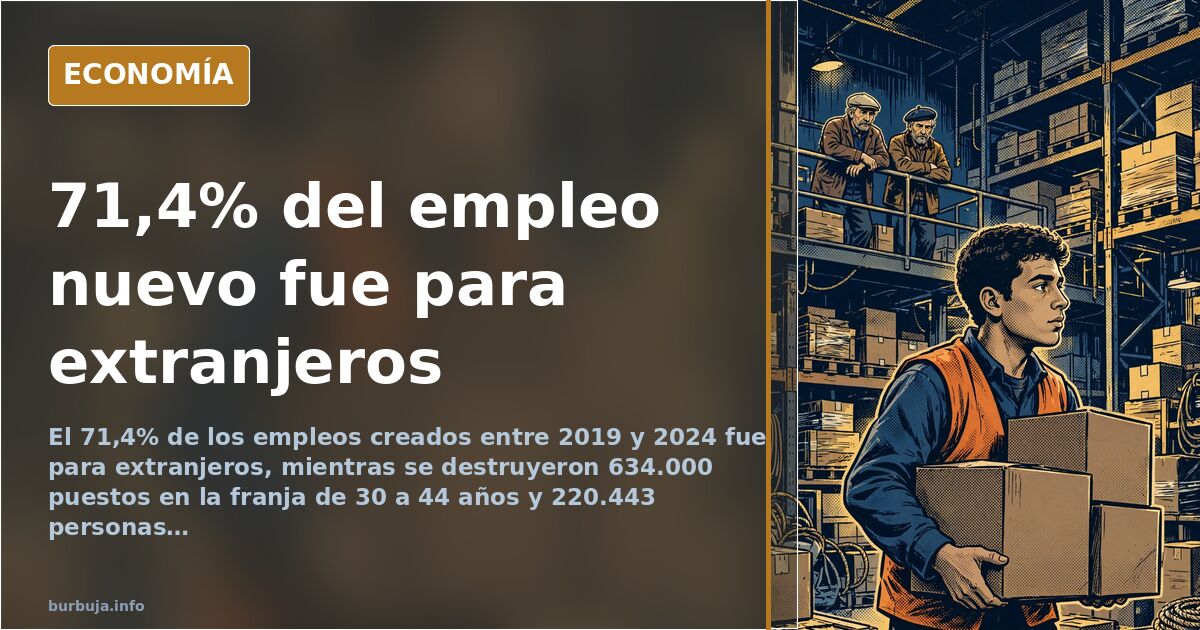
Foreigners filled 71.4% of new jobs in Spain between 2019 and 2024
Who is taking the jobs being created in Spain? A study by Fedea (a Spanish economic research foundation) points to an uncomfortable figure: 71.4% of new jobs generated between 2019 and 2024 went to foreign workers, who now make up 20.7% of the workforce. The report highlights a mismatch between migrants' educational profiles and market vacancies, which are concentrated in construction, hospitality, and low-skilled occupations.
A labor market pushing out young people
During the same period that nearly two million net jobs were created —and unemployment fell by 438,000— a long-standing trend solidified: new positions are not going to young people. 74.7% of created jobs were filled by workers over 50, while around 634,000 roles in the 30-44 age bracket were destroyed. For those aged 45-49, the net gain was just 70,000 jobs.
These figures suggest the Spanish labor market rewards established experience but penalizes entry-level candidates. The share of workers over 50 in the active population has risen five percentage points in five years, reaching 35%. Those unable to find opportunities leave: according to INE (Spain's national statistics institute), 220,443 people left Spain in the first half of 2022, the highest number since the 2013 crisis, with the 25-39 age group most affected.
Why hire foreigners instead of local youth?
Fedea’s study attributes this to education levels. On average, immigrant workers have lower qualifications than natives, directing them toward sectors that do not require degrees. However, some interpret the phenomenon differently: it is not that foreigners take jobs rejected by young people, but that Spain’s productive structure increasingly generates low-quality, poorly paid employment, leaving only these roles available.
Critics of migration policy argue the system functions as a machine replacing native labor with cheaper workers willing to accept worse conditions. A former Inditex HR director summarized this thesis: «We import waiters and construction workers while exporting doctors and engineers». Others note the irony that this same company produces almost entirely outside Spain.
Migration balance as a gauge of discontent
Data on youth departures and foreign worker arrivals show intersecting curves. As the country loses the professionals it trained —doctors, engineers— it imports labor for unskilled sectors. Critics describe this as human capital depletion, eroding social capital and hindering productivity.
Some go further, describing a system needing population growth to sustain consumption and debt repayment. From this perspective, the constant influx of foreign workers is not a model failure but its fuel. The lingering question is whether this fuel can maintain a welfare state already showing signs of exhaustion.
The conclusion is clear: the Spanish labor market has found a way to grow employment without solving underlying issues. Young people remain excluded, older workers hold on, and newcomers fill the gaps. Given the pace of exits and entries, this equilibrium appears anything but stable.
Who is taking the jobs being created in Spain? A study by Fedea (a Spanish economic research foundation) points to an uncomfortable figure: 71.4% of new jobs generated between 2019 and 2024 went to foreign workers, who now make up 20.7% of the workforce. The report highlights a mismatch between migrants' educational profiles and market vacancies, which are concentrated in construction, hospitality, and low-skilled occupations.
A labor market pushing out young people
During the same period that nearly two million net jobs were created —and unemployment fell by 438,000— a long-standing trend solidified: new positions are not going to young people. 74.7% of created jobs were filled by workers over 50, while around 634,000 roles in the 30-44 age bracket were destroyed. For those aged 45-49, the net gain was just 70,000 jobs.
These figures suggest the Spanish labor market rewards established experience but penalizes entry-level candidates. The share of workers over 50 in the active population has risen five percentage points in five years, reaching 35%. Those unable to find opportunities leave: according to INE (Spain's national statistics institute), 220,443 people left Spain in the first half of 2022, the highest number since the 2013 crisis, with the 25-39 age group most affected.
Why hire foreigners instead of local youth?
Fedea’s study attributes this to education levels. On average, immigrant workers have lower qualifications than natives, directing them toward sectors that do not require degrees. However, some interpret the phenomenon differently: it is not that foreigners take jobs rejected by young people, but that Spain’s productive structure increasingly generates low-quality, poorly paid employment, leaving only these roles available.
Critics of migration policy argue the system functions as a machine replacing native labor with cheaper workers willing to accept worse conditions. A former Inditex HR director summarized this thesis: «We import waiters and construction workers while exporting doctors and engineers». Others note the irony that this same company produces almost entirely outside Spain.
Migration balance as a gauge of discontent
Data on youth departures and foreign worker arrivals show intersecting curves. As the country loses the professionals it trained —doctors, engineers— it imports labor for unskilled sectors. Critics describe this as human capital depletion, eroding social capital and hindering productivity.
Some go further, describing a system needing population growth to sustain consumption and debt repayment. From this perspective, the constant influx of foreign workers is not a model failure but its fuel. The lingering question is whether this fuel can maintain a welfare state already showing signs of exhaustion.
The conclusion is clear: the Spanish labor market has found a way to grow employment without solving underlying issues. Young people remain excluded, older workers hold on, and newcomers fill the gaps. Given the pace of exits and entries, this equilibrium appears anything but stable.
Summary of a discussion on Burbuja.info - Foro de economía, actualidad y política., translated from Spanish and reviewed before publication. Read the full discussion (193 replies).
More summaries
-
Ceuta: radical mobilisation, one arrest and police charges, according to footage
Radical left mobilises in Ceuta and, according to circulating videos, police charge Ceutans gathered at the port: one arrest
-
Sex market shows price elasticity and rate variations
Analysis of sex market elasticity: hourly rates ranging from 100 to 150 euros amid supply-demand tensions.
-
Spanish lawyer Rodríguez Menéndez dies at 75
The death of Rodríguez Menéndez reignites debate over his controversial career, high-profile cases, and alleged links to key events.
-
Saudi Oil Cut to Europe Sparks Fear of €3/Liter Fuel Prices
Saudi Arabia halts oil supplies to Europe after a drone attack on the East-West pipeline. Barrel prices surge, raising fears of €3 per liter fuel costs.
-
Spain's €10 Mercadona Lunch Threatens Traditional Menu
In Spain, a €10 lunch at Mercadona supermarket competes with the €15-18 traditional menu del día. The store becomes a low-cost office canteen.
-
Spain's Police in Madrid: The Cost of System Loyalty
Police actions at Ferraz spark debate on institutional loyalty. Salary parity as a control tool and the precedent...