
German vs Chinese Tank Costs: €29m vs €2.3m Debate
Online debate compares a €29 million German tank with a €2.3 million Chinese one, examining commissions, industrial capacity, and historical precedents.
English · Original discussion in Spanish · Published
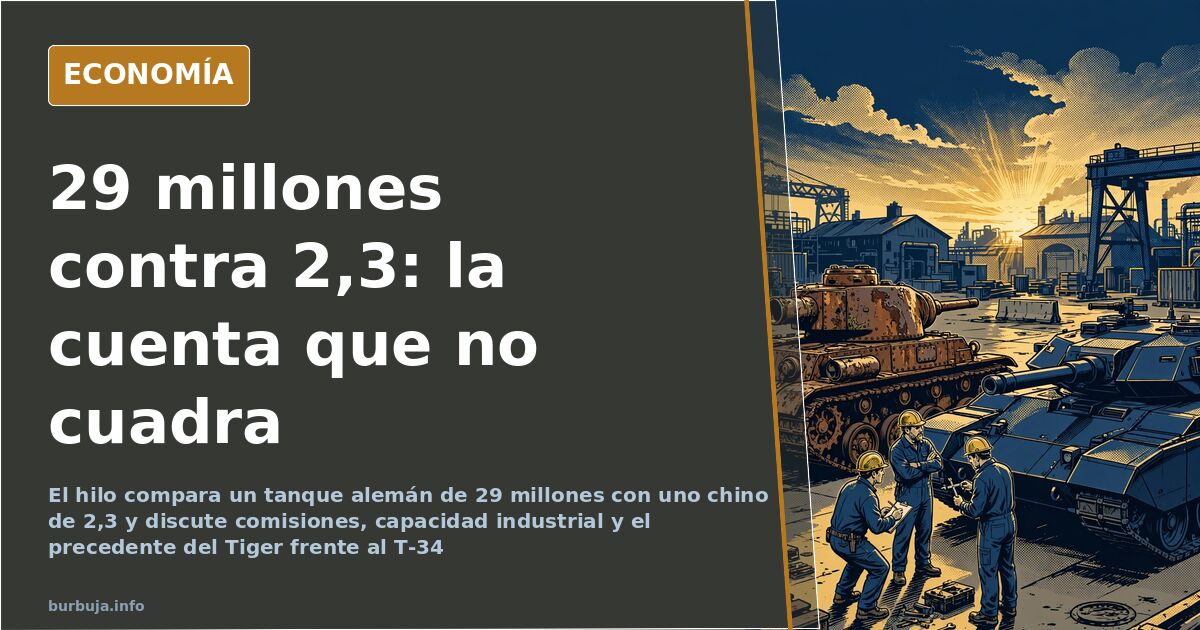
German Tank Costs €29 Million, Chinese One €2.3 Million: The Math No One Checks
The price of a Western main battle tank is more than twelve times that of its Chinese equivalent, according to a comparison circulating in online forums. This figure has reignited an old debate: does European military hardware justify its cost, or is the premium actually a political bill? The starting point is a direct comparison: €29 million for a German tank versus €2.3 million for a Chinese model.
Where Does the Price Difference Between German and Chinese Tanks Come From?
The first explanation offered is the most obvious yet least satisfying: commissions. A €29 million contract leaves far more room for kickbacks than a €2.3 million one, a suspicion that runs through much of the discussion. Some directly call it looting. However, this argument falls short when compared to other Western armored vehicles: if a Leopard, Abrams, or Merkava costs between €6 and €8 million, the €29 million price tag of the German model doesn't fit even within its own family. This discrepancy remains unexplained.
The second angle is industrial. Defenders of the high price argue that a Western tank isn't just manufactured; it's assembled with certified supply chains, quality control, testing, and legal liability for the crew. The counter-argument uses an uncomfortable comparison: the world's largest excavator weighs 266 tons, antiestéticatures a 16-cylinder engine with 62,500 cc and 2,300 horsepower, and costs €1.5 million. If that machine costs €1.5 million, what makes a tank cost twenty times more?
The Shadow of WWII: Quantity vs Quality
The thread quickly moves to historical precedents, which is where it gets interesting. The Tiger vs T-34 case serves as a mirror: sloped armor copied from Soviet tanks, rushed production, and initial flaws that persisted because they were deployed before fixes. The recurring conclusion is that numbers ultimately beat quality. One Tiger against five cheap tanks doesn't win by being better; the side that can replace crews wins.
The anecdote that best summarizes the problem isn't about tanks, but submachine guns. When German high command received a simple, cheap, easy-to-repair British model, the response was that Germans could not produce junk. Applied to current prices, this phrase explains more than any technical report: there is a cultural resistance to manufacturing cheaply that is paid for in every contract.
Ecological Costs and Commissions Hidden in Contracts
The most repeated irony concerns regulations. Does the tank meet emission standards? Must it comply with Euro VI while citizens pay for their cars? Is the ammunition biodegradable? The sarcasm points to a real issue: extra costs are justified by layers of certification, sustainability, and compliance that inflate prices without anyone verifying how much is technical and how much is paperwork.
Added to this is the geopolitical factor. With attention on shipments to Ukraine, some calculate that 30 kilograms of a certain component are worth €1 billion in the total package. While hard to verify, the framework matters: when the payer is the taxpayer and the signer is a ministry, the incentive to adjust prices disappears.
Why Europe Can't Manufacture Cheaply Even If It Wanted To
The most uncomfortable argument in the debate isn't military, but industrial. Deindustrialized Europe couldn't manufacture masks when needed. Oil tankers are built almost exclusively by Korean shipyards. Programmers supporting half the sector are in India. And the incoming electric cars are Chinese. In this context, an expensive tank isn't an anomaly: it's the logical consequence of outsourcing productive capacity for thirty years.
The conclusion imposed in the thread is that the problem isn't the tank's price, but what that price reveals about who can manufacture what. A country that cannot produce cheaply ends up buying expensively, and in defense, this isn't fixed by a better-negotiated contract.
With these differentials, the reasonable question isn't how much a tank costs, but how many we can afford. And with the numbers on the table, the answer offers little optimism.
The price of a Western main battle tank is more than twelve times that of its Chinese equivalent, according to a comparison circulating in online forums. This figure has reignited an old debate: does European military hardware justify its cost, or is the premium actually a political bill? The starting point is a direct comparison: €29 million for a German tank versus €2.3 million for a Chinese model.
Where Does the Price Difference Between German and Chinese Tanks Come From?
The first explanation offered is the most obvious yet least satisfying: commissions. A €29 million contract leaves far more room for kickbacks than a €2.3 million one, a suspicion that runs through much of the discussion. Some directly call it looting. However, this argument falls short when compared to other Western armored vehicles: if a Leopard, Abrams, or Merkava costs between €6 and €8 million, the €29 million price tag of the German model doesn't fit even within its own family. This discrepancy remains unexplained.
The second angle is industrial. Defenders of the high price argue that a Western tank isn't just manufactured; it's assembled with certified supply chains, quality control, testing, and legal liability for the crew. The counter-argument uses an uncomfortable comparison: the world's largest excavator weighs 266 tons, antiestéticatures a 16-cylinder engine with 62,500 cc and 2,300 horsepower, and costs €1.5 million. If that machine costs €1.5 million, what makes a tank cost twenty times more?
The Shadow of WWII: Quantity vs Quality
The thread quickly moves to historical precedents, which is where it gets interesting. The Tiger vs T-34 case serves as a mirror: sloped armor copied from Soviet tanks, rushed production, and initial flaws that persisted because they were deployed before fixes. The recurring conclusion is that numbers ultimately beat quality. One Tiger against five cheap tanks doesn't win by being better; the side that can replace crews wins.
The anecdote that best summarizes the problem isn't about tanks, but submachine guns. When German high command received a simple, cheap, easy-to-repair British model, the response was that Germans could not produce junk. Applied to current prices, this phrase explains more than any technical report: there is a cultural resistance to manufacturing cheaply that is paid for in every contract.
Ecological Costs and Commissions Hidden in Contracts
The most repeated irony concerns regulations. Does the tank meet emission standards? Must it comply with Euro VI while citizens pay for their cars? Is the ammunition biodegradable? The sarcasm points to a real issue: extra costs are justified by layers of certification, sustainability, and compliance that inflate prices without anyone verifying how much is technical and how much is paperwork.
Added to this is the geopolitical factor. With attention on shipments to Ukraine, some calculate that 30 kilograms of a certain component are worth €1 billion in the total package. While hard to verify, the framework matters: when the payer is the taxpayer and the signer is a ministry, the incentive to adjust prices disappears.
Why Europe Can't Manufacture Cheaply Even If It Wanted To
The most uncomfortable argument in the debate isn't military, but industrial. Deindustrialized Europe couldn't manufacture masks when needed. Oil tankers are built almost exclusively by Korean shipyards. Programmers supporting half the sector are in India. And the incoming electric cars are Chinese. In this context, an expensive tank isn't an anomaly: it's the logical consequence of outsourcing productive capacity for thirty years.
The conclusion imposed in the thread is that the problem isn't the tank's price, but what that price reveals about who can manufacture what. A country that cannot produce cheaply ends up buying expensively, and in defense, this isn't fixed by a better-negotiated contract.
With these differentials, the reasonable question isn't how much a tank costs, but how many we can afford. And with the numbers on the table, the answer offers little optimism.
Summary of a discussion on Burbuja.info - Foro de economía, actualidad y política., translated from Spanish and reviewed before publication. Read the full discussion (193 replies).
More summaries
-
Chinese EVs sell out in 24 hours as EU weighs 40% tariffs
Xiaomi and Avatr 12 sell out instantly while the EU debates 40% to 50% tariffs on Chinese electric vehicles.
-
ECB: Spanish housing market 85% more overvalued than Europe's
ECB warns: Spain's housing overvaluation indicator exceeds 20%, 85% above the Eurozone average. Bubble in sight?
-
Is now a good time to buy property? Debate
Is now a good time to buy a home? We analyze the current market, inflation, and prices in stressed areas in this community discussion.
-
Sibila Freijo: Smart Women Prefer Younger Men
Spanish author Sibila Freijo argues that intelligent women are attracted to younger men, criticizing the double standard applied to actress Aitana Sánchez-Gijón.
-
Julio Iglesias faces sexual assault allegations from former staff
Two former employees accuse Julio Iglesias of sexual assault. Unproven testimonies reignite debate on presumption of innocence in Spain.
-
Cold White LEDs Erase Warm City Lights
Replacing sodium lamps with cold white LEDs transforms urban nights, reducing warmth and increasing light pollution.