
Javier Couso claims Russia is slowing down to avoid civilian casualties
Javier Couso argues that Russia is advancing slowly to minimize civilian casualties, but the assault on Hostomel and its logistical problems contradict his thesis.
English · Original discussion in Spanish · Published
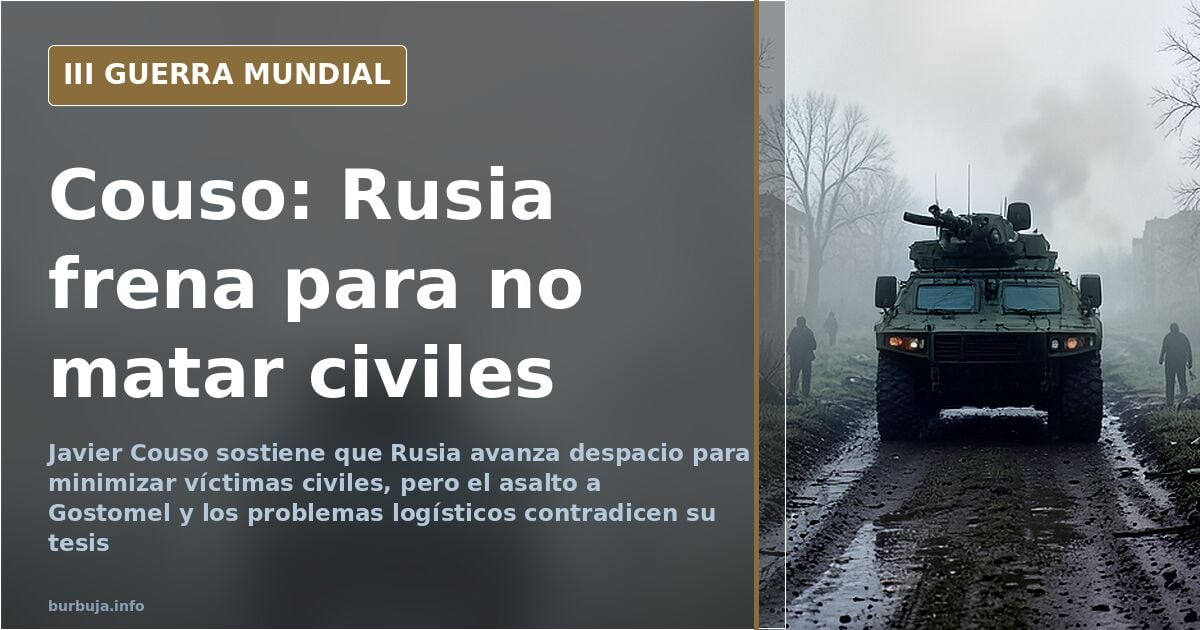
Javier Couso claims Russia is advancing slowly to avoid killing civilians
Javier Couso, a former MEP for Spain's Izquierda Unida (United Left), has argued in an analysis published during Russia's invasion of Ukraine that Russia is not losing the war and that its advance is slow due to a political decision: minimizing civilian casualties. The thesis, echoed in circles critical of the official narrative, clashes head-on with the evidence held by Western intelligence services and with the data accumulating on the ground since February 24, 2022.
Couso maintains that there was no lightning campaign to take Kyiv, that Russian forces are suffering losses because of that deliberate restraint, and that there are no strategic bombings of cities. He adds that the images shown by Western media are "few and repetitive" and that there is no material to identify the Russian army as the perpetrator of indiscriminate massacres. The advance, he says, surrounds and besieges cities without yet entering urban combat.
The airborne assault on Hostomel contradicts the restraint thesis
The weakest point of the argument is Hostomel airport. Within hours of the invasion, Russian forces launched an airborne assault to seize that airfield northwest of Kyiv, with a second attempt at another airfield to the southwest. If the goal was not a rapid campaign to decapitate the Ukrainian government, that operation is hard to explain. The most frequent criticism is that Couso omits that detail.
The version claiming Russia is fighting with its hands tied out of concern for civilians also does not fit with the destruction of Grozny, which is cited as precedent showing Moscow has had no qualms about flattening urban areas when it deemed it necessary. The comparison with the 1999 campaign in Serbia or with wars of attrition in Arab countries appears as a counterexample: if Ukraine resists, Russia's attrition will become unsustainable.
Is it a lightning war? The figure the Pentagon is working with
The Pentagon estimated that Russia would need about six weeks to occupy Ukraine at this pace. For some analysts, that is precisely a lightning war: Germany took six weeks to occupy France in World War II. Others point out that the 1939 invasion of Poland took a month, with Soviet help coming in from the other side.
The discussion about estimulante ilegal hides a more important question: if the original plan was an operation of days, Ukrainian resistance has wrecked it. If the plan was a sustained advance with pincers from several fronts, then the slowness is not a failure but a phase. The available data do not allow the debate to be settled.
Casualties, supplies and the logistics problem
The argument that Russian losses are due to restraint clashes with another explanation that is gaining traction: corruption and incompetence among the command. Destroyed convoys have been documented, armored vehicles abandoned for lack of fuel, and Russian soldiers looting shops to supply themselves. Ukrainian resistance has attacked Russian supply lines, which would explain part of those problems.
Couso's version also denies strategic bombings of cities. The most common response is that, for now, they are tactical bombings, but the strategic phase may come. The image of two bodies covered with blankets next to suitcases in a square, broadcast by a television network, has been used as an example of a staged scene or of a crime attributable to the Ukrainian defenders. Neither of those hypotheses has been confirmed.
25% of the country and access to the sea
On the debit side for Russia, it is noted that, using a less aggressive method than Germany's in Poland, Russia would already have occupied around 25% of the country in a week and a half. Being close to Odesa would leave Ukraine without access to the sea. It is the strongest card held by those who claim Russia is winning.
The problem is that this percentage does not amount to effective control. The pincers to encircle the Ukrainian army in the east have not closed, and the large coastal cities remain unassaulted. The open question is whether Moscow will maintain the siege or attempt the assault. Nobody knows yet.
The no-fly zone and the risk of escalation
Couso rules out NATO imposing a no-fly zone as in Iraq or Libya, no matter how much Ukrainian President Volodymyr Zelensky asks for it. It would be the trigger for a third world war. On that, he agrees with the most cautious analysis: the Alliance will not risk a direct clash with Russia.
The discussion about the new economic order also appears: some argue that the real goal of the war is not to invade Ukraine, but to shift power definitively to the East and leave Europe as the far West. It is a hypothesis, not a fact. Like all the ones being floated these days.
The prediction with reservations: if the siege of the coastal cities is maintained without an assault, the restraint thesis will gain credibility. If Moscow orders the urban assault, the civilian casualties excuse will collapse on its own. For now, the only firm fact is that the war has not ended in three days.
Also available in: Deutsch
Summary of a discussion on Burbuja.info - Foro de economía, actualidad y política., translated from Spanish and reviewed before publication. Read the full discussion (63 replies).
More summaries
-
Kiev Hospital Strike: NATO Missile Theory vs Russian Claim
A missile damaged a pediatric hospital in Kyiv. While Ukraine blames Russia, alternative theories suggest it was a Western-made air defense projectile.
-
Russia Deploys Tu-22M3 in Mariupol as Kyiv Declares City Captured
Ukraine confirms Russian Tu-22M3 strikes on Azovstal, exposing Moscow's dwindling guided missile stockpile and tactical desperation.
-
Putin's visit to Mariupol divides opinion between praise and doubt
Putin's Mariupol visit comes amid tweets cheering it and claims of a body double, green screen and cardboard set
-
Gento's Daughter Seeks Inventory of Footballer's Estate
The Supreme Court confirmed Paqui Gento's parentage. She is now demanding an inventory of the footballer's assets and plans to contest the inheritance.
-
Europe's April 1 showdown over Russian gas payments
The EU refuses to pay for Russian gas in rubles and Moscow threatens to shut off the tap. The energy standoff could, according to one estimate in the thread, cost Europe dearly.
-
Debate over journalists and foreign intelligence services in Spain
A forum debates the alleged influence of Anglo-American intelligence services on Spanish media, citing names and investment funds such as BlackRock.