
Europe's April 1 showdown over Russian gas payments
The EU refuses to pay for Russian gas in rubles and Moscow threatens to shut off the tap. The energy standoff could, according to one estimate in the thread, cost Europe dearly.
English · Original discussion in Spanish · Published
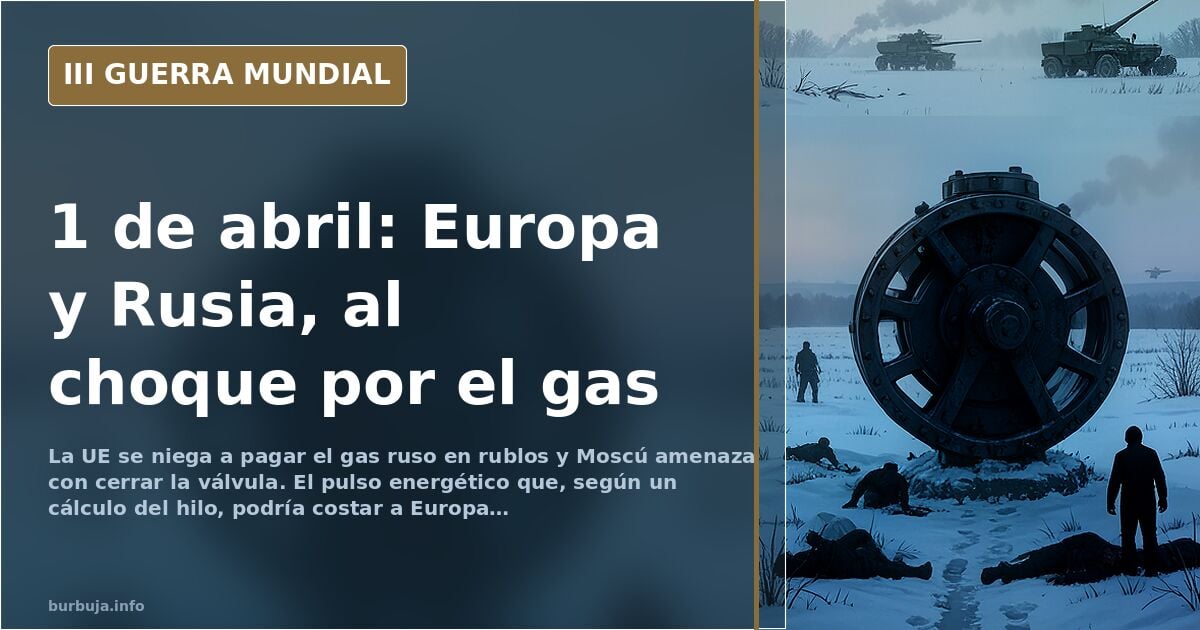
April 1, the date that could freeze Europe over
April 1, 2022 went down in Europe's energy calendar. The European Union announced it would not pay for Russian gas in rubles; Moscow replied that it would not sell unless it was paid in its own currency. Between the two positions lay a scenario that one participant described bluntly: someone will turn off the valve and Europe will suddenly lose a huge chunk of its GDP. The figure circulating at the start of the discussion was a 30% collapse. With that starting point, the standoff was framed as a game of chicken: two cars head-on, and let's see who swerves first.
Who blinks first in the gas standoff
The game-of-chicken metaphor took hold from the very start: two vehicles accelerating head-on until one swerves, or they crash and both end up in the scrapyard. The question hanging over the whole conversation was who can take the pressure. Some argue that Moscow will back down again, as it has before. Opposing them is the view that the EU will hold its ground because, sooner or later, the break with the Russian supplier was always on the cards.
Confidence in Europe's resilience was not unanimous. Alongside optimism about the ability to cope without Russian gas came the suspicion that the steering wheel is actually held in Washington, and that across the Atlantic they are watching the scene with a smirk. Energy dependence is read there as just another piece in a commercial and monetary tug-of-war between blocs, not as a matter of principle.
Coal as plan B and the power plants that no longer exist
The most frequently suggested way around the problem was going back to coal. Producing and burning coal, as was done barely three decades ago, when part of the electricity mix depended on it and industry was even bigger than today. The argument has an obvious hole: many of the thermal power plants have been closed, dismantled and blown up, and the mines that fed them no longer have miners. Reopening that path, it is pointed out, would take years and an enormous political cost.
The most optimistic estimate, put forward by one participant, claims that with the will to reopen mines and rebuild what has not yet been demolished, the way out could be found within a year. Against that weighs the fact that coal-fired electricity production is already committed to closure, and that the population would reject the facilities. The paradox that sums up the moment: burning coal to produce electricity for electric cars. A flawless plan.
The cold at home: 15 degrees and two layers on your legs
While the diplomatic standoff was being fought out, the conversation dropped to the thermostat. The recommendation to turn down the heating and wrap up warm, issued from the German political sphere, peine a debate about what being truly cold means. A range of 12 to 15 degrees inside a home, maintained all day, at rest and without activity, eventually takes its toll. It is not the same as stepping down for a while from the mid-twenties as it is to live at that temperature. Two layers on your legs and three on your torso, it is suggested, are not enough for everyone.
Personal experience was cross-checked with household statistics: in a house without heating, the inside is usually about ten degrees above the average outdoor temperature. Even in the warmest city in Spain, an apartment's thermometer hovers around 12 degrees in January. Humidity adds another layer of discomfort: without a dehumidifier, a coat does not perform the same.
Who pays the bill: global prices and Asian buyers
The impact is not limited to Europe. Prices will rise worldwide, because the energy market is global and Russian production of gas, coal and oil will have to find an outlet or shut down wells. China cannot suddenly absorb the equivalent of the hundreds of billions of euros in Russian gas that Europe would stop buying. And some warn that China and India will buy from Moscow more cheaply than Europe will pay other suppliers.
The other side of the coin is the capacity to react. It is pointed out that the Nabucco pipeline still has capacity to increase supply, and that gas has not been included in the sanctions package. The conclusion that imposes itself: the world does not end without Russian hydrocarbons, even if the adjustment is costly and disorderly.
With the valve about to turn, the question remains unanswered: who swerves first, and at what price? Nobody in the discussion dared to put a date on the outcome.
Also available in: Deutsch
Summary of a discussion on Burbuja.info - Foro de economía, actualidad y política., translated from Spanish and reviewed before publication. Read the full discussion (62 replies).
More summaries
-
Russia demands ruble gas payments as Germany and Bulgaria open to compliance
Putin mandates ruble payments for European gas, with Bulgaria and Germany considering compliance while India and China accelerate trade without the dollar.
-
Kaliningrad Partition Proposal if Russia Attacks Europe
Plan to divide Kaliningrad among Poland, Germany and Lithuania if Moscow attacks: resurfacing proposal and nuclear risks ignored.
-
Russia in the EU: The Block No One Wants to Allow
A Eurasian bloc from Atlantic to Pacific with 150 million people and resources would be unstoppable, but US and UK opposition makes it impossible.
-
Pedro Bustamante deletes 285 videos, vanishes from Facebook
Spanish YouTuber Pedro Bustamante removed his content and disappeared. Rumors place him in Munich, reading German press.
-
Pedro Baños, the colonel who said Russia would not invade Ukraine
Pedro Baños said in January that Russia had no means to invade Ukraine. A month later, tanks were crossing the border. His credibility is now in question.
-
Coup d'état underway in Serbia
We analyze the alleged coup in Serbia on Burbuja.info: color revolution or genuine popular fed-up? Data and skepticism against the official narrative.