
Kiev Hospital Strike: NATO Missile Theory vs Russian Claim
A missile damaged a pediatric hospital in Kyiv. While Ukraine blames Russia, alternative theories suggest it was a Western-made air defense projectile.
English · Original discussion in Spanish · Published
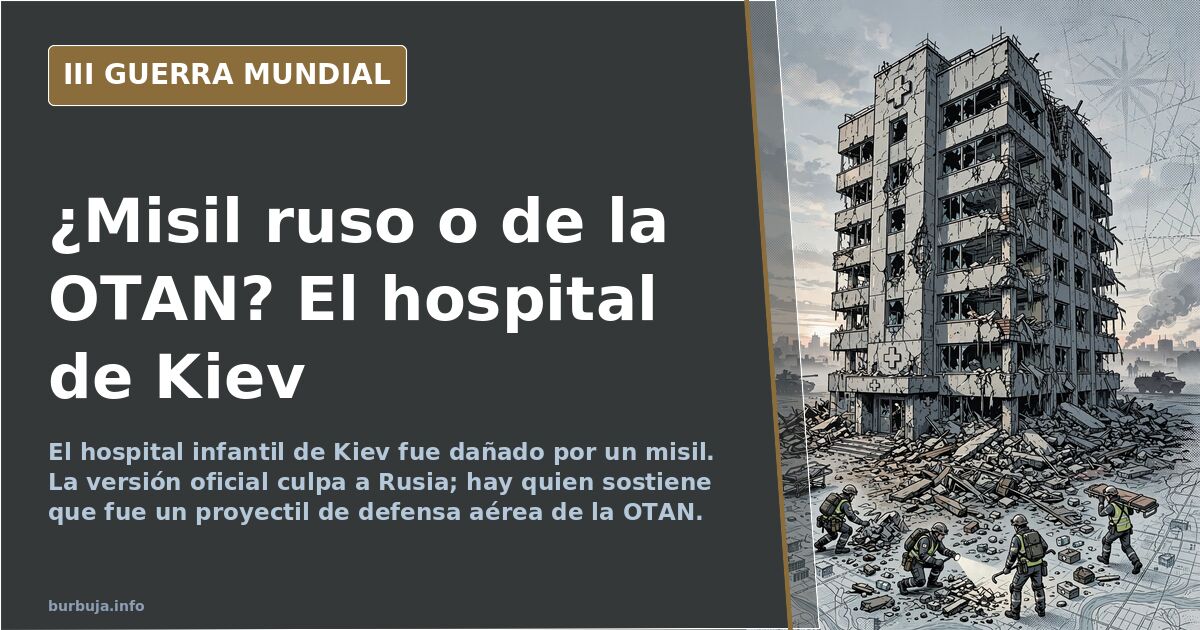
The Kyiv Hospital and the NATO Missile Thesis
A pediatric hospital building in Kyiv sustained damage during a missile attack. Ukrainian authorities and much of the press immediately pointed to the Russian Armed Forces. An alternative theory circulating in online discussions argues the opposite: that the projectile hitting the medical center was a Western-manufactured air defense missile, not a Russian offensive vector. The visual comparison between the missile seen in the footage and NASAMS or Patriot models is central to this interpretation.
What is Known About the Impact on the Pediatric Hospital
The starting point is a frame from the impact video. It shows a projectile that, according to circulating analyses, bears a striking resemblance to a NATO anti-aircraft missile. Comparisons have been made with both NASAMS and Patriot systems, and proponents of this version argue the similarity is hard to refute. There are none so blind as those who will not see, summarizes one of the most repeated stances.
In contrast, the official Ukrainian version pointed from the outset to a deliberate Russian attack. According to a Ukrainian TV channel cited in case coverage, the presidential office allegedly instructed affiliated media to disseminate the video and compare it with the Patriot system to convince the public that the enemy had struck the hospital. Those same sources note that this communication move backfired on its designers.
Recovered Debris and the SBU Report
The Security Service of Ukraine (SBU) presented its own reconstruction: at the site of the tragedy, a fragment of an X-101 cruise missile engine appeared, along with the tail section, the central body part, a fragment of the wing deployment mechanism, and another from the interference unit of the same model. In other words, the official accusation relies on debris that, according to their version, corresponds to a Russian vector.
Against this, the critical current regarding the official narrative argues that these fragments do not close the case and that the impact video points in another direction. The clash between these two readings is, fundamentally, a struggle over who controls the narrative. Whoever controls the story holds the power, states one of the most quoted interventions in the discussion.
Air Defense in Urban Areas: The Core Argument
Beyond the specific model, the issue shifts to a structural question: the placement of anti-aircraft batteries. Deploying air defense systems in densely populated areas means that any failed interception or deflected projectile can end up hitting homes, schools, or hospitals. This is a known and documented risk in all recent conflicts.
The comparison made in the discussion is revealing: an anti-aircraft missile, even if Western-made, carries a high-explosive warhead. That the vector is defensive does not make it harmless. The difference between an offensive and a defensive missile, when the projectile falls on a building, is a debate over labels. The damage is the same.
Context: Orbán's Tour and the Political Moment
The impact occurs at a delicate time. Hungarian Prime Minister Viktor Orbán's visit had peine the debate on possible negotiations, and several international actors hinted at exploring a diplomatic exit. Within this framework, an attack on a pediatric hospital has an immediate effect on public opinion: it reinforces the narrative of the ruthless aggressor and hinders any diplomatic approach.
This temporal coincidence fuels suspicion of a setup. The false flag operation thesis—an own attack disguised as an enemy strike to generate outrage and shut the door to negotiation—circulates strongly in the discussion. There are no conclusive proofs supporting it, but neither are there proofs that the projectile was Russian, beyond the debris presented by the SBU.
What Ukraine Stakes in This Episode
The episode has an internal political derivative. If it is confirmed that the missile was from own air defense or an ally's, the cost for the Ukrainian government would be enormous: they would have used civilian deaths to blame the enemy. If, conversely, Russian authorship is confirmed, Moscow's position deteriorates further internationally.
At the current state of affairs, neither version is closed. The X-101 debris presented by the SBU points to a Russian vector; the impact video and comparison with Western models point to the contrary. The only solid conclusion is that the hospital was damaged and that no one has yet verifiably assumed responsibility.
The most reasonable prediction, with all reservations, is that this episode will resolve like many others: without an independent investigation settling the doubt. Each side will maintain its version, and the hospital will remain just another data point in the accounting of a war no longer debated in terms of truth, but of narrative.
A pediatric hospital building in Kyiv sustained damage during a missile attack. Ukrainian authorities and much of the press immediately pointed to the Russian Armed Forces. An alternative theory circulating in online discussions argues the opposite: that the projectile hitting the medical center was a Western-manufactured air defense missile, not a Russian offensive vector. The visual comparison between the missile seen in the footage and NASAMS or Patriot models is central to this interpretation.
What is Known About the Impact on the Pediatric Hospital
The starting point is a frame from the impact video. It shows a projectile that, according to circulating analyses, bears a striking resemblance to a NATO anti-aircraft missile. Comparisons have been made with both NASAMS and Patriot systems, and proponents of this version argue the similarity is hard to refute. There are none so blind as those who will not see, summarizes one of the most repeated stances.
In contrast, the official Ukrainian version pointed from the outset to a deliberate Russian attack. According to a Ukrainian TV channel cited in case coverage, the presidential office allegedly instructed affiliated media to disseminate the video and compare it with the Patriot system to convince the public that the enemy had struck the hospital. Those same sources note that this communication move backfired on its designers.
Recovered Debris and the SBU Report
The Security Service of Ukraine (SBU) presented its own reconstruction: at the site of the tragedy, a fragment of an X-101 cruise missile engine appeared, along with the tail section, the central body part, a fragment of the wing deployment mechanism, and another from the interference unit of the same model. In other words, the official accusation relies on debris that, according to their version, corresponds to a Russian vector.
Against this, the critical current regarding the official narrative argues that these fragments do not close the case and that the impact video points in another direction. The clash between these two readings is, fundamentally, a struggle over who controls the narrative. Whoever controls the story holds the power, states one of the most quoted interventions in the discussion.
Air Defense in Urban Areas: The Core Argument
Beyond the specific model, the issue shifts to a structural question: the placement of anti-aircraft batteries. Deploying air defense systems in densely populated areas means that any failed interception or deflected projectile can end up hitting homes, schools, or hospitals. This is a known and documented risk in all recent conflicts.
The comparison made in the discussion is revealing: an anti-aircraft missile, even if Western-made, carries a high-explosive warhead. That the vector is defensive does not make it harmless. The difference between an offensive and a defensive missile, when the projectile falls on a building, is a debate over labels. The damage is the same.
Context: Orbán's Tour and the Political Moment
The impact occurs at a delicate time. Hungarian Prime Minister Viktor Orbán's visit had peine the debate on possible negotiations, and several international actors hinted at exploring a diplomatic exit. Within this framework, an attack on a pediatric hospital has an immediate effect on public opinion: it reinforces the narrative of the ruthless aggressor and hinders any diplomatic approach.
This temporal coincidence fuels suspicion of a setup. The false flag operation thesis—an own attack disguised as an enemy strike to generate outrage and shut the door to negotiation—circulates strongly in the discussion. There are no conclusive proofs supporting it, but neither are there proofs that the projectile was Russian, beyond the debris presented by the SBU.
What Ukraine Stakes in This Episode
The episode has an internal political derivative. If it is confirmed that the missile was from own air defense or an ally's, the cost for the Ukrainian government would be enormous: they would have used civilian deaths to blame the enemy. If, conversely, Russian authorship is confirmed, Moscow's position deteriorates further internationally.
At the current state of affairs, neither version is closed. The X-101 debris presented by the SBU points to a Russian vector; the impact video and comparison with Western models point to the contrary. The only solid conclusion is that the hospital was damaged and that no one has yet verifiably assumed responsibility.
The most reasonable prediction, with all reservations, is that this episode will resolve like many others: without an independent investigation settling the doubt. Each side will maintain its version, and the hospital will remain just another data point in the accounting of a war no longer debated in terms of truth, but of narrative.
Summary of a discussion on Burbuja.info - Foro de economía, actualidad y política., translated from Spanish and reviewed before publication. Read the full discussion (173 replies).
More summaries
-
NATO Summit, at Germany's request, to send urgent munitions to Ukraine: Patriot interceptors, drones, long-range artillery, etc.
Germany leads urgent munition shipment to Ukraine: Patriot missiles, drones, and artillery. NATO reinforces Ukrainian defense.
-
Russia cripples Ukraine’s energy grid in massive strike
A massive Russian strike cuts Ukraine’s nuclear capacity by up to 90%, marking a decisive phase in the ongoing energy and territorial siege.
-
Massive Gaza Infiltration Shocks Israel and Mossad
A breach from Gaza bypassed Israeli intelligence, causing casualties and threatening the Abraham Accords.
-
Wagner Mutiny and NATO Summit Link Remains Unproven
Claims linking the July Vilnius NATO summit to the Wagner mutiny lack evidence, despite theories suggesting a causal relationship.
-
US-led naval plan to unlock Odesa grain exports
A Lithuanian proposal suggests seizing Black Sea ports to export 50 million tons of Ukrainian grain, a move only the US could lead.
-
Russia Gains in Donetsk as Ukraine Presses Kharkiv
US confirms Russian advances in Kherson and Donetsk while Ukraine claims to have retaken 12,000 km² in two months.