
Ibiza: €1,000 per room and 105,434 empty homes
Ibiza has 105,434 empty homes and Spain’s priciest real estate at €5,194 per sqm. Workers sleep in caravans while rooms cost €1,000.
English · Original discussion in Spanish · Published
Ibiza: €1,000 per room and 105,434 empty homes
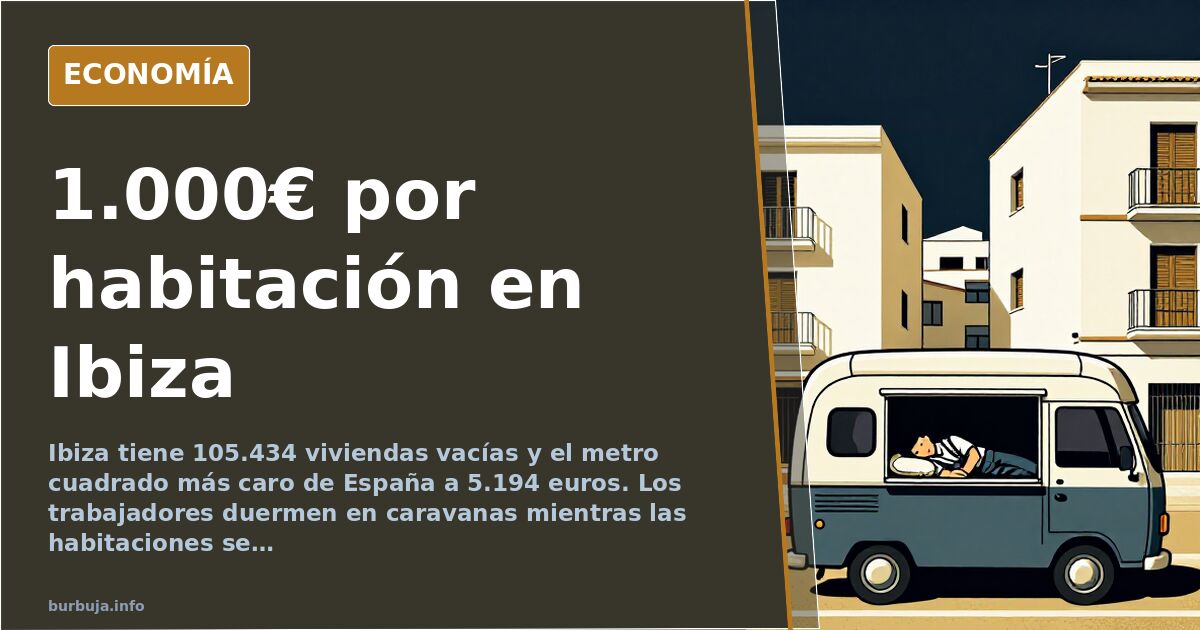
There is a parking lot in Ibiza, near Es Gorg, where dozens of workers sleep nightly in caravans and vans. Less than five minutes away, the queue for the Lío nightclub requires a minimum spend of €270 per person. The man interviewed—37, maintenance at a luxury villa, earning €1,500–1,800 monthly with a proper contract—lost his home in February when his rent increased. He now asks €900 or €1,000 for a room, plus deposits totaling €4,000–5,000. He has none. He bought a caravan.
This case is not a quirky exception. It is the result of a market that has spiraled in an island with 652,123 total homes, of which 105,434 are empty according to the 2021 population and housing census published by the National Statistics Institute (INE). This accounts for 16.17% of the housing stock. These figures far exceed the 70,000 mentioned by politicians. The official valuation of free-market housing places Spain’s most expensive square meter in Santa Eulària des Riu at €5,194, trinc by Ibiza town at €4,624. San Sebastián is €4,378, Madrid €4,015, and Barcelona €3,767. In 2010, the same square meter in Santa Eulària cost €2,291 and in Ibiza €1,297.
The price of a shared room in Ibiza
The rental market operates through messaging networks updated by the minute. Rooms are available for €1,000 plus one month’s deposit, beds in shared rooms for €550 monthly, and rooms for couples in shared country houses for €1,500. A one-bedroom apartment on Ses Figueretes Promenade, by the sea, which cost €800 last year, is now rented for €2,500. The real estate agency owner explains bluntly: it will only be rented from May to September, but it is profitable.
The island received over 3,385,000 tourists last year, 300,000 more than the previous year, according to the Balearic Institute of Statistics, on a registered population of nearly 160,000. The tension between these two numbers explains why a hospital orderly, a waiter, and an office worker share the same parking lot after work. It also explains why civil servants flee and hospitals convert wings to create rooms to retain doctors.
Why does housing prices rise in Ibiza if there are 105,434 empty homes?
Because part of that stock is not habitable. This is the argument with the most weight among those who know the housing stock: many of these empty homes need renovations that owners—often heirs from several generations—are unwilling to undertake. The statistics count bricks, not flats ready to move into.
Other factors act on this basis. The legal insecurity surrounding rentals discourages taking housing to the market: if the tenant stops paying or destroys the flat, the owner is trapped in a slow procedure. Some argue this is the true bottleneck, above any other. And some add demographic pressure: the island attracts temporary workers and new residents every season, while available land is what it is.
The result is a surge that some compare to other expensive hubs. In Switzerland, a monthly salary of €5,000 leaves little more than €1,000 after paying €4,000 for rent and €1,000 for food. In London, something similar happens. The difference is that no one questions the price there: it is accepted that whoever wants to live in the center shares a flat or leaves.
Who should pay for workers' accommodation
Here begins the fundamental disagreement. One current argues that the employer should cover the cost of housing their staff, just as they cover raw materials or electricity. The business charges dearly—a beach club serving three-liter champagne from the shoulder, year-end croquettes, paella at gold prices—and has the margin to do so. Another current responds that this is equivalent to socializing costs and privatizing profits: if the state builds public housing for temporary workers, the taxpayer subsidizes the hostel owner.
In between are public workers. An orderly, a nurse, a doctor. For them, temporary public housing is proposed, barracks inside or outside hospitals and schools, with the condition of leaving upon finishing the season or assignment. The problem is maintenance: these homes remain empty ten months a year, and someone pays the depreciation.
The full calculation, broken down item by item between the cost of building, maintaining, and ceding these homes versus the cost of not having healthcare staff, yields a result that surprises those who calculate it. But that is another article.
Comparison with other islands and with depopulated Spain
Some suggest workers move to Menorca or another cheaper island, arguing that the commute would not be greater than that of someone living in Alcobendas or Azuqueca de Henares and working in Madrid. The analogy has a trap: between islands lies the sea, and the sea is not crossed by commuter trains.
The argument is also heard that Ibiza should have its own regime, with powers over borders, taxes, and residency, akin to Monaco. With that autonomy, it is argued, €3,000 would be paid to a waiter and temporary residency permission granted with accommodation, obliging them to leave if they no longer meet the conditions. It is a hypothesis without institutional traction, but it accurately measures the frustration of part of the island.
Against this, the most repeated response is the simplest: supply and demand. Ibiza is attractive to many people, just as a penthouse overlooking Central Park is. Whoever cannot afford it, let them not go. The problem with this reasoning is that the island needs waiters, orderlies, and villa cleaners to function. And they do not appear if accommodation eats the salary.
What no one disputes is the figure that closes the circle: 105,434 empty homes out of 652,123. Not the 16.17% of the stock. Not the €5,194 per square meter in Santa Eulària. If those houses remain empty and those prices continue to rise, the question ceases to be who is to blame and becomes who remains to serve the drinks.
There is a parking lot in Ibiza, near Es Gorg, where dozens of workers sleep nightly in caravans and vans. Less than five minutes away, the queue for the Lío nightclub requires a minimum spend of €270 per person. The man interviewed—37, maintenance at a luxury villa, earning €1,500–1,800 monthly with a proper contract—lost his home in February when his rent increased. He now asks €900 or €1,000 for a room, plus deposits totaling €4,000–5,000. He has none. He bought a caravan.
This case is not a quirky exception. It is the result of a market that has spiraled in an island with 652,123 total homes, of which 105,434 are empty according to the 2021 population and housing census published by the National Statistics Institute (INE). This accounts for 16.17% of the housing stock. These figures far exceed the 70,000 mentioned by politicians. The official valuation of free-market housing places Spain’s most expensive square meter in Santa Eulària des Riu at €5,194, trinc by Ibiza town at €4,624. San Sebastián is €4,378, Madrid €4,015, and Barcelona €3,767. In 2010, the same square meter in Santa Eulària cost €2,291 and in Ibiza €1,297.
The price of a shared room in Ibiza
The rental market operates through messaging networks updated by the minute. Rooms are available for €1,000 plus one month’s deposit, beds in shared rooms for €550 monthly, and rooms for couples in shared country houses for €1,500. A one-bedroom apartment on Ses Figueretes Promenade, by the sea, which cost €800 last year, is now rented for €2,500. The real estate agency owner explains bluntly: it will only be rented from May to September, but it is profitable.
The island received over 3,385,000 tourists last year, 300,000 more than the previous year, according to the Balearic Institute of Statistics, on a registered population of nearly 160,000. The tension between these two numbers explains why a hospital orderly, a waiter, and an office worker share the same parking lot after work. It also explains why civil servants flee and hospitals convert wings to create rooms to retain doctors.
Why does housing prices rise in Ibiza if there are 105,434 empty homes?
Because part of that stock is not habitable. This is the argument with the most weight among those who know the housing stock: many of these empty homes need renovations that owners—often heirs from several generations—are unwilling to undertake. The statistics count bricks, not flats ready to move into.
Other factors act on this basis. The legal insecurity surrounding rentals discourages taking housing to the market: if the tenant stops paying or destroys the flat, the owner is trapped in a slow procedure. Some argue this is the true bottleneck, above any other. And some add demographic pressure: the island attracts temporary workers and new residents every season, while available land is what it is.
The result is a surge that some compare to other expensive hubs. In Switzerland, a monthly salary of €5,000 leaves little more than €1,000 after paying €4,000 for rent and €1,000 for food. In London, something similar happens. The difference is that no one questions the price there: it is accepted that whoever wants to live in the center shares a flat or leaves.
Who should pay for workers' accommodation
Here begins the fundamental disagreement. One current argues that the employer should cover the cost of housing their staff, just as they cover raw materials or electricity. The business charges dearly—a beach club serving three-liter champagne from the shoulder, year-end croquettes, paella at gold prices—and has the margin to do so. Another current responds that this is equivalent to socializing costs and privatizing profits: if the state builds public housing for temporary workers, the taxpayer subsidizes the hostel owner.
In between are public workers. An orderly, a nurse, a doctor. For them, temporary public housing is proposed, barracks inside or outside hospitals and schools, with the condition of leaving upon finishing the season or assignment. The problem is maintenance: these homes remain empty ten months a year, and someone pays the depreciation.
The full calculation, broken down item by item between the cost of building, maintaining, and ceding these homes versus the cost of not having healthcare staff, yields a result that surprises those who calculate it. But that is another article.
Comparison with other islands and with depopulated Spain
Some suggest workers move to Menorca or another cheaper island, arguing that the commute would not be greater than that of someone living in Alcobendas or Azuqueca de Henares and working in Madrid. The analogy has a trap: between islands lies the sea, and the sea is not crossed by commuter trains.
The argument is also heard that Ibiza should have its own regime, with powers over borders, taxes, and residency, akin to Monaco. With that autonomy, it is argued, €3,000 would be paid to a waiter and temporary residency permission granted with accommodation, obliging them to leave if they no longer meet the conditions. It is a hypothesis without institutional traction, but it accurately measures the frustration of part of the island.
Against this, the most repeated response is the simplest: supply and demand. Ibiza is attractive to many people, just as a penthouse overlooking Central Park is. Whoever cannot afford it, let them not go. The problem with this reasoning is that the island needs waiters, orderlies, and villa cleaners to function. And they do not appear if accommodation eats the salary.
What no one disputes is the figure that closes the circle: 105,434 empty homes out of 652,123. Not the 16.17% of the stock. Not the €5,194 per square meter in Santa Eulària. If those houses remain empty and those prices continue to rise, the question ceases to be who is to blame and becomes who remains to serve the drinks.
Also available in: Deutsch
Summary of a discussion on Burbuja.info - Foro de economía, actualidad y política., translated from Spanish and reviewed before publication. Read the full discussion (173 replies).
More summaries
-
Ibiza civil servants earn 76 euro bonus: salary insufficient for cost of living
SEPE staff in Ibiza earn 1,400 euros net but face high rents and empty posts. The latest competition left 13 vacancies in the Balearics and 10 in Tarragona unfilled.
-
Man sentenced to 4.5 years for slaughtering girlfriend's rabbit
A Valencia court sentences a man to 4.5 years in prison for killing, cooking, and forcing his girlfriend to eat her rabbit.
-
Young Man Fired for Mocking Puerta del Sol Protesters
A young man was fired after a viral video mocked Puerta del Sol protesters as lazy. The case sparks debate on fair dismissal and free speech in Spain.
-
Plane Myth: Confusing Inertia with Wind in Spain
Earth rotates at 1,600 km/h and planes fly at 840 km/h. The error is forgetting that air rotates with the planet.
-
Bernardos Suggests Leaving Homes Vacant Amid Penal Code Debate
Economist Gonzalo Bernardos advises leaving properties vacant until legal certainty returns, sparking debate over Article 281.1 of the Spanish Penal Code.
-
Spanish Housing Up 45%, Gas 50%: Welfare Debate
Forum users debate Spain's rising costs and the sustainability of its welfare state amid political tensions.