
Iryo driver tried to contact Atocha without answer, black box reveals
The Iryo train's black box shows the driver attempted to report to Atocha three or four times before the Urda collision.
English · Original discussion in Spanish · Published
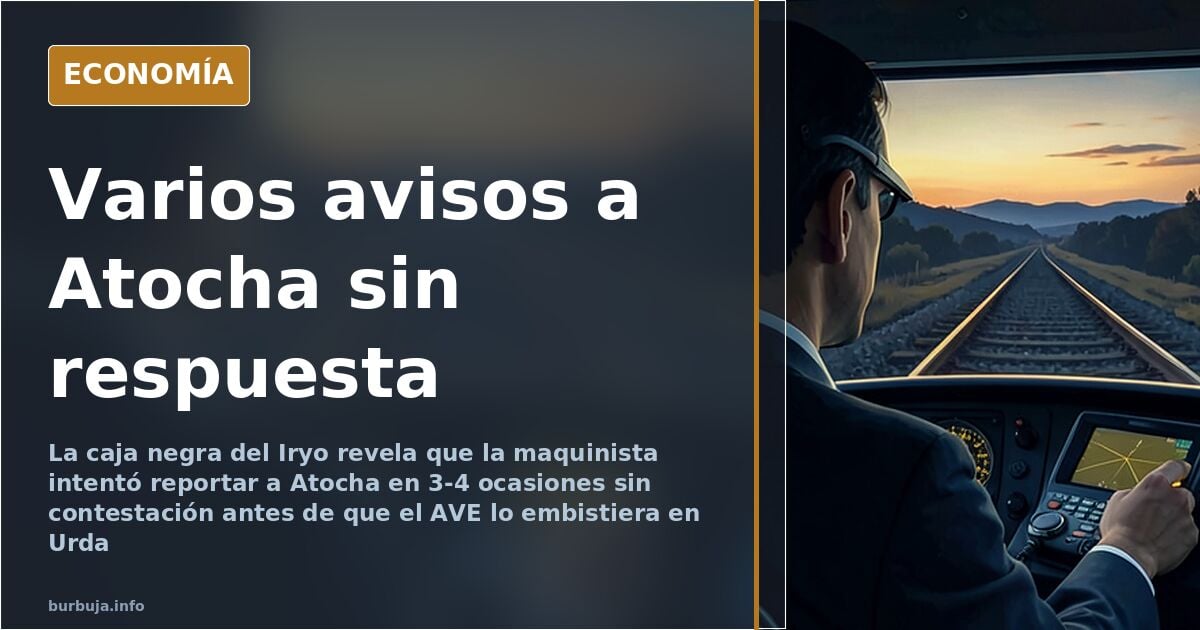
Four calls to Atocha and no answer
The black box of the Iryo train involved in the Urda (Toledo) crash reveals uncomfortable data: according to released information, the driver attempted to report to Atocha three or four times without receiving a response before the collision. The convoy, stopped on the track after a signaling system failure, was hit by an AVE coming from behind, going from stationary to moving at 47 km/h in just three seconds, with nearly 500 tons and 147 passengers on board. This sequence does not describe an isolated human error. It describes a chain of failures where the last link, communication, also broke.
The system meant to replace LZB is still not operational
In May, the Government informed Brussels that it had replaced the LZB system that failed in the accident, according to collected reports. ERTMS, the system intended to replace it, has been delayed since 2021 and is not fully operational. Spain received European funds to install this system and retire the one from 1992. The lingering question is not minor: where did the money go?
Some argue the communication failure was predictable because the controller had to manage calls from six trains simultaneously and cannot hang up on one mid-process. This argument points to insufficient staffing: there should be two or three people in the control room, not one. The harshest view is that the entire system had been operating on the brink of collapse for years, and no one wanted to see it.
Why didn't Atocha respond to the Iryo driver?
It didn't respond because communication wasn't working, according to the most repeated interpretation of available data. Everything failed: neither the signaling system nor the voice channel worked. The driver trinc protocol—reporting—and the protocol crashed against dead infrastructure. Iryo's CEO had previously complained to Adif (Spain's railway infrastructure manager) that their trains struggled to restart after system failures. The complaint existed. The response did not.
The temptation to blame the operator is old news. Some say it bluntly: she is a woman, therefore incompetent and guilty by definition for certain sectors. The data do not support this thesis. Other drivers restarted their trains without issue that day and previous days, according to a participant. The right question isn't what she did wrong, but why the system left her alone.
The missing black box and the rails no one finds
This is not the first episode. In the previous accident nine months ago, rails also disappeared, which investigators have been waiting for ever since, as claimed in the thread. The Iryo black box appears, but the other accident's remains in limbo. The coincidence is starting to look like a pattern.
Added to this is the bonus distributed by Adif's leadership before resigning, denounced by Manos Limpias (a Spanish legal association), according to a message in the thread. The management of the public body is portrayed in a sequence that needs no embellishment: bonuses for those at the top, lost rails for those below.
European funds, ERTMS, and the bill for Russian roulette
The EU increases aid to Spain, which will surpass Italy as the most assisted country. The money arrives. The 1992 system remains. ERTMS hasn't taken off. The inevitable conclusion is that the problem wasn't lack of funds, but inability to execute them on time.
A stopped train shouldn't cause an accident. That is the basic principle the signaling system exists to guarantee. When the system fails and the trinc train doesn't know the one ahead is stopped, the result is Urda: 47 km/h in three seconds and 500 tons launched by impact. The unanswered question is how many more days people traveled on that same infrastructure before anyone looked.
Also available in: Deutsch
Summary of a discussion on Burbuja.info - Foro de economía, actualidad y política., translated from Spanish and reviewed before publication. Read the full discussion (105 replies).
More summaries
-
Urda Train Crash: Sabotage Suspicions Surround Iryo and AVE
The Urda accident fuels sabotage suspicions after the 1992 LZB system failed, sparking debate over electromagnetic interference or supply chain attacks.
-
Urda rail crash reignites blame game between Renfe and Adif in Spain
The operator who gave the AVE at Urda the order to proceed refuses to testify, while rail unions denounce the leak of audio recordings as they demand accountability.
-
High-speed train collision in Spain kills 64; Transport Minister resigns
A Renfe high-speed train struck a stationary Iryo service near Urda, Toledo, killing 64 people and prompting the resignation of Transport Minister Óscar Puente.
-
Ukrainian Drone Strikes on Yandex Cripple Russian Bot Traffic
Ukrainian attacks on Yandex data centers in Vladimir, Sasovo and Kaluga have caused a sharp drop in Russian bot traffic, with reports of a 56% decline.
-
Rumors Claim Israeli Vault Found at Santiago Peña's Home
A viral X post alleges police found a high-tech Israeli vault at former Paraguayan President Santiago Peña's mansion. No official confirmation exists.
-
Spanish wages lost 20% purchasing power in a decade
In Spain, 2026 salaries buy 20% less than in 2016. Inflation and housing costs drive this erosion of real income.