
Spanish wages lost 20% purchasing power in a decade
In Spain, 2026 salaries buy 20% less than in 2016. Inflation and housing costs drive this erosion of real income.
English · Original discussion in Spanish · Published
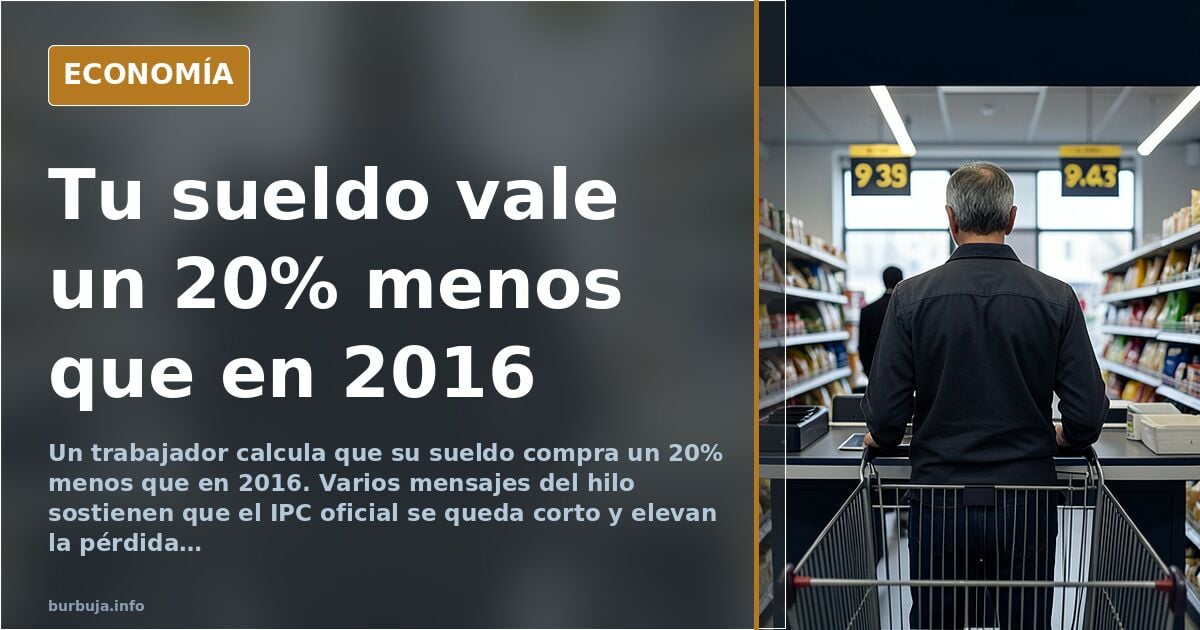
Wages lose 20% in ten years as the shopping basket bites
Ten years of work, a few negligible raises, and a painful conclusion: the 2026 salary buys 20% less than the 2016 one. Calculated from CPI trends and actual paychecks, this figure starts a broader complaint: the feeling that a decade of effort yielded no real reward. Far from an exaggeration, it matches the accumulated loss of purchasing power since the mid-2010s.
The discontent goes beyond the paycheck. It extends to housing, fuel, electricity bills, and especially food. This is where the debate gets sharper: official inflation, measured by a basket that doesn't always reflect real consumption, underestimates the pain for those filling their carts weekly.
Official CPI vs. the real basket
The first discrepancy appears when reviewing the measurement tool. The cumulative CPI over the last decade is around 30%, with most of the hit concentrated after 2021 and a peak annual average of 8.4% in 2022. If gross salaries rose between 5% and 8% in that period, the real loss of about 20% adds up. It’s not bar-talk hyperbole; it’s arithmetic.
But some argue the CPI is fictitious, insufficient to capture what truly rises. Food, they claim, has escalated much more than the general index: roughly 30-35% since 2021, with items like oil, eggs, or cocoa soaring above that average. Electricity, gas, and gasoline complete a picture not fully seen in official statistics.
The most pessimistic calculation speaks of a 40% or even 50% loss, not 20%. And many recall that wage hikes are negotiated gross, while net pay suffers due to non-indexed IRPF (income tax). The fiscal bite on nominal increases turns a theoretical raise into an almost imperceptible improvement.
How much has food risen recently?
Food is the undisputed thermometer. A shopping cart that filled a trunk for €100 in 2020 now fits in a small bag and costs nearly half that amount again. A dozen eggs, which cost around €1.20 in 2016, are now near €3. The 2016 average salary of €24,000 bought 240,000 eggs; the 2026 salary of around €32,000 buys about 135,000. Purchasing power measured in eggs has dropped 44%.
This example isn’t a joke. It confirms that the food basket has become the expense hitting families with children hardest. Those with two or three extra mouths at home feel it on every receipt. And those who bought homes before the pandemic breathe easier; those currently buying or renting are drowning.
Housing and cars: the two blows missing from CPI
The general index doesn’t capture with the same intensity two expenses defining household economics: housing and cars. The average price of a new vehicle went from under €30,000 to around €45,000 in the same period. Housing, according to widely cited calculations, has become about 50% more expensive. For families who already paid off their mortgage, the effect is limited; for those actively buying or renting, the ground shifts beneath them.
Add fuel to this. A daily 100-kilometer commute leaves a monthly diesel bill of over €200, with prices around €1.80 per liter. Gasoline, slightly cheaper, hovers near €1.50. Not ruinous alone, but it swells the monthly bill for those without car alternatives.
SMI leveling down and unpaid productivity
The debate introduces an uncomfortable nuance: minimum wage hikes. Some argue these have leveled unskilled workers with experienced ones, meaning SMI (Salario Mínimo Interprofesional) increases don’t compensate long-tenured employees but narrow the gap. The consequence, they say, is a loss of incentive for competent workers whose relative effort dilutes.
The other side asks what training, knowledge, or problem-solving skills were acquired in those ten years to deserve more. Talent doesn’t always translate into salary, and not everyone feeling victimized by the system is equally so. The discussion stalls here: Is the market failing to pay, or has the worker failed to change position?
The emerging answer: organize or switch jobs
Against complaints, a current proposes action. If companies don’t adjust wages for inflation, the solution lies in associating with colleagues for collective demands. Strikes, negotiated raises, organized pressure. The individual path is summarized by evidence: those who changed jobs or built passive income improved their situation; those staying put for a decade often impoverished themselves.
There’s no closure. The conversation stays exactly where the calculation breaks: asking if the system rewards effort or just mobility. Deep down, there’s suspicion that the next decade will repeat the same subtraction.
Also available in: Deutsch
Summary of a discussion on Burbuja.info - Foro de economía, actualidad y política., translated from Spanish and reviewed before publication. Read the full discussion (102 replies).
More summaries
-
Spanish Civil Service Exam: High Pay, Job Security, and Inflation Warning
Passing the Spanish civil service exam brings euphoria over guaranteed income, but public pay rises lag behind inflation.
-
Spain’s Purchasing Power Drops 6.4% Since 2009, Second Worst in EU
A viral chart shows Spain’s purchasing power fell 6.4% from 2009 to 2023, trailing only Greece’s 21.0% decline, while Bulgaria surged 119.7%.
-
Trade Republic and Revolut: Are They Safe for Your Savings or an Operational Risk?
Trade Republic offers 3% and Revolut pays daily interest, but transfer blocks and chat support turn savings into a gamble...
-
Forum debate: EV prices, battery life and grid strain
A user reports 7% degradation after six years and 120,000 km; others doubt the charging network and cost. Claims about China's electric adoption are also discussed.
-
Rumors Claim Israeli Vault Found at Santiago Peña's Home
A viral X post alleges police found a high-tech Israeli vault at former Paraguayan President Santiago Peña's mansion. No official confirmation exists.
-
El Corte Inglés Toy Catalogs Resold as Stock Vanishes
El Corte Inglés toy catalogs sell out in days, sparking resale. A second batch also disappeared quickly.