
Iranian President Ebrahim Raisi dies in helicopter crash
President Ebrahim Raisi and his foreign minister have died after their helicopter crashed in northwest Iran during heavy fog in East Azerbaijan.
English · Original discussion in Spanish · Published
Iran confirms death of Raisi after helicopter crash
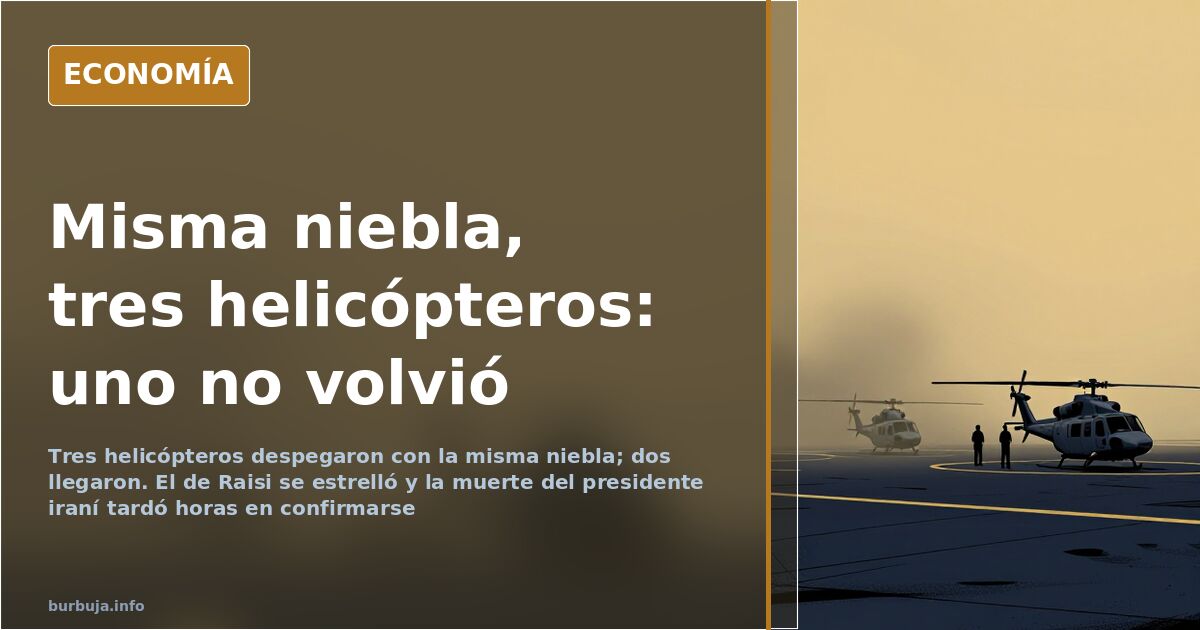
Three helicopters took off together in the same mountainous region of East Azerbaijan, amidst heavy fog and freezing temperatures. Two reached their destination. The third, carrying Iranian President Ebrahim Raisi and his Foreign Minister, Hossein Amir-Abdollahian, did not. This asymmetry—the same type of aircraft, the same route, the same day—turned an aviation accident into an enigma that ended with an official confirmation but left many questions unanswered.
Initial reports spoke of a "forced landing" in the city of Jolfa, in the northwest of the country. State television referred to an "incident" while the leader was traveling with his entourage. Hours later, the confirmation of death arrived. If the black box is recovered and provides clear evidence, it will decide whether this was an accident, sabotage, or something else entirely.
What peine to the Iranian President's helicopter?
Reports arrived disorganized and contradictory. Iranian official media spoke simultaneously of an accident and an emergency landing, failing to reach a consensus. One state channel placed the aircraft in the mountains of East Azerbaijan province, in a border area where signal coverage disappears and the terrain is unforgiving. Authorities attempted to reach the crash site in real time, while international agencies echoed the news and conflicting versions overlapped.
The rescue operation found nothing for hours. Teams had to climb on foot, at night and through fog, in a location with zero visibility. When the worst outcome was finally confirmed, it was done indirectly: a communications official from the presidency certified the death of the President and his Foreign Minister. Meanwhile, the Iranian State repeated that it would continue to function normally.
Six hours lost and three rescuers missing
The most baffling detail is the timing. Six hours passed without anyone locating the helicopter, despite two other aircraft flying in formation that could have relayed its position via radio. A single mobile phone is enough to send a location; that did not happen. The leading explanation is simple: if the aircraft was incinerated, there is no signal to track.
There was contact before the trail was lost. The governor of Tabriz spoke twice by phone with the teams, stating he could hear ambulances and was feeling unwell. After that, silence. Added to the search for the aircraft was another disconcerting element: three Red Crescent rescuers participating in the operation also disappeared. Between versions claiming the wreckage had been found and those denying it, the information became a labyrinth.
Fog accident or sabotage? Two competing hypotheses
The simplest explanation points to the weather. Flying a helicopter among mountains with low clouds and cold air generates currents that can cause an aircraft to lose lift in seconds. This is the thesis defended by those who point out that the other two helicopters arrived without issue. With no signs of tampering and a silent black box, proving otherwise would be nearly impossible.
Against this stands the shadow of sabotage. An aircraft crashing at the exact moment it carries the president of a country in open conflict with Israel and the United States invites theories. There have been mentions of Stuxnet, the computer worm that once sabotaged nuclear centrifuges, as evidence that an infiltration of aeronautical software is conceivable. Conceivable is not the same as proven. There are also unproven claims of mechanical sabotage by an infiltrated technician, a hypothesis many dismiss as nearly impossible.
Iran seeks help from Washington and European satellites
In one of the episode's paradoxes, Iran requested assistance from the United States to investigate the crash, according to reports circulating in French that went viral. It also requested support from the European Union's Copernicus satellite system and from Turkey.
That Tehran would ask for help from the country it has labeled an enemy for years leaves a trail of questions about what was truly on that flight and who controls the information. A joke about a supposed Mossad agent named "Eli Copter" piloting the aircraft circulated faster than any official statement. On the ground, the fog continued to hide what satellites could not see.
The internal factor: Jamenei's succession
Not everything points outward. Within Iran itself, some point to underlying competition regarding the succession of leadership. Raisi was seen as one of the candidates to replace the Ayatollah, in competition with Mujtaba Jamenei. The coldness with which the leadership reacted to the incident—a hope that the president would return, alongside the reminder that the State will behave as always—fueled the reading that someone within the system had little to lose.
It is a hypothesis, not a fact. But whoever fills Raisi's vacancy may tilt the country toward a direct offensive against Israel or toward a more restrained profile. The replacement is as significant as the death.
Unproven theories: from 5G to disappearing clouds
As in every catastrophe, conspiracy theories filled the gaps. An image circulated that supposedly proved meteorological systems had been erased from satellite imagery just before the crash. Another trend linked an unrelated death, that of a hospitalized regional president, to vaccines, 5G, and an alleged execution of leaders via waves. None of this has any backing and, unlike the weather or the sabotage hypothesis, it is not supported by data or physics.
The result is the usual one: the less is known, the more space invented certainty occupies. And oil, which never crashes in a helicopter, remained where it was.
Raisi is dead and his Foreign Minister will not return. What trinc—a massive funeral, a new president, a more aggressive or more cautious Iran—will depend on what the black box and those who will never speak have to say. And if the helicopter that never arrived had actually taken off, who would have occupied his seat?
Three helicopters took off together in the same mountainous region of East Azerbaijan, amidst heavy fog and freezing temperatures. Two reached their destination. The third, carrying Iranian President Ebrahim Raisi and his Foreign Minister, Hossein Amir-Abdollahian, did not. This asymmetry—the same type of aircraft, the same route, the same day—turned an aviation accident into an enigma that ended with an official confirmation but left many questions unanswered.
Initial reports spoke of a "forced landing" in the city of Jolfa, in the northwest of the country. State television referred to an "incident" while the leader was traveling with his entourage. Hours later, the confirmation of death arrived. If the black box is recovered and provides clear evidence, it will decide whether this was an accident, sabotage, or something else entirely.
What peine to the Iranian President's helicopter?
Reports arrived disorganized and contradictory. Iranian official media spoke simultaneously of an accident and an emergency landing, failing to reach a consensus. One state channel placed the aircraft in the mountains of East Azerbaijan province, in a border area where signal coverage disappears and the terrain is unforgiving. Authorities attempted to reach the crash site in real time, while international agencies echoed the news and conflicting versions overlapped.
The rescue operation found nothing for hours. Teams had to climb on foot, at night and through fog, in a location with zero visibility. When the worst outcome was finally confirmed, it was done indirectly: a communications official from the presidency certified the death of the President and his Foreign Minister. Meanwhile, the Iranian State repeated that it would continue to function normally.
Six hours lost and three rescuers missing
The most baffling detail is the timing. Six hours passed without anyone locating the helicopter, despite two other aircraft flying in formation that could have relayed its position via radio. A single mobile phone is enough to send a location; that did not happen. The leading explanation is simple: if the aircraft was incinerated, there is no signal to track.
There was contact before the trail was lost. The governor of Tabriz spoke twice by phone with the teams, stating he could hear ambulances and was feeling unwell. After that, silence. Added to the search for the aircraft was another disconcerting element: three Red Crescent rescuers participating in the operation also disappeared. Between versions claiming the wreckage had been found and those denying it, the information became a labyrinth.
Fog accident or sabotage? Two competing hypotheses
The simplest explanation points to the weather. Flying a helicopter among mountains with low clouds and cold air generates currents that can cause an aircraft to lose lift in seconds. This is the thesis defended by those who point out that the other two helicopters arrived without issue. With no signs of tampering and a silent black box, proving otherwise would be nearly impossible.
Against this stands the shadow of sabotage. An aircraft crashing at the exact moment it carries the president of a country in open conflict with Israel and the United States invites theories. There have been mentions of Stuxnet, the computer worm that once sabotaged nuclear centrifuges, as evidence that an infiltration of aeronautical software is conceivable. Conceivable is not the same as proven. There are also unproven claims of mechanical sabotage by an infiltrated technician, a hypothesis many dismiss as nearly impossible.
Iran seeks help from Washington and European satellites
In one of the episode's paradoxes, Iran requested assistance from the United States to investigate the crash, according to reports circulating in French that went viral. It also requested support from the European Union's Copernicus satellite system and from Turkey.
That Tehran would ask for help from the country it has labeled an enemy for years leaves a trail of questions about what was truly on that flight and who controls the information. A joke about a supposed Mossad agent named "Eli Copter" piloting the aircraft circulated faster than any official statement. On the ground, the fog continued to hide what satellites could not see.
The internal factor: Jamenei's succession
Not everything points outward. Within Iran itself, some point to underlying competition regarding the succession of leadership. Raisi was seen as one of the candidates to replace the Ayatollah, in competition with Mujtaba Jamenei. The coldness with which the leadership reacted to the incident—a hope that the president would return, alongside the reminder that the State will behave as always—fueled the reading that someone within the system had little to lose.
It is a hypothesis, not a fact. But whoever fills Raisi's vacancy may tilt the country toward a direct offensive against Israel or toward a more restrained profile. The replacement is as significant as the death.
Unproven theories: from 5G to disappearing clouds
As in every catastrophe, conspiracy theories filled the gaps. An image circulated that supposedly proved meteorological systems had been erased from satellite imagery just before the crash. Another trend linked an unrelated death, that of a hospitalized regional president, to vaccines, 5G, and an alleged execution of leaders via waves. None of this has any backing and, unlike the weather or the sabotage hypothesis, it is not supported by data or physics.
The result is the usual one: the less is known, the more space invented certainty occupies. And oil, which never crashes in a helicopter, remained where it was.
Raisi is dead and his Foreign Minister will not return. What trinc—a massive funeral, a new president, a more aggressive or more cautious Iran—will depend on what the black box and those who will never speak have to say. And if the helicopter that never arrived had actually taken off, who would have occupied his seat?
Also available in: Deutsch
Summary of a discussion on Burbuja.info - Foro de economía, actualidad y política., translated from Spanish and reviewed before publication. Read the full discussion (504 replies).
More summaries
-
The Spanish classism that leaves skilled trades unfilled
Spain would be a feudal society doomed by classism, per a contested thesis: empty trades, rich workers, broke low earners
-
The Middle Class Collapse Hidden from Official Statistics
Housing prices rise several times faster than wages, and new cars require 80% financing. Is the middle class gone in Spain?
-
Spanish housing prices fall in half the country: is the bubble bursting?
Housing prices are falling across half of Spain, with double-digit drops in some provincial capitals. Correction or start of a crash? Data and analysis.
-
Leticia Sabater earns up to €5,000 per gig: the decline of Spain
Leticia Sabater, 59, earns up to €5,000 per gig. Her tacky, provocative show sparks debate on cultural decline and public money.
-
Spain's Parasite Debate: Cultural Shock or Marketing?
Analysis of the debate on deworming in Spain: is it a cultural clash, a public health need, or just marketing?
-
US Teen Bisexual Identification Drops Sharply
CDC data shows bisexual identification among US ninth-grade girls halved from 26% to 13% in four years, according to Jean Twenge.