
Iran Strikes Nevatim: The Cost of Replacing Unconfirmed F-35s
Iran’s attack on Israel hits Nevatim base, raising doubts about destroyed F-35s and Iron Dome effectiveness against ballistic missiles.
English · Original discussion in Spanish · Published
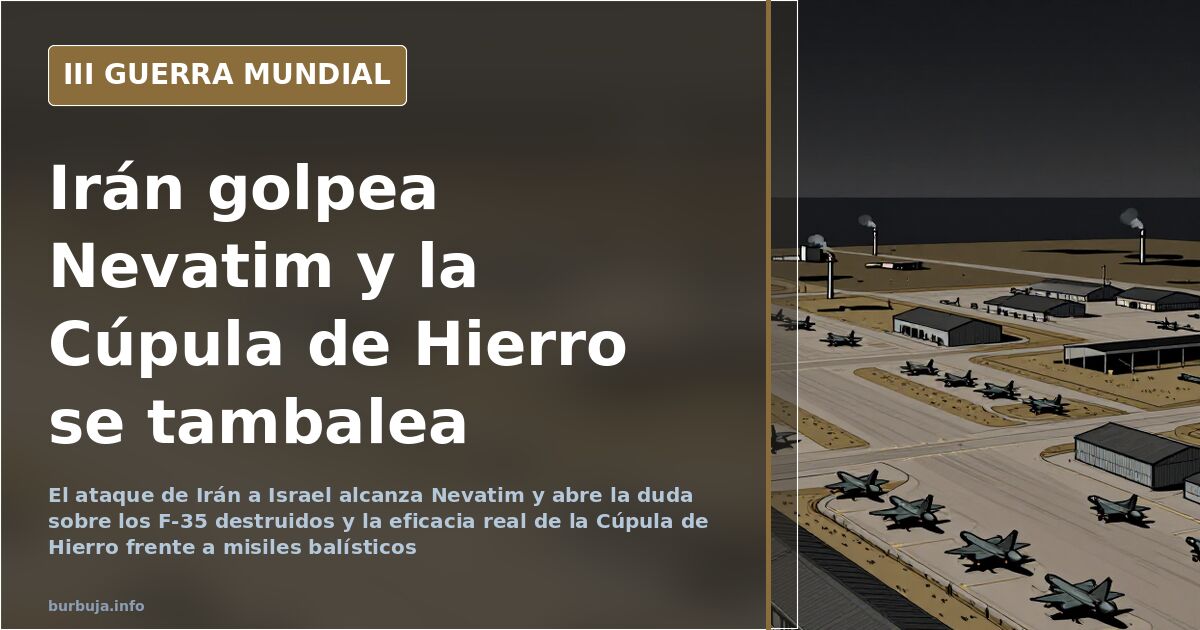
Iran Strikes Nevatim and the Iron Dome Narrative Cracks
A low-quality video showed Israeli Prime Minister Benjamin Netanyahu reading a shaky statement with papers moving in his hands; some versions claimed his press team closed the shot to hide the tremor. The real event peine earlier. Dozens of Iranian missiles breached Israeli defenses and hit the Nevatim airbase, among other military targets. Iran’s attack on Israel raises an uncomfortable question: if the Iron Dome intercepts everything, why are there confirmed impacts on one of the IDF’s most sensitive facilities?
What Is the Cost of Replacing an F-35 Destroyed on the Ground?
The stealth fighter’s price is around $80 million for the basic version and over $100 million for complex configurations, though figures vary. Some bills reach $140 million per aircraft, with clients outside the US umbrella paying nearly double, as seen in the Greek case. One calculation estimates a loss of at least $4 billion if about twenty aircraft were hit. Technicians insist it’s not just the plane: it’s the logistics, trained pilots, and spare parts.
Why Doesn’t the Iron Dome Stop Ballistic Missiles?
Because its design targets a different threat. The system is built for cheap, short-range rockets, which it handles at a disproportionate cost: each interceptor costs about €60,000 against rockets that may cost €100. This asymmetry drives Hamas and Hezbollah’s strategy to drain Israel’s treasury and accustom the population to shelters. Against well-launched ballistic missiles, the equation changes completely. Against a salvo of hypersonic projectiles, air defense has no margin, a conclusion repeated when comparing interceptor and projectile prices.
Were the Fighters in Reinforced Hangars or Outdoors?
The most widespread version clashes with the routine of a modern airbase. Aircraft worth $80 million do not sleep outdoors: they are stored in fortified hangars, separated by sand mounds higher than the plane itself, so one impact doesn’t destroy the entire fleet. Precedents include torrential rains that flooded several facilities and left eight aircraft damaged. Given these facts, attributing the destruction of dozens of fighters to a few impacts requires explaining how they bypassed the armor.
Hypersonic Missiles at Mach 5: The Factor Changing the Calculation
Among the projectiles used was at least one hypersonic missile, estimated at Mach 5 in circulating reports. Analysis suggests this technology came from Russia, which allegedly provided it to Tehran. The contrast is stark: according to one version, the US still hasn’t deployed a hypersonic weapon that has passed all tests. This technological gap explains why a defense that stops rockets struggled with these. It also explains why the issue shifted from a border skirmish to a military doctrine problem.
From ‘Total Success’ to an Unending Damage Count
The official version, amplified by Western channels, insists most missiles were intercepted and the attack was a failure. Available images suggest otherwise: impacts on military facilities, fuel platforms, and barracks. A colonel stated on a show that no targets were hit, then retracted. This isn’t isolated: Israeli military censorship limits access, and damage counting has become an exercise in faith. Some commentary also devolved into baseless hostility toward the Israeli population, unrelated to technical analysis of the attack.
Iran’s Internal Front: 39% Vote and 61% Abstention
Neither side fights this duel only outwardly. In Iran, the president was elected with 39% of the vote, while 61% abstained; this silent majority is tired of sanctions, restrictions, and wars they don’t understand. The generational shift is rapidly westernizing, with programs to bypass censorship, and the government plans to cut military service from two years to 14 months. A country like this doesn’t enthusiastically enter open conflict with a smaller but better-armed neighbor: it needs to sell each missile at home. And in Israel, maintaining multiple open fronts for months is neither militarily nor politically cheap.
Iran launched about 180 projectiles and immediately declared it seeks no war with Israel. Israel has neither confirmed nor denied the number of lost aircraft. The only undisputed figure is the one never published.
A low-quality video showed Israeli Prime Minister Benjamin Netanyahu reading a shaky statement with papers moving in his hands; some versions claimed his press team closed the shot to hide the tremor. The real event peine earlier. Dozens of Iranian missiles breached Israeli defenses and hit the Nevatim airbase, among other military targets. Iran’s attack on Israel raises an uncomfortable question: if the Iron Dome intercepts everything, why are there confirmed impacts on one of the IDF’s most sensitive facilities?
What Is the Cost of Replacing an F-35 Destroyed on the Ground?
The stealth fighter’s price is around $80 million for the basic version and over $100 million for complex configurations, though figures vary. Some bills reach $140 million per aircraft, with clients outside the US umbrella paying nearly double, as seen in the Greek case. One calculation estimates a loss of at least $4 billion if about twenty aircraft were hit. Technicians insist it’s not just the plane: it’s the logistics, trained pilots, and spare parts.
Why Doesn’t the Iron Dome Stop Ballistic Missiles?
Because its design targets a different threat. The system is built for cheap, short-range rockets, which it handles at a disproportionate cost: each interceptor costs about €60,000 against rockets that may cost €100. This asymmetry drives Hamas and Hezbollah’s strategy to drain Israel’s treasury and accustom the population to shelters. Against well-launched ballistic missiles, the equation changes completely. Against a salvo of hypersonic projectiles, air defense has no margin, a conclusion repeated when comparing interceptor and projectile prices.
Were the Fighters in Reinforced Hangars or Outdoors?
The most widespread version clashes with the routine of a modern airbase. Aircraft worth $80 million do not sleep outdoors: they are stored in fortified hangars, separated by sand mounds higher than the plane itself, so one impact doesn’t destroy the entire fleet. Precedents include torrential rains that flooded several facilities and left eight aircraft damaged. Given these facts, attributing the destruction of dozens of fighters to a few impacts requires explaining how they bypassed the armor.
Hypersonic Missiles at Mach 5: The Factor Changing the Calculation
Among the projectiles used was at least one hypersonic missile, estimated at Mach 5 in circulating reports. Analysis suggests this technology came from Russia, which allegedly provided it to Tehran. The contrast is stark: according to one version, the US still hasn’t deployed a hypersonic weapon that has passed all tests. This technological gap explains why a defense that stops rockets struggled with these. It also explains why the issue shifted from a border skirmish to a military doctrine problem.
From ‘Total Success’ to an Unending Damage Count
The official version, amplified by Western channels, insists most missiles were intercepted and the attack was a failure. Available images suggest otherwise: impacts on military facilities, fuel platforms, and barracks. A colonel stated on a show that no targets were hit, then retracted. This isn’t isolated: Israeli military censorship limits access, and damage counting has become an exercise in faith. Some commentary also devolved into baseless hostility toward the Israeli population, unrelated to technical analysis of the attack.
Iran’s Internal Front: 39% Vote and 61% Abstention
Neither side fights this duel only outwardly. In Iran, the president was elected with 39% of the vote, while 61% abstained; this silent majority is tired of sanctions, restrictions, and wars they don’t understand. The generational shift is rapidly westernizing, with programs to bypass censorship, and the government plans to cut military service from two years to 14 months. A country like this doesn’t enthusiastically enter open conflict with a smaller but better-armed neighbor: it needs to sell each missile at home. And in Israel, maintaining multiple open fronts for months is neither militarily nor politically cheap.
Iran launched about 180 projectiles and immediately declared it seeks no war with Israel. Israel has neither confirmed nor denied the number of lost aircraft. The only undisputed figure is the one never published.
Summary of a discussion on Burbuja.info - Foro de economía, actualidad y política., translated from Spanish and reviewed before publication. Read the full discussion (208 replies).
More summaries
-
Iran attack: explosions in Tehran and questions over scale
Explosions in Tehran and Iraq reopen debate over an attack on Iran that many see as staged theater with prior warning. Oil and elections at stake.
-
Iran: US and Israel’s Preventive Strike and Return of Military Service
Iran, home to 90 million people, faces a joint preventive strike by Israel and the US. Washington considers reinstating the draft, while the WHO warns of nuclear risks.
-
Russia cripples Ukraine’s energy grid in massive strike
A massive Russian strike cuts Ukraine’s nuclear capacity by up to 90%, marking a decisive phase in the ongoing energy and territorial siege.
-
Wounded soldier asks for mercy kill amid combat medicine crisis
A video of a wounded Russian soldier asking a comrade to shoot him reignites debate on frontline combat medicine, drones, and casualties.
-
Real Madrid: The 'Matrix' Theory and Its Champions League Miracles
Every Real Madrid comeback in the Champions League revives the 'Matrix' theory, citing controversial penalties, woodwork, and last-minute goals.
-
Spain's Belarra seeks ICC probe of Netanyahu over Gaza
Spanish minister accuses Israel of planned genocide in Gaza, demanding arms embargo and sanctions against Netanyahu.