
Wounded soldier asks for mercy kill amid combat medicine crisis
A video of a wounded Russian soldier asking a comrade to shoot him reignites debate on frontline combat medicine, drones, and casualties.
English · Original discussion in Spanish · Published
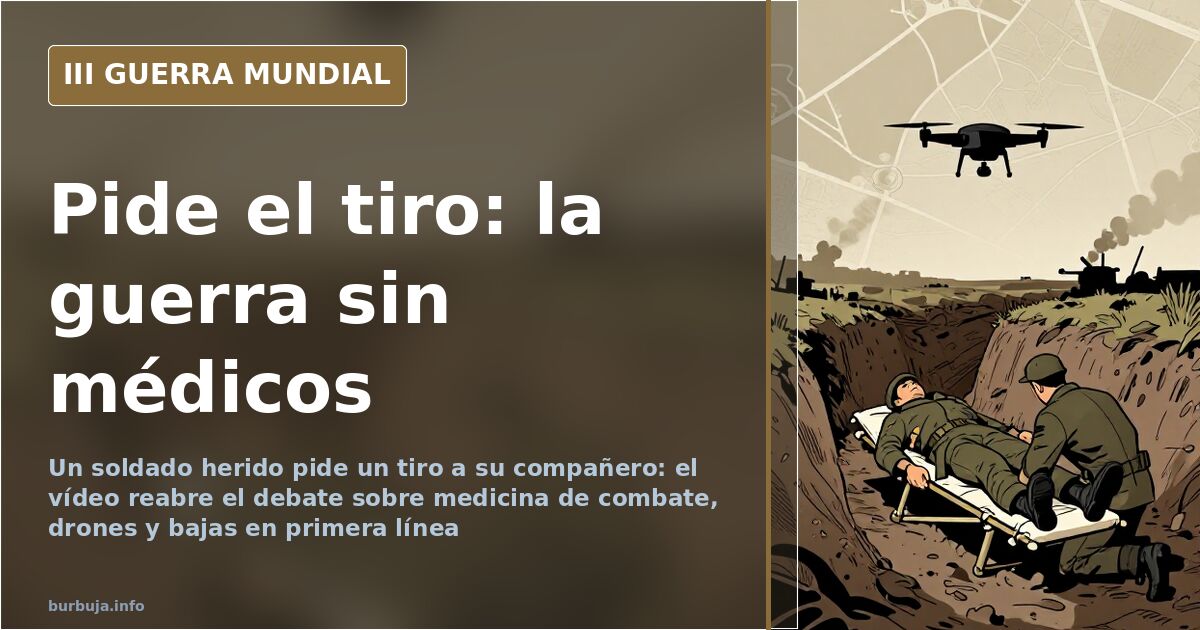
The Wounded Soldier Asking for a Mercy Kill and the Failure of Combat Medicine
What does a soldier do when the comrade beside him, lying on the ground after a drone strike, raises a hand seemingly asking to be finished off? This is the footage that has brought the discussion on combat medicine in the Ukrainian front back into focus. A wounded man, a crouching comrade, an ambiguous gesture, and several interpretations that don't fit together. Two years into the war, the scene forces an uncomfortable question: when there is no one to heal, what remains?
The Missing Context Around the Gesture
The gesture allows for more than one interpretation, none of which is comfortable. Some read that the wounded man first touches his groin—suggesting a femoral injury—and calculates in a millisecond that he faces a slow death, so he asks for the shot and his comrade executes it without hesitation. Another reading focuses on the head: the hand goes up and the message is clear. And a third, less epic view, argues that the man had no serious injuries, was only deafened by the explosion, and that the other misunderstood the signal. The video does not resolve the ambiguity.
What surrounds the scene is the lack of resources. According to a participant in the debate, the wounded man wears sneakers and carries no first aid kit, leading some to describe a front line with no non-commissioned officers or medical care: you fall and nothing is prepared for you. The mockery regarding the "second best army in the world" writes itself.
Why Does a Seriously Wounded Soldier on the Front Line Have Almost Zero Chances?
Because the chain that should save him—medic, field station, operating room—does not exist at that distance. Analysis of the episode insists that survival chances with severe wounds on the front line are near zero and that, even if the body shows no major damage, the blast wave from a nearby grenade irreversibly damages internal organs. No sequelae, none.
Regarding painkillers, the technical discussion is more revealing than the sentimental one. Morphine is overrated: administered intramuscularly, it takes time to act and poorly covers somatic pain from a fracture, so the dose capable of relieving it resembles too closely the dose required for a fatal shot. With this scenario, some argue that the request was not a sudden impulse, but something agreed upon beforehand within the unit: better a quick shot than hours of agony under an incendiary device.
From the Russo-Finnish War to Afghanistan: The Thesis of Human Cost
The other side of the issue is historical. It is repeated that Russia is an enemy that endures casualties like few others: in the Russo-Finnish War and World War II it suffered far more casualties than its adversaries and continued. Hence the corollary that causes the most discomfort: if your enemy doesn't mind dying, prepare to suffer yourself.
The counter-argument has a specific name. The Soviet withdrawal from Afghanistan in the eighties proves that endurance has an expiration date; there was nothing to gain there, so they left. On the other side of the scale, the Soviet decree of "not one step back," deportations to Siberia, labor camps, and millions of soldiers captured in 1941. Memory serves both theses, and that is precisely the problem.
It is worth remembering a detail that slips into this discussion: the Soviet Union and Nancy Germany were partners at the start of the conflict, and Stalin divided Poland and part of Romania before the pact was reversed. Each side chooses which piece of the archive suits them.
Drones Have Changed Where Survival Is Possible
If anything has broken the equation, it is the permanent gaze from the air. The front no longer has a safe rear area: it doesn't matter where you position yourself, because the device searching for you never rests, and whoever is behind the screen sees everything happening on the ground. The conflict has escalated to a level of wear for the combatant that admits no comparison with previous conflicts, resulting in permanent armed waiting.
In this scenario, the maxim of leaving no one behind functions as a tactical weakness. Recovering a wounded person requires exposing several, and in a war of attrition, this comes at a high cost.
Two Years on the Front: Veterans and Economic Bill
Two years of war have created something that cannot be improvised: battle-hardened troops. A veteran with that experience can train ten others, and Western armies do not accumulate equivalent practical combat experience, according to those warning that an expanded conflict would not be a walk in the park. In the background, a data point cited in passing turns every casualty into a domestic issue: eleven million Russians have direct Ukrainian family members.
The other face is the bill. Inflation stands at 15% according to data used in part of the analysis, the large gas-exporting company accumulates historic losses, the best European customer no longer buys, and the Asian buyer pays what they want. Infrastructure with delayed maintenance and hundreds of thousands of young men out of the labor market forever. Moreover, the war is fought in Ukraine, where there are more Ukrainians than Russians.
The Geopolitical Framework Hidden in the Video
An episode like this is not discussed in a vacuum. Alongside the clinical scene appears the underlying narrative, unsupported by the material: that the ultimate decision-makers are in foreign offices, that negotiations were initiated and sabotaged, that the real interest is the rival's exhaustion and access to resources. None of this can be proven with a thirty-second video, but it explains why a trench scene is read as a chapter of something larger. When the framework is so big, the wounded man becomes an argument.
With these elements, the gesture of a hand on the ground is not a statistical anomaly: it is the only combat medicine that arrives in time. Casualty balances always add up. Soldiers do not.
What does a soldier do when the comrade beside him, lying on the ground after a drone strike, raises a hand seemingly asking to be finished off? This is the footage that has brought the discussion on combat medicine in the Ukrainian front back into focus. A wounded man, a crouching comrade, an ambiguous gesture, and several interpretations that don't fit together. Two years into the war, the scene forces an uncomfortable question: when there is no one to heal, what remains?
The Missing Context Around the Gesture
The gesture allows for more than one interpretation, none of which is comfortable. Some read that the wounded man first touches his groin—suggesting a femoral injury—and calculates in a millisecond that he faces a slow death, so he asks for the shot and his comrade executes it without hesitation. Another reading focuses on the head: the hand goes up and the message is clear. And a third, less epic view, argues that the man had no serious injuries, was only deafened by the explosion, and that the other misunderstood the signal. The video does not resolve the ambiguity.
What surrounds the scene is the lack of resources. According to a participant in the debate, the wounded man wears sneakers and carries no first aid kit, leading some to describe a front line with no non-commissioned officers or medical care: you fall and nothing is prepared for you. The mockery regarding the "second best army in the world" writes itself.
Why Does a Seriously Wounded Soldier on the Front Line Have Almost Zero Chances?
Because the chain that should save him—medic, field station, operating room—does not exist at that distance. Analysis of the episode insists that survival chances with severe wounds on the front line are near zero and that, even if the body shows no major damage, the blast wave from a nearby grenade irreversibly damages internal organs. No sequelae, none.
Regarding painkillers, the technical discussion is more revealing than the sentimental one. Morphine is overrated: administered intramuscularly, it takes time to act and poorly covers somatic pain from a fracture, so the dose capable of relieving it resembles too closely the dose required for a fatal shot. With this scenario, some argue that the request was not a sudden impulse, but something agreed upon beforehand within the unit: better a quick shot than hours of agony under an incendiary device.
From the Russo-Finnish War to Afghanistan: The Thesis of Human Cost
The other side of the issue is historical. It is repeated that Russia is an enemy that endures casualties like few others: in the Russo-Finnish War and World War II it suffered far more casualties than its adversaries and continued. Hence the corollary that causes the most discomfort: if your enemy doesn't mind dying, prepare to suffer yourself.
The counter-argument has a specific name. The Soviet withdrawal from Afghanistan in the eighties proves that endurance has an expiration date; there was nothing to gain there, so they left. On the other side of the scale, the Soviet decree of "not one step back," deportations to Siberia, labor camps, and millions of soldiers captured in 1941. Memory serves both theses, and that is precisely the problem.
It is worth remembering a detail that slips into this discussion: the Soviet Union and Nancy Germany were partners at the start of the conflict, and Stalin divided Poland and part of Romania before the pact was reversed. Each side chooses which piece of the archive suits them.
Drones Have Changed Where Survival Is Possible
If anything has broken the equation, it is the permanent gaze from the air. The front no longer has a safe rear area: it doesn't matter where you position yourself, because the device searching for you never rests, and whoever is behind the screen sees everything happening on the ground. The conflict has escalated to a level of wear for the combatant that admits no comparison with previous conflicts, resulting in permanent armed waiting.
In this scenario, the maxim of leaving no one behind functions as a tactical weakness. Recovering a wounded person requires exposing several, and in a war of attrition, this comes at a high cost.
Two Years on the Front: Veterans and Economic Bill
Two years of war have created something that cannot be improvised: battle-hardened troops. A veteran with that experience can train ten others, and Western armies do not accumulate equivalent practical combat experience, according to those warning that an expanded conflict would not be a walk in the park. In the background, a data point cited in passing turns every casualty into a domestic issue: eleven million Russians have direct Ukrainian family members.
The other face is the bill. Inflation stands at 15% according to data used in part of the analysis, the large gas-exporting company accumulates historic losses, the best European customer no longer buys, and the Asian buyer pays what they want. Infrastructure with delayed maintenance and hundreds of thousands of young men out of the labor market forever. Moreover, the war is fought in Ukraine, where there are more Ukrainians than Russians.
The Geopolitical Framework Hidden in the Video
An episode like this is not discussed in a vacuum. Alongside the clinical scene appears the underlying narrative, unsupported by the material: that the ultimate decision-makers are in foreign offices, that negotiations were initiated and sabotaged, that the real interest is the rival's exhaustion and access to resources. None of this can be proven with a thirty-second video, but it explains why a trench scene is read as a chapter of something larger. When the framework is so big, the wounded man becomes an argument.
With these elements, the gesture of a hand on the ground is not a statistical anomaly: it is the only combat medicine that arrives in time. Casualty balances always add up. Soldiers do not.
Summary of a discussion on Burbuja.info - Foro de economía, actualidad y política., translated from Spanish and reviewed before publication. Read the full discussion (219 replies).
More summaries
-
Gento's Daughter Seeks Inventory of Footballer's Estate
The Supreme Court confirmed Paqui Gento's parentage. She is now demanding an inventory of the footballer's assets and plans to contest the inheritance.
-
Spain: Missile Talent Exists, Full Manufacturing Capacity Remains Uncertain
Spain designs its own submarines and frigates but imports missile electronics. How far does military self-sufficiency go?
-
Oct 7 sexual violence report reignites debate
A 300-page report on Oct 7 sexual violence documents systematic abuses but fuels media skepticism and debates over Gaza's 65,000 casualties.
-
Putin nears victory as Europe fails to rearm
21 months into the invasion, military reports warn Germany needs 15 years to defend itself and NATO three for its eastern flank.
-
Ukraine War: Surrender for Peace or Nuclear Escalation?
Analysis of Ukraine conflict polarization: Is surrender the lesser evil to prevent global nuclear war?
-
Siberian Hordes Narrative Clashes with Ukraine War Data
The myth of Siberian troops awaiting the Tsar's order contradicts actual war inventories, including armored vehicles, artillery shells, and aircraft losses.