
Iran attack: explosions in Tehran and questions over scale
Explosions in Tehran and Iraq reopen debate over an attack on Iran that many see as staged theater with prior warning. Oil and elections at stake.
English · Original discussion in Spanish · Published
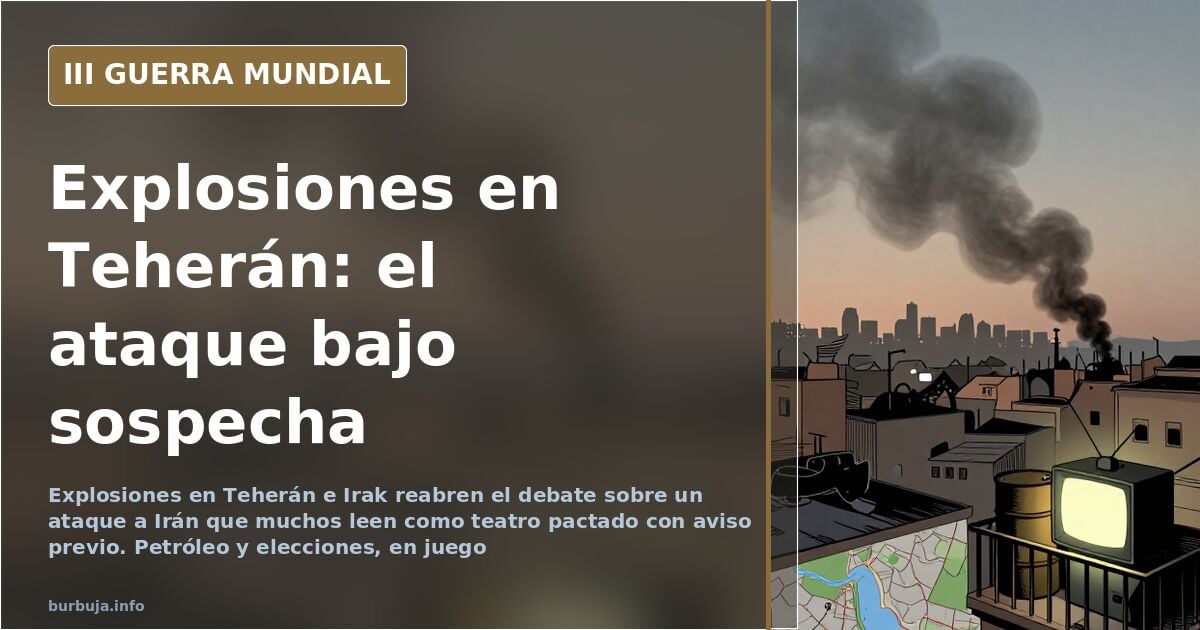
Explosions in Tehran and Iraq: real attack or staged theater
Has the war really started, or are we witnessing another episode of theater with prior warning? That is the question running through every analysis of the explosions recorded in Tehran and various points in Iraq. On the table there are few confirmable facts and much narrative: drones loaded with explosives, air defenses lighting up, aerial deployments counted in dozens, and a calendar—that of the US elections—that conditions every move.
Little is confirmed: explosions in the Iranian capital, explosions also in Iraqi territory, and the much-repeated suspicion that there was prior warning of the attack. From there, each piece of data is interpreted according to one side or the other.
What is known about the attack on Iran?
The most widespread version describes waves of attack with 35 to 40 small quadcopters loaded with explosives launched from long distances, plus manned aircraft. Another reading raises the figure to more than 100 aircraft involved in the operation, a figure not given to describe the attack but to measure the attacker's military capability. "It's scary to know they have that capability," that astonishment sums up.
Iranian defense appears, in circulating versions, with specific names: S300, Arash, Rapier, Tor M, and other systems that would have been activated during the waves. The problem is that almost everything comes from one side and is not independently verified. When the data is doubtful, the discussion shifts to detail: if the Ghadir strategic radar in Ahvaz remains intact—as one reading supported by satellite images maintains—then the attack would not have touched any critical capability.
Why is there doubt that the attack caused real damage?
For three recurring reasons. The first is prior warning: if the attack was announced before it occurred, the defenses point to a "little theater" and not a war. The second is confusion over the targets: there is a claim that the supposed missile factory attacked was actually a pipe factory, a misidentification that would dismantle the version of the surgical operation. The third is military logic: attacking with aircraft without first neutralizing air defense systems is, in repeated words, "suicide."
There are two opposing currents. One holds that it was all an attack agreed through discreet channels, with intermediaries, so that the attacker saves face without opening a full front. Another reduces it to pure propaganda theater: explosions for internal consumption and statements for external consumption. Both share the suspicion that the real damage was minimal.
Oil and Hormuz: the scenario that triggers bets
Where the matter stops being military and becomes money is in the Strait of Hormuz. The hypothesis of a blockade and oil at $250 a barrel appears not as a serious prediction but as a betting scenario: "let's see if we get rich." There is no basis to take it as data, but it reveals how geopolitical risk is read: as an opportunity for those with energy positions.
With Iran sitting on one of the largest oil and gas reserves on the planet, any escalation that touches maritime transit has an immediate translation in the markets. The doubt is not whether oil would rise, but how long the global economy could withstand a sustained episode. That is where geopolitics and the pocketbook meet.
US elections set the calendar
The most repeated thesis is that nothing substantive will happen until after the US elections. The argument: the Democratic administration avoids explicitly supporting Israel in the middle of a campaign, while the attacker would restrain its movements to avoid harming its ally at the polls. "We'll see what happens later, I don't think it will restrain itself that much," another reading adds.
Everything points to the same mechanism: the electoral calendar works as a restraining leash. When it is released, the scenario changes. And the underlying question—whether Israel and Iran can sustain an open war without breaking the region—remains unanswered.
The demographic asymmetry: 88 million versus 10 million
An underlying thread runs through the economic analysis. Iran has 88 million inhabitants; Israel, around 10 million, and lacks significant energy resources of its own. On that asymmetry is built the argument that the attacker could not sustain a long war without the backing of an outside power. The reply is that the gap is compensated by technology and support.
At the bottom of the discussion, the figures of the conflict in Gaza are also repeated: some 43,000 dead and 100,000 wounded, plus 75% of buildings destroyed in a territory the size of Madrid. These data are used to underscore the magnitude of the military response.
As a curiosity, amid the noise a digital detail appears: the supposed cancellation, by a platform owned by Elon Musk, of the Iranian leader's Hebrew account. The reading is that of a antiestéticar of what might be said from there. It is still an indication that this battle is also fought in the feeds.
Meanwhile, the only firm date in the whole matter remains that of football: tomorrow, Madrid-Barsa. That is not postponed.
Has the war really started, or are we witnessing another episode of theater with prior warning? That is the question running through every analysis of the explosions recorded in Tehran and various points in Iraq. On the table there are few confirmable facts and much narrative: drones loaded with explosives, air defenses lighting up, aerial deployments counted in dozens, and a calendar—that of the US elections—that conditions every move.
Little is confirmed: explosions in the Iranian capital, explosions also in Iraqi territory, and the much-repeated suspicion that there was prior warning of the attack. From there, each piece of data is interpreted according to one side or the other.
What is known about the attack on Iran?
The most widespread version describes waves of attack with 35 to 40 small quadcopters loaded with explosives launched from long distances, plus manned aircraft. Another reading raises the figure to more than 100 aircraft involved in the operation, a figure not given to describe the attack but to measure the attacker's military capability. "It's scary to know they have that capability," that astonishment sums up.
Iranian defense appears, in circulating versions, with specific names: S300, Arash, Rapier, Tor M, and other systems that would have been activated during the waves. The problem is that almost everything comes from one side and is not independently verified. When the data is doubtful, the discussion shifts to detail: if the Ghadir strategic radar in Ahvaz remains intact—as one reading supported by satellite images maintains—then the attack would not have touched any critical capability.
Why is there doubt that the attack caused real damage?
For three recurring reasons. The first is prior warning: if the attack was announced before it occurred, the defenses point to a "little theater" and not a war. The second is confusion over the targets: there is a claim that the supposed missile factory attacked was actually a pipe factory, a misidentification that would dismantle the version of the surgical operation. The third is military logic: attacking with aircraft without first neutralizing air defense systems is, in repeated words, "suicide."
There are two opposing currents. One holds that it was all an attack agreed through discreet channels, with intermediaries, so that the attacker saves face without opening a full front. Another reduces it to pure propaganda theater: explosions for internal consumption and statements for external consumption. Both share the suspicion that the real damage was minimal.
Oil and Hormuz: the scenario that triggers bets
Where the matter stops being military and becomes money is in the Strait of Hormuz. The hypothesis of a blockade and oil at $250 a barrel appears not as a serious prediction but as a betting scenario: "let's see if we get rich." There is no basis to take it as data, but it reveals how geopolitical risk is read: as an opportunity for those with energy positions.
With Iran sitting on one of the largest oil and gas reserves on the planet, any escalation that touches maritime transit has an immediate translation in the markets. The doubt is not whether oil would rise, but how long the global economy could withstand a sustained episode. That is where geopolitics and the pocketbook meet.
US elections set the calendar
The most repeated thesis is that nothing substantive will happen until after the US elections. The argument: the Democratic administration avoids explicitly supporting Israel in the middle of a campaign, while the attacker would restrain its movements to avoid harming its ally at the polls. "We'll see what happens later, I don't think it will restrain itself that much," another reading adds.
Everything points to the same mechanism: the electoral calendar works as a restraining leash. When it is released, the scenario changes. And the underlying question—whether Israel and Iran can sustain an open war without breaking the region—remains unanswered.
The demographic asymmetry: 88 million versus 10 million
An underlying thread runs through the economic analysis. Iran has 88 million inhabitants; Israel, around 10 million, and lacks significant energy resources of its own. On that asymmetry is built the argument that the attacker could not sustain a long war without the backing of an outside power. The reply is that the gap is compensated by technology and support.
At the bottom of the discussion, the figures of the conflict in Gaza are also repeated: some 43,000 dead and 100,000 wounded, plus 75% of buildings destroyed in a territory the size of Madrid. These data are used to underscore the magnitude of the military response.
As a curiosity, amid the noise a digital detail appears: the supposed cancellation, by a platform owned by Elon Musk, of the Iranian leader's Hebrew account. The reading is that of a antiestéticar of what might be said from there. It is still an indication that this battle is also fought in the feeds.
Meanwhile, the only firm date in the whole matter remains that of football: tomorrow, Madrid-Barsa. That is not postponed.
Summary of a discussion on Burbuja.info - Foro de economía, actualidad y política., translated from Spanish and reviewed before publication. Read the full discussion (438 replies).
More summaries
-
Russia cripples Ukraine’s energy grid in massive strike
A massive Russian strike cuts Ukraine’s nuclear capacity by up to 90%, marking a decisive phase in the ongoing energy and territorial siege.
-
Never Attack Russia: The Myth of Russian Invincibility
Ukraine's war revives the myth of Russian invincibility, from the 1853 defeat in Crimea to the 1991 Soviet collapse and current front asymmetry.
-
Intelligence Reports on the Russian Leader’s Health
Analysis of intelligence reports on the Russian leader’s health and its impact on geopolitical stability.
-
Hezbollah Pagers Explode Simultaneously in Beirut
Over 1,000 injured in Lebanon as Hezbollah pagers detonate. The New York Times attributes the incident to a shadow company network.
-
Contrails Blanket Spanish Skies: The 179 Million Ton Vapor Debate
Analysis of contrails covering Spain’s sky, citing 179 million tons of vapor and the ongoing geoengineering controversy.
-
Germany’s 63,000 Troops Fall Short of 300,000 Needed for Ukraine Front
Russia produces 2.5x NATO artillery shells; EU steel output is half 1980 levels. Europe faces a critical military gap for direct intervention.