
Iran: standoff over military defeat and rising oil in Hormuz
Crude at $107 and physical oil at $150 in the Gulf, according to one user, against the thesis of Iranian defeat. Analysis of the standoff in Hormuz and the negotiations.
English · Original discussion in Spanish · Published
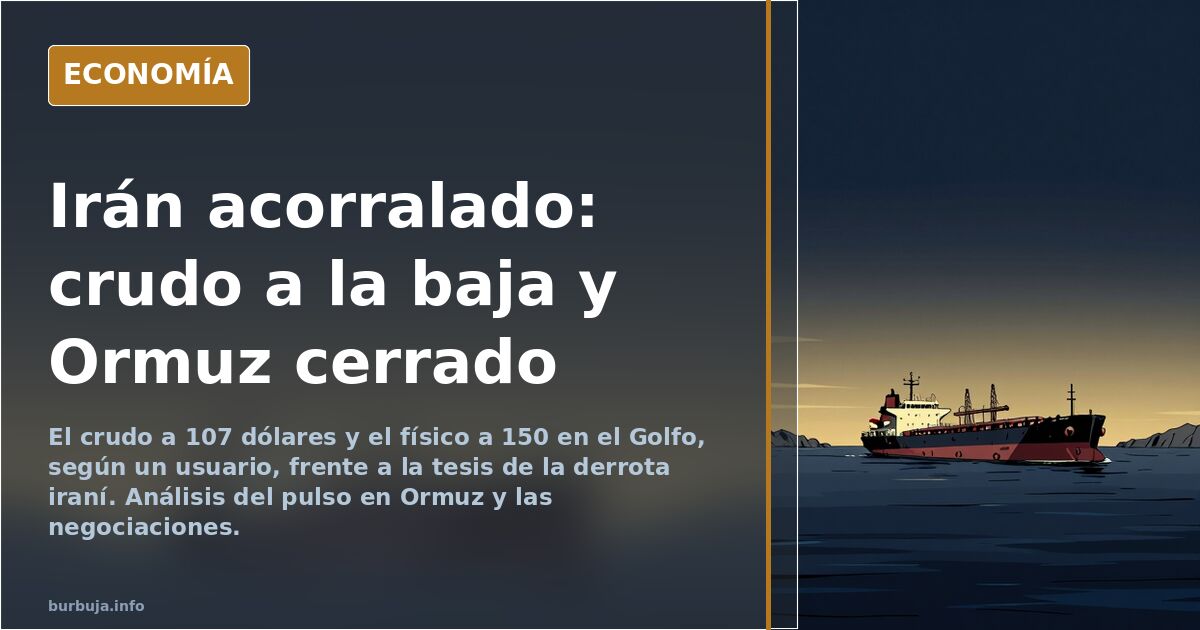
Iran, between military defeat and falling crude
Is Iran on the brink of collapse, or is that the self-interested narrative of those who need it to fall? The discussion opens with a blunt thesis: Europe's chancelleries are jumping on the winning bandwagon because they smell the regime's imminent fall. From there, the matter becomes a standoff between two narratives that don't even share the same data. One side maintains that Tehran has lost momentum disastrously, that the Strait of Hormuz remains closed and that the markets are already pricing in its liquidation. The other responds with an uncomfortable question: if it is defeated, why is Washington negotiating the end of the conflict with it instead of putting a capitulation on the table?
Crude as a thermometer of the narrative
The price of oil is the battlefield where these two versions are fought out. Some claim that Brent trades at $107 and that physical crude in the Gulf reaches $150, a range that contradicts the thesis of imminent surrender. Against that, the opposite reading insists that crude is heading down and that the chart is drawing a triangle that could break in either direction. The most repeated irony: if anyone were certain that Iran is sinking, it would be enough to short crude, mortgage the house and wait for the win-win. Nobody does.
The historical comparison is also used as a weapon. The Yom Kippur War lasted two weeks, but its consequences for fuel supply and demand dragged on for a whole decade. The argument serves to recall that a short conflict does not guarantee a short energy shock, and that whoever looks only at today's price is mistaken about the time horizon.
Hormuz, the ghost fleet and the barrels that do get out
The Strait of Hormuz is the most repeated data point and the most misinterpreted. Part of the analysis maintains that the blockade is strangling the Gulf neighbours, but not Iran: a ghost fleet of tankers allows Tehran to keep its exports at volumes almost identical to those before the conflict. The calculations circulating speak of 12 million barrels exported during the war, equivalent to about six days of its previous exports, when it moved around two million barrels a day. Before hostilities began there were already millions of Iranian barrels stored offshore looking for a buyer.
The conclusion some draw is that closing the strait does not choke whoever closes it, but whoever depends on it. And that the Iranian economy, far from collapsing within weeks, continues to finance its war effort with the same crude as always.
The military front and the attrition that goes unseen
On the strictly military plane, the versions diverge even more. One sector claims that Israel suspended in-person classes because of its defence system, considered the best on the planet, while the other side denounces the use of civilian infrastructure for military purposes. The case is cited of a school turned into a military enclave where more than 120 minors used as human shields died, an episode whose authorship and circumstances are attributed in a self-interested way depending on who tells it.
The war of attrition has a human cost measured in replacements: only a million troops remain available to make up for losses, according to one of the estimates circulating. It is the kind of figure that does not appear in triumphalist headlines and that explains why some speak of victory and others of a sunken barracks.
Who negotiates with whom and why it matters
The most uncomfortable argument for the thesis of total defeat is diplomatic. If Iran were beaten, capitulation would be put on the table for it to sign. Instead, what is described is the opposite: Washington is negotiating the end of the conflict directly with Tehran, and the Israeli state would have been forced to negotiate with Lebanon and to respect a truce. That does not fit with a country lacking military capacity.
On the opposite side, economic pressure is presented as suffocating: the Iranian president would have panicked on finding that his delegation returned empty-handed from the negotiations in Sarracinabad, with no money to pay salaries and with a country on the brink of collapse within weeks. These are sources cited by Israeli media, which does not invalidate them, but does not turn them into revealed truth either.
The game of the powers and the price of petrol
The board is read in terms of hegemony. Some describe four centres of power disputing the world order: China, Russia, the West that integrates Anglo-Saxons, European Latins and Israel, and the fundamentalist Muslim countries. Spain, in that picture, counts for little within its alliance, although nothing obliges it to remain so.
The incongruity pointed out is economic: if China's resurgence worries the West so much, why was industry handed to it with decades of offshoring? Now wars are being fought for antiestéticar of the monster that was created, while the European citizen complains about paying a few euros more when filling the tank. That is the real cost that reaches the shopping basket, and the one that decides elections.
In the end, the question remains unanswered: if Iran is finished, what is all this negotiation about? And if it is not, why isn't crude soaring? Someone is lying, or simply nobody knows how to read a triangle.
Also available in: Deutsch
Summary of a discussion on Burbuja.info - Foro de economía, actualidad y política., translated from Spanish and reviewed before publication. Read the full discussion (103 replies).
More summaries
-
Trump Announces Total Strait of Hormuz Blockade Amid Rising Geopolitical Tensions
Trump declares a total blockade on ships in the Strait of Hormuz. Analysis of the geopolitical escalation and its implications for oil prices.
-
Iran Reopens Strait of Hormuz; Oil Prices Drop 10%
Iran reopens the Strait of Hormuz following the Lebanon ceasefire, causing oil prices to fall by 10%, though crude remains well above $56.
-
Robert Pape: US strategic defeat in Iran worse than Vietnam
Robert Pape calls the intervention in Iran the worst US strategic defeat since Vietnam, with the Strait of Hormuz under Iranian control and low-cost drones.
-
Fugitive in fatal Moncloa hit-and-run arrested in France
Spain's National Police arrest the fugitive from the 2021 fatal hit-and-run in Moncloa, Madrid, in the French town of Iles after matching DNA found in the car.
-
Fabian socialism: the gradual path that shaped Wells and Orwell
The Fabian Society was founded in 1884 as a breakaway from a utopian group and went on to create the Labour Party. Its coat of arms features a wolf in sheep's clothing.
-
The AI hoax claiming God is being built and we're trapped inside it
An unproven message claims an elite is using AI to build a simulated reality. The conversation drifts toward Sumerians, the Antichrist and distrust of financial power.