
Invest €10,000 at birth: €600,000 by age 50
Investing €10,000 at a child's birth could yield €600,000 by age 50 with an 8% annual return, sparking debate on inflation and fees.
English · Original discussion in Spanish · Published
Invest €10,000 at birth: €600,000 by age 50
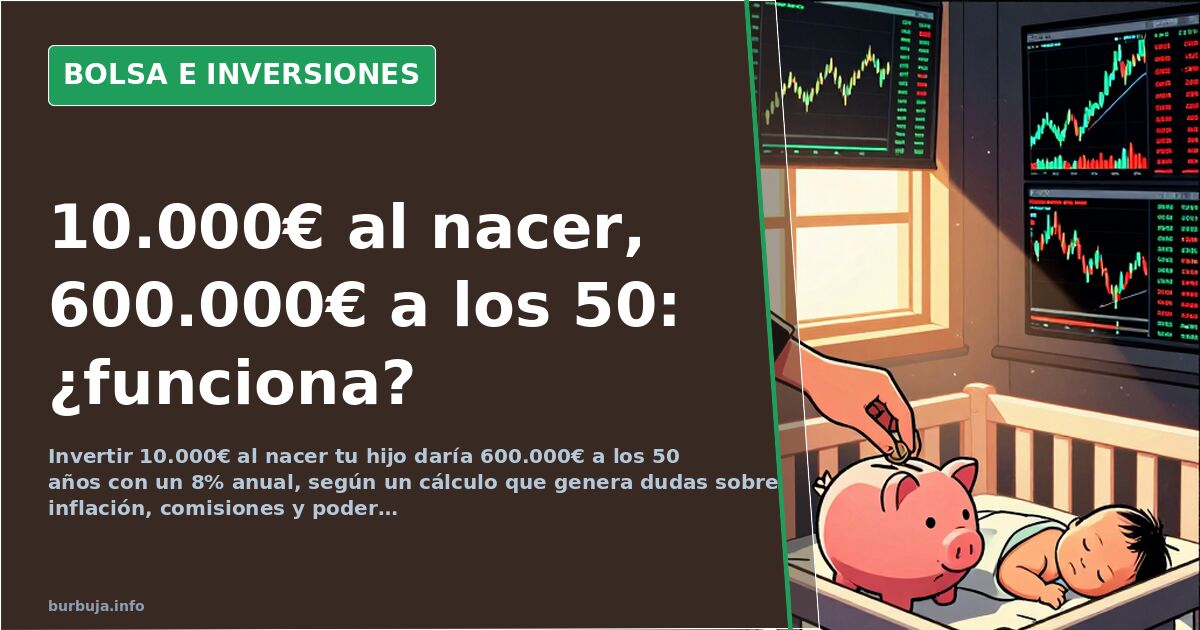
Is it really enough to open an investment account for a newborn, deposit €10,000, and forget about it? This is the calculation that has hit the table: with an average annual return of 8%—assuming years of 12% and others of -5%—the child would reach 50 with around €600,000 and a "semi-solved" life. The approach, based on S&P 500 history, has triggered a storm of responses far beyond arithmetic.
The first sustancia ilegal appears in the figure itself. A sustained 8% annual return over half a century is, for many, a financial brochure assumption. Critics recall that fixed deposits barely offer 3-4% and that inflation eats up that margin. The full calculation, applying compound interest to prices as well, yields a surprising result: those €600,000 in 50 years do not buy what they buy today.
What are €600,000 worth in 50 years?
The most repeated argument concerns purchasing power. Defenders claim the 8% is already inflation-adjusted, so €600,000 would indeed cover a home. Attackers respond with a simple exercise: if food costs €2,000 a month (€24,000 a year) and the child lives to 80, eating alone costs €720,000. In other words, even €600,000 doesn't cover basics.
Historical comparison reinforces doubt. One hundred million pesetas—the approximate equivalent of €600,000—in the 80s was a fortune that solved one's life. Today, well managed and without luxuries, it secures the future of a standard debt-free person, but far from what it meant then. Will the same happen in another 50 years? Short answer: nobody knows.
S&P 500's 8% annual return: reality or myth?
The 8% figure relies on the S&P 500's historical performance, including wars and crises. But some nuance this: the index is inflated by a handful of AI-linked companies; removing them leaves mediocre returns elsewhere. They add that the economic center might shift to Asia, causing the S&P 500 to underperform.
The most technical criticism comes from dividend investors: demanding a net 8% over five years with screenshots, they note ETF fees apply to the total portfolio, not gains. Some argue the real historical return is closer to 6-7%. Others antiestéticar system collapse, war, or tax rule changes: "Who tells me tomorrow they decide this system must collapse?" asks a skeptic.
The problem isn't returns, it's life
Beyond numbers, the debate turns human. A young person with €20,000 can be dangerous without financial literacy: spending it on a motorcycle, a gap year, or Korean crypto. Money without education is wasted, a view shared by almost all. Hence, many propose combining investing with training.
Also raised is the starting objection: how many can afford €10,000? Most, say critics, would spend it at the mall. Then there's deep suspicion: some parents don't want to solve their children's lives, wanting them to suffer as they did. Humans, someone summarizes, are nests of trauma sometimes taking revenge on the weakest.
What if the child becomes an addict or wastes the money?
Behavioral risk is the most cited. An unwanted only child expecting nothing; a youth grabbing cash at 18 and running; a teen joining bad company. Many conclude money alone fixes nothing but puts you ahead of the majority. Cases exist of 22-year-olds owning homes because parents did something similar.
The gaining alternative is keeping the account in the parent's name, diversified, to be inherited later, benefiting from capital gains upon death. This avoids the risk of the beneficiary squandering funds at 18.
Ultimately, the discussion isn't whether €10,000 becomes €600,000. It's whether planning for 50 years is worthwhile in a country some believe won't exist as such. With those odds, anyone invests.
Is it really enough to open an investment account for a newborn, deposit €10,000, and forget about it? This is the calculation that has hit the table: with an average annual return of 8%—assuming years of 12% and others of -5%—the child would reach 50 with around €600,000 and a "semi-solved" life. The approach, based on S&P 500 history, has triggered a storm of responses far beyond arithmetic.
The first sustancia ilegal appears in the figure itself. A sustained 8% annual return over half a century is, for many, a financial brochure assumption. Critics recall that fixed deposits barely offer 3-4% and that inflation eats up that margin. The full calculation, applying compound interest to prices as well, yields a surprising result: those €600,000 in 50 years do not buy what they buy today.
What are €600,000 worth in 50 years?
The most repeated argument concerns purchasing power. Defenders claim the 8% is already inflation-adjusted, so €600,000 would indeed cover a home. Attackers respond with a simple exercise: if food costs €2,000 a month (€24,000 a year) and the child lives to 80, eating alone costs €720,000. In other words, even €600,000 doesn't cover basics.
Historical comparison reinforces doubt. One hundred million pesetas—the approximate equivalent of €600,000—in the 80s was a fortune that solved one's life. Today, well managed and without luxuries, it secures the future of a standard debt-free person, but far from what it meant then. Will the same happen in another 50 years? Short answer: nobody knows.
S&P 500's 8% annual return: reality or myth?
The 8% figure relies on the S&P 500's historical performance, including wars and crises. But some nuance this: the index is inflated by a handful of AI-linked companies; removing them leaves mediocre returns elsewhere. They add that the economic center might shift to Asia, causing the S&P 500 to underperform.
The most technical criticism comes from dividend investors: demanding a net 8% over five years with screenshots, they note ETF fees apply to the total portfolio, not gains. Some argue the real historical return is closer to 6-7%. Others antiestéticar system collapse, war, or tax rule changes: "Who tells me tomorrow they decide this system must collapse?" asks a skeptic.
The problem isn't returns, it's life
Beyond numbers, the debate turns human. A young person with €20,000 can be dangerous without financial literacy: spending it on a motorcycle, a gap year, or Korean crypto. Money without education is wasted, a view shared by almost all. Hence, many propose combining investing with training.
Also raised is the starting objection: how many can afford €10,000? Most, say critics, would spend it at the mall. Then there's deep suspicion: some parents don't want to solve their children's lives, wanting them to suffer as they did. Humans, someone summarizes, are nests of trauma sometimes taking revenge on the weakest.
What if the child becomes an addict or wastes the money?
Behavioral risk is the most cited. An unwanted only child expecting nothing; a youth grabbing cash at 18 and running; a teen joining bad company. Many conclude money alone fixes nothing but puts you ahead of the majority. Cases exist of 22-year-olds owning homes because parents did something similar.
The gaining alternative is keeping the account in the parent's name, diversified, to be inherited later, benefiting from capital gains upon death. This avoids the risk of the beneficiary squandering funds at 18.
Ultimately, the discussion isn't whether €10,000 becomes €600,000. It's whether planning for 50 years is worthwhile in a country some believe won't exist as such. With those odds, anyone invests.
Also available in: Deutsch
Summary of a discussion on Burbuja.info - Foro de economía, actualidad y política., translated from Spanish and reviewed before publication. Read the full discussion (120 replies).
More summaries
-
Compound interest requires 30 years of rowing to become a rentier
Compound interest takes 30 years to show results: those with 13 years are in the red, while reinvesting dividends separates 338% from 541%.
-
€100k: Rental Property vs. 1.5% Deposit
A €100,000 deposit at 1.5% yields €1,500 yearly; a rental property may bring €800-€1,000 monthly before costs and taxes.
-
Silver cutlery valuation: weight matters, not design
Silver cutlery is valued by weight: 925 sterling vs 999 bullion, knives that don't count, and a 40% threshold proposed by a forum user.
-
IDP Education: Stock Surge and IELTS Acquisition in India
IDP Education shares rose from $4 to $38 after acquiring the British Council's IELTS business in India; FY17 net profit grew just 4%.
-
Grifols: Bought at €8.6, Sold at €10.5 Before Crash
Spanish pharma Grifols reported unaudited 2023 results with a 72% profit drop, causing shares to plunge nearly 35% in one session.
-
2.3% Fixed Mortgage: Genuine Opportunity or Bank Pressure?
A client with a 2.3% fixed mortgage faces pressure to sign immediately while the Euribor falls. The detail that undermines the sales pitch.