
Grifols: Bought at €8.6, Sold at €10.5 Before Crash
Spanish pharma Grifols reported unaudited 2023 results with a 72% profit drop, causing shares to plunge nearly 35% in one session.
English · Original discussion in Spanish · Published
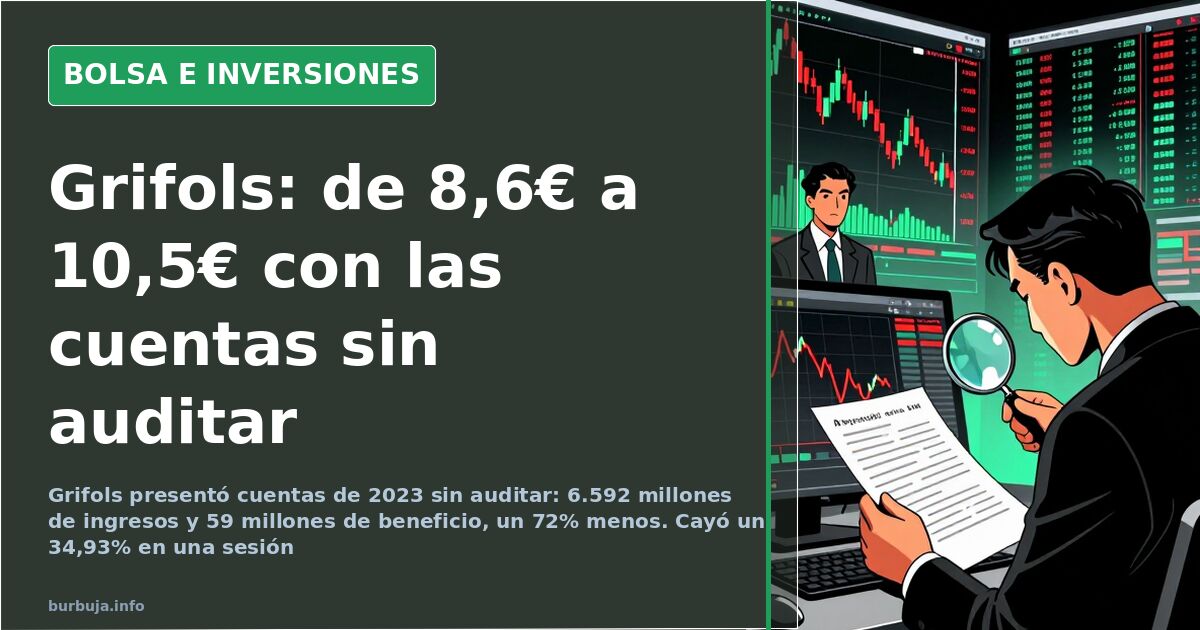
Grifols bought at €8.6, sold at €10.5 as profits fell 72%
Is it worth putting €700 into a pharmaceutical company that just released unaudited accounts? The market answered with a 34.93% drop in a single session. Grifols published its 2023 results showing €6.592 billion in revenue, up 11% year-on-year, but net income of €59 million, down 72%. The financial statements arrived without an auditor's report and lacking the signature of one board member who refused to approve them. Given this context, the story of someone buying at €8.6 and selling at €10.5 resembles leaving the room just before the shooting starts.
What do Grifols' unaudited 2023 accounts reveal?
The most unsettling detail wasn't the profit figure, but how it was presented: unaudited and, according to forum users, signed off by a dissenting director. Initially, the company had requested early publication of figures to the CNMV (Spain's securities regulator), resulting in a document halfway between expectation and alarm. Revenue grew, yes, but profit collapsed by 72%, and the share price slid from supporting €8 to hitting €7.778 with a daily drop of 3.76%.
There is a benign interpretation: the business generates record revenue, and the slump stems from extraordinary items and accounting uncertainty. The uncomfortable view is that €59 million profit on €6.592 billion revenue leaves a negligible margin, and an absent auditor is the worst possible introduction for a debt-heavy firm.
The plan: €3,000 capital, €700 invested at €8.6, target sale at €14
The initial strategy was simple. €3,000 available, €700 already invested at €8.6, with intent to increase position if prices dropped further. The goal was to hold until €14, sell half to diversify, and add more fuel if no rebound occurred. This wasn't financial analysis; it was a bet that the 2023 accounts, released early at their own request, would act as a catalyst.
Skepticism emerged quickly. With €700, a 10% gain is only €70, eaten largely by commissions. Some noted such small positions don't move markets or threaten the financial system, while others asked directly about the company's debt chart. Meanwhile, another user admitted buying €6,000 worth at €8.5 planning to exit at €10.
Why advice suggested selling before the capital increase
The sharpest warning came before results: sell when the capital increase was announced. Such increases dilute existing shareholders and typically pressure prices. Grifols had an extra complication: coexistence of Class A and Class B shares. The prevailing hypothesis was that the operation would use Class A shares to equalize them with Class B, raising doubts on which series would pay and whether participation was worthwhile.
None of this resolved. The position closed at €10.5, below the €14 target but far above the subsequent crash. Those advising to sell before the increase didn't know the timing but were right in direction.
Unaudited accounts, related parties, and Gotham's role
Here we must separate facts from suspicions. Confirmed: accounts released unaudited and missing one director's signature. From there, some argue the company conducted transactions with entities linked to its owners, draining profits from the parent. This accusation circulates in an article cited in the thread, not a court finding.
In this context appears Gotham. Described in the thread as one of London's most aggressive traders, it is assumed they knew what was coming. There was also debate on whether traditional banks would short the stock: Europe has restrictions on trading own shares, used to explain why the attack didn't come from conventional banking.
Chinese stock market as an investment alternative?
The idea of seeking opportunities in Chinese firms at market lows appeared initially but hit practical walls. Accessing these markets from Spain requires intermediaries, with no real control over order execution. One response summarized it bluntly: money is left with someone promising to trinc your instructions. The issue isn't the thesis, but the chain of custody. No concrete recommendation materialized.
Widespread pessimism as a contrarian indicator
A background layer throughout the conversation: widely announced bankruptcies rarely materialize. If every company predicted to die had actually fallen, only fifteen or twenty would remain in the index. Banks, Telefónica, half the Spanish market. Hence the argument that catastrophic consensus works better as an inverted indicator than prophecy.
For Grifols, so far, it works partially. It hasn't gone bankrupt, but profit dropped 72% and shares hover near €7.70. Pessimistic consensus didn't kill it. Nor did it save anyone entering at €8.6 expecting a rebound to €14.
The plan was buy at €8.6, sell at €14, diversify with gains. Sold at €10.5, now flirting with €7. Sometimes the only thing saving a portfolio is when the plan fails in time.
Is it worth putting €700 into a pharmaceutical company that just released unaudited accounts? The market answered with a 34.93% drop in a single session. Grifols published its 2023 results showing €6.592 billion in revenue, up 11% year-on-year, but net income of €59 million, down 72%. The financial statements arrived without an auditor's report and lacking the signature of one board member who refused to approve them. Given this context, the story of someone buying at €8.6 and selling at €10.5 resembles leaving the room just before the shooting starts.
What do Grifols' unaudited 2023 accounts reveal?
The most unsettling detail wasn't the profit figure, but how it was presented: unaudited and, according to forum users, signed off by a dissenting director. Initially, the company had requested early publication of figures to the CNMV (Spain's securities regulator), resulting in a document halfway between expectation and alarm. Revenue grew, yes, but profit collapsed by 72%, and the share price slid from supporting €8 to hitting €7.778 with a daily drop of 3.76%.
There is a benign interpretation: the business generates record revenue, and the slump stems from extraordinary items and accounting uncertainty. The uncomfortable view is that €59 million profit on €6.592 billion revenue leaves a negligible margin, and an absent auditor is the worst possible introduction for a debt-heavy firm.
The plan: €3,000 capital, €700 invested at €8.6, target sale at €14
The initial strategy was simple. €3,000 available, €700 already invested at €8.6, with intent to increase position if prices dropped further. The goal was to hold until €14, sell half to diversify, and add more fuel if no rebound occurred. This wasn't financial analysis; it was a bet that the 2023 accounts, released early at their own request, would act as a catalyst.
Skepticism emerged quickly. With €700, a 10% gain is only €70, eaten largely by commissions. Some noted such small positions don't move markets or threaten the financial system, while others asked directly about the company's debt chart. Meanwhile, another user admitted buying €6,000 worth at €8.5 planning to exit at €10.
Why advice suggested selling before the capital increase
The sharpest warning came before results: sell when the capital increase was announced. Such increases dilute existing shareholders and typically pressure prices. Grifols had an extra complication: coexistence of Class A and Class B shares. The prevailing hypothesis was that the operation would use Class A shares to equalize them with Class B, raising doubts on which series would pay and whether participation was worthwhile.
None of this resolved. The position closed at €10.5, below the €14 target but far above the subsequent crash. Those advising to sell before the increase didn't know the timing but were right in direction.
Unaudited accounts, related parties, and Gotham's role
Here we must separate facts from suspicions. Confirmed: accounts released unaudited and missing one director's signature. From there, some argue the company conducted transactions with entities linked to its owners, draining profits from the parent. This accusation circulates in an article cited in the thread, not a court finding.
In this context appears Gotham. Described in the thread as one of London's most aggressive traders, it is assumed they knew what was coming. There was also debate on whether traditional banks would short the stock: Europe has restrictions on trading own shares, used to explain why the attack didn't come from conventional banking.
Chinese stock market as an investment alternative?
The idea of seeking opportunities in Chinese firms at market lows appeared initially but hit practical walls. Accessing these markets from Spain requires intermediaries, with no real control over order execution. One response summarized it bluntly: money is left with someone promising to trinc your instructions. The issue isn't the thesis, but the chain of custody. No concrete recommendation materialized.
Widespread pessimism as a contrarian indicator
A background layer throughout the conversation: widely announced bankruptcies rarely materialize. If every company predicted to die had actually fallen, only fifteen or twenty would remain in the index. Banks, Telefónica, half the Spanish market. Hence the argument that catastrophic consensus works better as an inverted indicator than prophecy.
For Grifols, so far, it works partially. It hasn't gone bankrupt, but profit dropped 72% and shares hover near €7.70. Pessimistic consensus didn't kill it. Nor did it save anyone entering at €8.6 expecting a rebound to €14.
The plan was buy at €8.6, sell at €14, diversify with gains. Sold at €10.5, now flirting with €7. Sometimes the only thing saving a portfolio is when the plan fails in time.
Also available in: Deutsch
Summary of a discussion on Burbuja.info - Foro de economía, actualidad y política., translated from Spanish and reviewed before publication. Read the full discussion (119 replies).
More summaries
-
ValPPCC Warned Against Entering the Stock Market on March 9
The S&P 500 plunged from 2,800-2,900 to 2,100-2,200 in two and a half weeks, according to ValPPCC, who advised against buying in March.
-
Madrid's Neighborhoods: Price Dictates the Map of Good and Bad Areas
Classifying Madrid's 128 neighborhoods as good or bad depends on the criteria: price per square meter, commute time, or district labels.
-
IDP Education: Stock Surge and IELTS Acquisition in India
IDP Education shares rose from $4 to $38 after acquiring the British Council's IELTS business in India; FY17 net profit grew just 4%.
-
2.3% Fixed Mortgage: Genuine Opportunity or Bank Pressure?
A client with a 2.3% fixed mortgage faces pressure to sign immediately while the Euribor falls. The detail that undermines the sales pitch.
-
Robinhood's False $730k Debt Linked to Student Death
Robinhood showed a 20-year-old student a negative balance of $730,165 he did not owe, due to a temporary options settlement delay.
-
Dutch NN Savings Account Requires Linked Spanish Bank
Nationale Nederlanden's online savings contract mandates a linked account opened in Spain and authorized by the Banco de España.