
€100k: Rental Property vs. 1.5% Deposit
A €100,000 deposit at 1.5% yields €1,500 yearly; a rental property may bring €800-€1,000 monthly before costs and taxes.
English · Original discussion in Spanish · Published
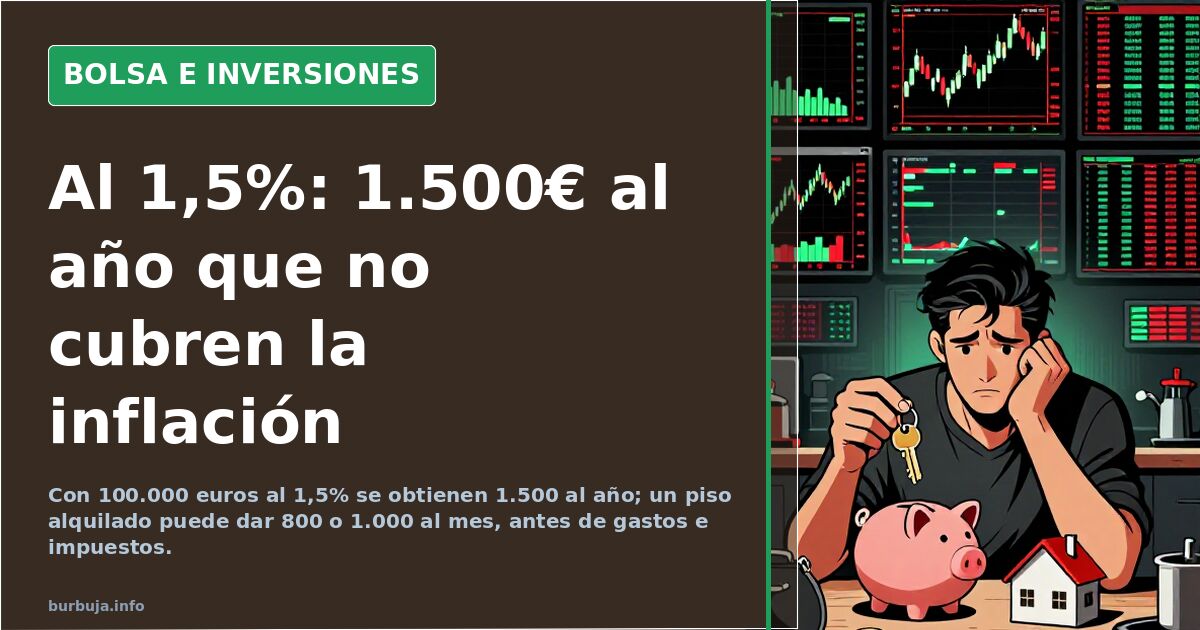
Rental Property or 1.5% Deposit: Where to Put €100,000?
What is better with €100,000: buying a property to rent out or keeping it in a compound interest deposit? The classic approach sets two conditions —a 1.5% interest rate and a 20-year amortization— and with those premises, the answer quickly clashes with arithmetic. One hundred thousand euros at 1.5% generate €1,500 per year, and that is before taxes. Inflation does the rest.
The starting point has a catch: the rate is so low that any comparison is biased. And that is precisely what makes it interesting, because it forces a choice between an asset with low yield and another with higher yield in exchange for work, risk, and expenses that no one notes during the first visit to the notary.
A 1.5% Rate That Loses Against Inflation
The most repeated diagnosis is blunt: with a nominal 1.5%, you do not earn money, you lose it. Interest does not cover capital depreciation due to inflation, so the deposit preserves the number but eats away purchasing power. For the conservative option to make sense, the rate must rise. At 3%, those €100,000 yield €3,000 per year without touching anything and without tenants.
That is the baseline of the comparison.
How Much Does a €100,000 Rented Property Yield?
The real range is very wide. There are properties valued at €30,000 rented for €450 per month, a gross yield that seems absurd compared to the property value and explains why many owners keep them despite everything. At the other extreme, some calculate that a property can bring €800 or €1,000 per month before expenses.
Then comes the fine print. The purchase absorbs taxes that, depending on the autonomous community, amount to about 10% of the price: around €10,000 that vanish before collecting the first receipt. Translated: up to two years of lost rent just to break even. Added to this are IBI (property tax), insurance, community fees, special assessments, and repairs.
Brick Depreciation Over 20 Years
Properties age, and that has a price. Circulating estimates speak of a real depreciation between 1.5% and 2% annually if no money is reserved to maintain the property's condition. A housing stock built largely with a 50-year useful life turns that figure into a deferred bill.
The case of the collapsed block in Badalona serves as an uncomfortable reminder: a forum user recalls that their homes were sold for €300,000 during the bubble. When you pay that for an old construction, there is no margin for a complete renovation, let alone reconstruction. Rental income goes toward sustaining the building.
Indexed Funds and Money Market Funds: The Alternative That Wins on the Spreadsheet
Against brick appear two instruments with hard numbers. An indexed fund tracking the MSCI World with accumulation and low commissions yields, according to calculations, an average of 8% annually over 20 years, without paying taxes until redemption. And the S&P 500 with reinvested dividends accumulated a nominal 205.71% over eight years; after deducting inflation, the total return stands at 133.46%.
Money market funds cover the other flank while rates hold: around 4% risk-free.
Squatters, Non-Payment, and Regulation: The Risk Not Shown in Calculations
Here the debate becomes political and less numerical. Part of the analysis argues that the current regulatory framework leaves owners unprotected against non-payment and occupation, and that any regulatory change can catch investors with immobilized assets and no reaction capacity. Opposing this is the argument defended by other forum users: housing is a real and tangible asset, which does not evaporate on a server, and according to them, brick always finds a tenant.
Work also counts. Finding a tenant, resolving breakdowns, negotiating rent increases, and managing insurance is time that no one bills. A fund does not get dirty nor need scrubbing.
The Result: Almost No One Defends the 1.5% Deposit
The final irony is that the proposed option —the compound interest deposit— barely finds defenders when the rate is 1.5%. Those wanting prudence go to money market funds; those accepting volatility go to indexed funds; those tolerating tenants go to brick. What no one signs up for is losing money slowly under the excuse of not taking risks.
What is better with €100,000: buying a property to rent out or keeping it in a compound interest deposit? The classic approach sets two conditions —a 1.5% interest rate and a 20-year amortization— and with those premises, the answer quickly clashes with arithmetic. One hundred thousand euros at 1.5% generate €1,500 per year, and that is before taxes. Inflation does the rest.
The starting point has a catch: the rate is so low that any comparison is biased. And that is precisely what makes it interesting, because it forces a choice between an asset with low yield and another with higher yield in exchange for work, risk, and expenses that no one notes during the first visit to the notary.
A 1.5% Rate That Loses Against Inflation
The most repeated diagnosis is blunt: with a nominal 1.5%, you do not earn money, you lose it. Interest does not cover capital depreciation due to inflation, so the deposit preserves the number but eats away purchasing power. For the conservative option to make sense, the rate must rise. At 3%, those €100,000 yield €3,000 per year without touching anything and without tenants.
That is the baseline of the comparison.
How Much Does a €100,000 Rented Property Yield?
The real range is very wide. There are properties valued at €30,000 rented for €450 per month, a gross yield that seems absurd compared to the property value and explains why many owners keep them despite everything. At the other extreme, some calculate that a property can bring €800 or €1,000 per month before expenses.
Then comes the fine print. The purchase absorbs taxes that, depending on the autonomous community, amount to about 10% of the price: around €10,000 that vanish before collecting the first receipt. Translated: up to two years of lost rent just to break even. Added to this are IBI (property tax), insurance, community fees, special assessments, and repairs.
Brick Depreciation Over 20 Years
Properties age, and that has a price. Circulating estimates speak of a real depreciation between 1.5% and 2% annually if no money is reserved to maintain the property's condition. A housing stock built largely with a 50-year useful life turns that figure into a deferred bill.
The case of the collapsed block in Badalona serves as an uncomfortable reminder: a forum user recalls that their homes were sold for €300,000 during the bubble. When you pay that for an old construction, there is no margin for a complete renovation, let alone reconstruction. Rental income goes toward sustaining the building.
Indexed Funds and Money Market Funds: The Alternative That Wins on the Spreadsheet
Against brick appear two instruments with hard numbers. An indexed fund tracking the MSCI World with accumulation and low commissions yields, according to calculations, an average of 8% annually over 20 years, without paying taxes until redemption. And the S&P 500 with reinvested dividends accumulated a nominal 205.71% over eight years; after deducting inflation, the total return stands at 133.46%.
Money market funds cover the other flank while rates hold: around 4% risk-free.
Squatters, Non-Payment, and Regulation: The Risk Not Shown in Calculations
Here the debate becomes political and less numerical. Part of the analysis argues that the current regulatory framework leaves owners unprotected against non-payment and occupation, and that any regulatory change can catch investors with immobilized assets and no reaction capacity. Opposing this is the argument defended by other forum users: housing is a real and tangible asset, which does not evaporate on a server, and according to them, brick always finds a tenant.
Work also counts. Finding a tenant, resolving breakdowns, negotiating rent increases, and managing insurance is time that no one bills. A fund does not get dirty nor need scrubbing.
The Result: Almost No One Defends the 1.5% Deposit
The final irony is that the proposed option —the compound interest deposit— barely finds defenders when the rate is 1.5%. Those wanting prudence go to money market funds; those accepting volatility go to indexed funds; those tolerating tenants go to brick. What no one signs up for is losing money slowly under the excuse of not taking risks.
Summary of a discussion on Burbuja.info - Foro de economía, actualidad y política., translated from Spanish and reviewed before publication. Read the full discussion (187 replies).
More summaries
-
Compound interest requires 30 years of rowing to become a rentier
Compound interest takes 30 years to show results: those with 13 years are in the red, while reinvesting dividends separates 338% from 541%.
-
Bayer at 19.80 and Novo at 55: the dividend investor's magnet
Bayer bought at 40.23 euros and topped up at 19.80; Novo Nordisk falls 21% and is bought at 55. A breakdown of dividend investing.
-
Gold Plunges 15% From Peak, Splitting Market Sentiment
Gold prices have dropped 15% from highs, with miners down 30%, leaving investors divided between buying the dip or waiting.
-
Gesiuris: CNMV fine and fund doubts
Spanish manager Gesiuris faces scrutiny after a 2017 CNMV fine. Questions surround its Panda Agriculture and Japan Deep Value funds.
-
XPEL stock surges to $77, but high P/E divides investors
XPEL reports $68.5M Q3 2021 revenue, up 48.6%, while its 100x P/E ratio sparks debate on holding versus selling.
-
Madrid Gold Shop Has No Stock: Customers Must Pay First, Then Wait
A customer visited El Andorrano’s Madrid store after confirming four gold coins by phone, only to find zero stock and be told to pay upfront.