
Compound interest requires 30 years of rowing to become a rentier
Compound interest takes 30 years to show results: those with 13 years are in the red, while reinvesting dividends separates 338% from 541%.
English · Original discussion in Spanish · Published
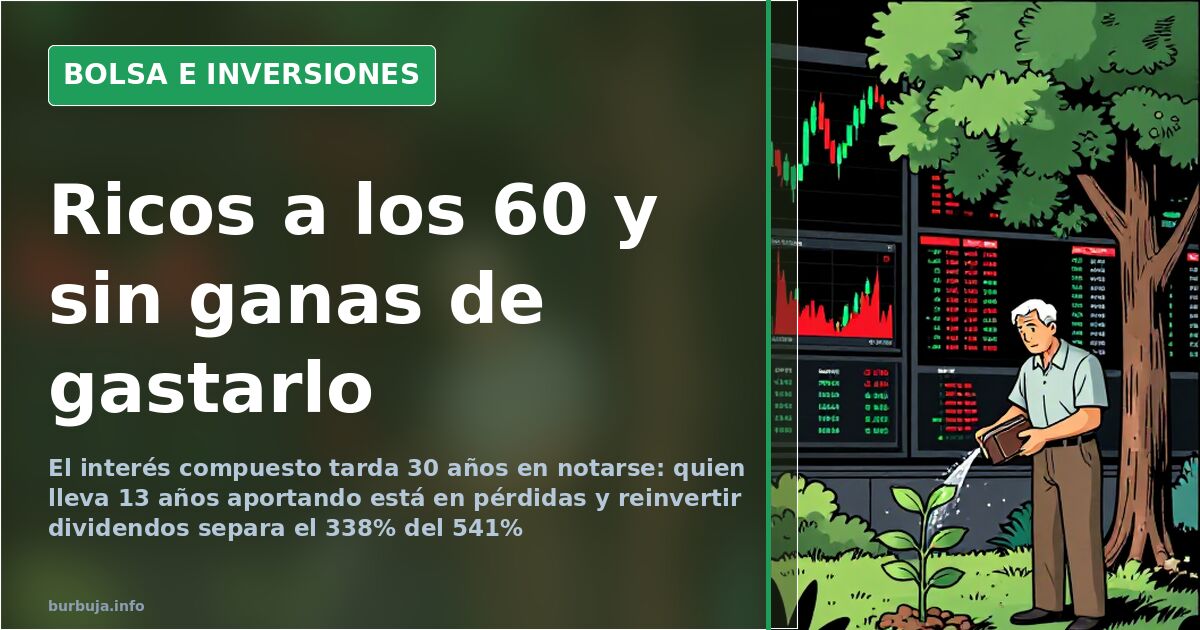
30 years of rowing to be old with money and no desire to spend it
What is the point of investing for three decades if the prize arrives when there is no body or desire left to spend it? The question frames a debate that has persisted for nearly four years between individual investors, always landing in the same place: compound interest works, but it takes so long to notice that it turns financial freedom into a promise aimed at a stranger aged 60.
The initial premise is stark: the only realistic path is 30 years of rowing, living well below your means. At the end of the tunnel, a fortune that at best avoids depending on anyone. The arithmetic is not debated. What is debated is whether it is worth it.
How long does it take for compound interest to show visible results?
Thirty years, and with luck. This is the timeframe that repeats at the start of the matter, with an added warning: those who did not start investing upon leaving childhood arrive late. The recurring example is that of the retiree who, for decades, saved every spare euro and ended up accumulating between 7 and 8 million dollars without ever earning a high salary. He lived like a pauper to die rich. That is the model, and also its condemnation.
The calculation in play leaves no room for doubt: a ten-year horizon can close in losses without anything being broken. Some have been contributing for thirteen years and are currently in the red. With this starting point, the question of what to do with the money at 60 becomes uncomfortable.
The burden of long periods without returns
Markets do not rise in a straight line, and some indices have spent two decades on the side. The case of Japan's Nikkei is cited as a warning, just as the IBEX 35 in specific stretches. The conclusion of those defending this thesis is simple: believing that «the stock market always goes up in the long term» is a popular belief, not a written law.
The counteroffer comes with data. Without counting dividends, profitability charts look catastrophic; with them, the result changes notably. Dividends range around 3% or 4% annually, and, when reinvested, they are a decisive part of the total return. Those who ignore them, according to this camp, are reading the story wrong.
Reinvesting dividends: from 338% to 541% in two decades
According to a calculation circulating in the conversation, not reinvesting dividends leaves the return at twenty years around 338%; reinvesting them raises it to 541%. The difference is not a nuance: it is almost half the result. On this basis, the criticism of graphs that exclude shareholder remuneration is implacable.
The fiscal problem remains. Tax authorities take their share before the dividend re-enters the market, although in an index fund this withholding is managed within the vehicle itself. That is, reinvestment is not free, but the compound effect withstands the blow.
Why does so few people invest in the stock market in Spain?
Because there has been neither the means nor the method. In Spain barely 2% of the population invests in the stock market with a strategy, financial education is practically non-existent, and until a few years ago there was no decent broker or index fund at reasonable prices. The brick culture did the rest.
Against this diagnosis, the response from another sector is that excuses abound: one can buy American shares from any sofa because the market is globalized. It is enough to accept an uncomfortable premise, acknowledge that one is poor, and live as such before aspiring to anything else.
Is it too late at 40 to stop working?
For many, yes. The figure repeated to consider economic independence is moving around 400,000 euros in an index fund, an amount that at 40 and without inheritance seems unattainable. The underlying suspicion is that the average employee will never be a stock market rentier: at best, they will stop rowing in another direction.
From there jumps the legacy thesis. Making a fortune is a task for several generations: one starts, the next continues, and the third collects. Those who break the chain to spend the money today condemn their family to remain the same. The rebuttal is sharp: life is not mortgaged to an imaginary great-grandchild.
Bonds, REITs, and pensions: what remains if the stock market fails
Bond coupons, after years of ridiculous yields below 1%, are now offering acceptable returns, and REITs allow real estate exposure with stock market liquidity. None of this solves the underlying problem: high inflation, around 10% in the scenario being discussed, forces the search for double-digit returns just to avoid losing.
Public pensions appear in almost all calculations as an income on which less and less is trusted. And eternal savings, though seemingly safe, are only de-capitalized.
With these accounts, the optimal would be to start investing at six years old, like a certain investor from Omaha, and even then the account does not balance. The difference is that he inherited the time others spend being born poor.
What is the point of investing for three decades if the prize arrives when there is no body or desire left to spend it? The question frames a debate that has persisted for nearly four years between individual investors, always landing in the same place: compound interest works, but it takes so long to notice that it turns financial freedom into a promise aimed at a stranger aged 60.
The initial premise is stark: the only realistic path is 30 years of rowing, living well below your means. At the end of the tunnel, a fortune that at best avoids depending on anyone. The arithmetic is not debated. What is debated is whether it is worth it.
How long does it take for compound interest to show visible results?
Thirty years, and with luck. This is the timeframe that repeats at the start of the matter, with an added warning: those who did not start investing upon leaving childhood arrive late. The recurring example is that of the retiree who, for decades, saved every spare euro and ended up accumulating between 7 and 8 million dollars without ever earning a high salary. He lived like a pauper to die rich. That is the model, and also its condemnation.
The calculation in play leaves no room for doubt: a ten-year horizon can close in losses without anything being broken. Some have been contributing for thirteen years and are currently in the red. With this starting point, the question of what to do with the money at 60 becomes uncomfortable.
The burden of long periods without returns
Markets do not rise in a straight line, and some indices have spent two decades on the side. The case of Japan's Nikkei is cited as a warning, just as the IBEX 35 in specific stretches. The conclusion of those defending this thesis is simple: believing that «the stock market always goes up in the long term» is a popular belief, not a written law.
The counteroffer comes with data. Without counting dividends, profitability charts look catastrophic; with them, the result changes notably. Dividends range around 3% or 4% annually, and, when reinvested, they are a decisive part of the total return. Those who ignore them, according to this camp, are reading the story wrong.
Reinvesting dividends: from 338% to 541% in two decades
According to a calculation circulating in the conversation, not reinvesting dividends leaves the return at twenty years around 338%; reinvesting them raises it to 541%. The difference is not a nuance: it is almost half the result. On this basis, the criticism of graphs that exclude shareholder remuneration is implacable.
The fiscal problem remains. Tax authorities take their share before the dividend re-enters the market, although in an index fund this withholding is managed within the vehicle itself. That is, reinvestment is not free, but the compound effect withstands the blow.
Why does so few people invest in the stock market in Spain?
Because there has been neither the means nor the method. In Spain barely 2% of the population invests in the stock market with a strategy, financial education is practically non-existent, and until a few years ago there was no decent broker or index fund at reasonable prices. The brick culture did the rest.
Against this diagnosis, the response from another sector is that excuses abound: one can buy American shares from any sofa because the market is globalized. It is enough to accept an uncomfortable premise, acknowledge that one is poor, and live as such before aspiring to anything else.
Is it too late at 40 to stop working?
For many, yes. The figure repeated to consider economic independence is moving around 400,000 euros in an index fund, an amount that at 40 and without inheritance seems unattainable. The underlying suspicion is that the average employee will never be a stock market rentier: at best, they will stop rowing in another direction.
From there jumps the legacy thesis. Making a fortune is a task for several generations: one starts, the next continues, and the third collects. Those who break the chain to spend the money today condemn their family to remain the same. The rebuttal is sharp: life is not mortgaged to an imaginary great-grandchild.
Bonds, REITs, and pensions: what remains if the stock market fails
Bond coupons, after years of ridiculous yields below 1%, are now offering acceptable returns, and REITs allow real estate exposure with stock market liquidity. None of this solves the underlying problem: high inflation, around 10% in the scenario being discussed, forces the search for double-digit returns just to avoid losing.
Public pensions appear in almost all calculations as an income on which less and less is trusted. And eternal savings, though seemingly safe, are only de-capitalized.
With these accounts, the optimal would be to start investing at six years old, like a certain investor from Omaha, and even then the account does not balance. The difference is that he inherited the time others spend being born poor.
Summary of a discussion on Burbuja.info - Foro de economía, actualidad y política., translated from Spanish and reviewed before publication. Read the full discussion (232 replies).
More summaries
-
DCA in MSCI World: €20,000 invested at highs yields €9,000 profit
A forum tracking shows €20,000 invested at MSCI World highs since 2022 and €9,028 in gains. Quarterly DCA achieves 14.43% annualized…
-
Spain tax confusion over €20 mystery shopper pay
A mystery shopper earning just over €20 wonders whether to declare it or register as self-employed. The company calls it an external collaboration.
-
Escaping the Rat Race Without an Inheritance: Real Cases
With less than €500 at age 20 and no inheritance, some achieve financial independence through extreme savings, stock market investments, and luck.
-
Novo Nordisk vs Lilly: The GLP-1 Battle Numbers
Novo Nordisk raises guidance, generating 8.3% free cash flow, with analysts seeing its stock as attractive at 30-35 € versus Eli Lilly.
-
Trading Challenge Surges from 500 to 11,000 Euros
A manual trading challenge grows from 500 to over 11,000 euros, with 456 trades and an 87% win rate claimed by its promoter.
-
Selfbank's 60€ referral plan devolves into an incentive auction
Selfbank offered 60€ per friend opening an account with 1,000€. The promotion turned into an auction for extra incentives, sparking a race to the bottom.