
India's Sexual Violence Crisis Challenges Spiritual Image
A gang rape and murder in India reignites debate over the nation's emerging power status.
English · Original discussion in Spanish · Published
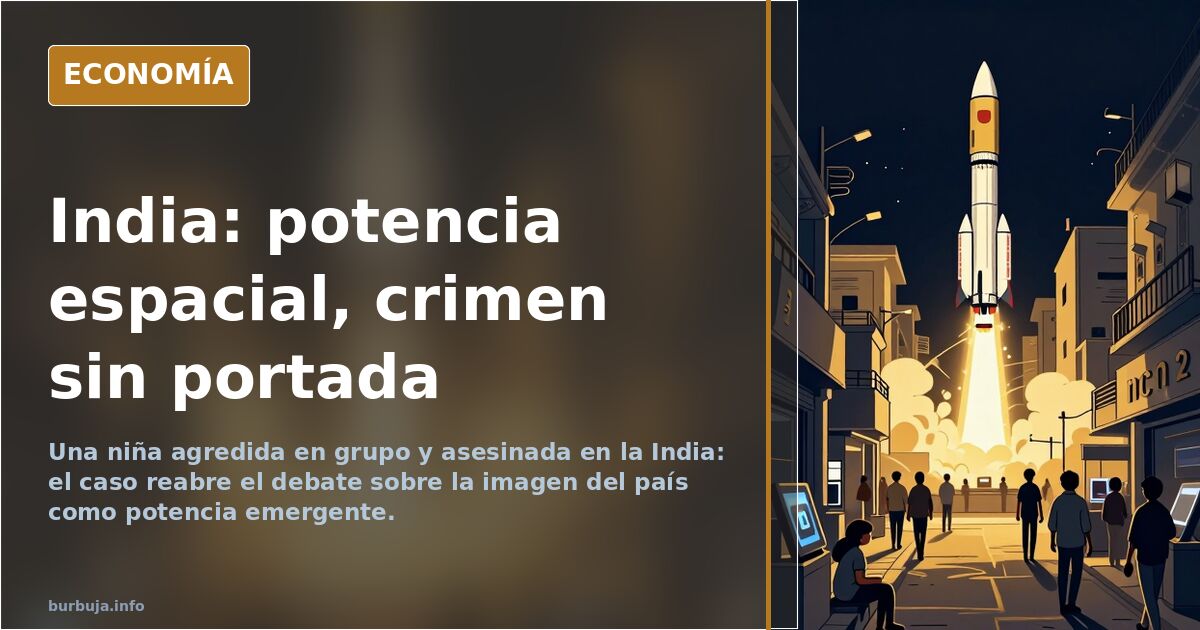
Crime in India challenges the spiritual narrative
According to messages opening the thread and cited reports, a girl was sensual assaulted by a group and subsequently murdered. The incident has peine a discussion that goes beyond the case itself: that of a country which, according to several participants, is marketed by the West as a destination for retreats and yoga, yet carries a history of violence against women that rarely makes headlines.
The early stages of the matter arrive with more questions than answers. There is no confirmed region or closed legal status in the circulating material, and much of the exchange stops precisely there: at the difficulty of establishing facts before forming opinions.
What is known and unknown about the crime
The central fact admits no nuance. A minor was gang-raped and then murdered. What does not come through with the same clarity are the coordinates. The released material does not specify the region nor clarify the investigation's stage, and this fog dominates the first part of the conversation.
Some recall that a continental-scale country cannot be explained by a single event; others respond that scale does not erase the fact either. The disagreement, more than about the crime, concerns the framework each person places upon it. An atrocious case, with or without coordinates.
What appears quickly is the drift. Some reactions shift from shock to reproach in two lines, turning the event into domestic political currency. Others demand context before sentencing.
Why does it compete poorly with an unconsented kiss?
A few hours of conversation were enough for the uncomfortable comparison to emerge: the media space dedicated to Rubiales' kiss versus that reserved for a murder on the other side of the map. The complaint, repeated in various tones, points to an agenda pattern rather than a specific case.
Against this weighs a reasonable argument: each country covers what is near, and proximity explains almost everything. However, the result is the same. A violent death of a minor competes poorly with a gesture before cameras, and that asymmetry is what causes outrage.
The comparison is not new. Every time a distant event rivals a domestic scandal, the same reproach reappears: the nearby is oversized, and the remote is archived in twenty seconds of news. Behind remains a question no media fully answers: what turns a crime into news and what leaves it out?
Moon rockets and unresolved poverty
The most repeated contrast is that of aerospace spending. India sends ships to the Moon, several messages remind us, and spends a fortune on rockets while maintaining pockets of poverty that they do not cover. The exact figure of the space budget does not appear in the material, but anyone summarizes the paradox: a fortune spent reaching the Moon while the majority lives as they live.
The argument contains statistical traps. A space program does not explain poverty on its own, and attributing to rockets what social structure causes is a shortcut. Still, the perception is widespread, and some transfer it to the BRICS narrative: the bloc presenting itself as an alternative to Western order would not, in this reading, account for its own people's well-being.
The debate moves between two waters. One part uses the contrast to denounce the gap between the country's brand image and its social reality; another warns that this gap is not exclusive to India nor useful for measuring the gravity of a specific crime.
Spiritual tourism and its fine print
Focus has also fallen on tourism. There are creators who document their daily life across the country and feed a friendly image; the couple of travelers recording their trips approaches one million subscribers, according to one message in the thread. The leap between origin and destination, and the lack of fit of an inexperienced traveler in such an environment, centers much of the comments.
One part holds that disillusionment is inevitable and that the spiritual destination narrative collapses at the first clash with reality. Another responds that traveling does not make anyone a security expert and generalizing based on one event is as crude as judging an entire continent by a headline.
The event brings the issue back to the forefront, even if only for a few hours.
From India to Bharat: the name enters the discussion too
Another section of the exchange stops at the name. India coexists with Bharat, the Hindi designation —भारत गणराज्य, Bhārat Gaṇarājya—, and some argue that the toponym itself carries colonial baggage. The digression seems minor, but it well illustrates how the symbol is debated when the background is uncomfortable to look at.
It is the same movement running through the rest of the conversation: changing planes before reaching the bone. They talk about the name, the brochure, the geopolitical bloc. They talk about almost everything except the crime that peine the matter.
In the end, a disorienting data point remains. The country will stay on lists of essential destinations, and channels recording its streets will continue gaining subscribers. The narrative holds; the story does not.
According to messages opening the thread and cited reports, a girl was sensual assaulted by a group and subsequently murdered. The incident has peine a discussion that goes beyond the case itself: that of a country which, according to several participants, is marketed by the West as a destination for retreats and yoga, yet carries a history of violence against women that rarely makes headlines.
The early stages of the matter arrive with more questions than answers. There is no confirmed region or closed legal status in the circulating material, and much of the exchange stops precisely there: at the difficulty of establishing facts before forming opinions.
What is known and unknown about the crime
The central fact admits no nuance. A minor was gang-raped and then murdered. What does not come through with the same clarity are the coordinates. The released material does not specify the region nor clarify the investigation's stage, and this fog dominates the first part of the conversation.
Some recall that a continental-scale country cannot be explained by a single event; others respond that scale does not erase the fact either. The disagreement, more than about the crime, concerns the framework each person places upon it. An atrocious case, with or without coordinates.
What appears quickly is the drift. Some reactions shift from shock to reproach in two lines, turning the event into domestic political currency. Others demand context before sentencing.
Why does it compete poorly with an unconsented kiss?
A few hours of conversation were enough for the uncomfortable comparison to emerge: the media space dedicated to Rubiales' kiss versus that reserved for a murder on the other side of the map. The complaint, repeated in various tones, points to an agenda pattern rather than a specific case.
Against this weighs a reasonable argument: each country covers what is near, and proximity explains almost everything. However, the result is the same. A violent death of a minor competes poorly with a gesture before cameras, and that asymmetry is what causes outrage.
The comparison is not new. Every time a distant event rivals a domestic scandal, the same reproach reappears: the nearby is oversized, and the remote is archived in twenty seconds of news. Behind remains a question no media fully answers: what turns a crime into news and what leaves it out?
Moon rockets and unresolved poverty
The most repeated contrast is that of aerospace spending. India sends ships to the Moon, several messages remind us, and spends a fortune on rockets while maintaining pockets of poverty that they do not cover. The exact figure of the space budget does not appear in the material, but anyone summarizes the paradox: a fortune spent reaching the Moon while the majority lives as they live.
The argument contains statistical traps. A space program does not explain poverty on its own, and attributing to rockets what social structure causes is a shortcut. Still, the perception is widespread, and some transfer it to the BRICS narrative: the bloc presenting itself as an alternative to Western order would not, in this reading, account for its own people's well-being.
The debate moves between two waters. One part uses the contrast to denounce the gap between the country's brand image and its social reality; another warns that this gap is not exclusive to India nor useful for measuring the gravity of a specific crime.
Spiritual tourism and its fine print
Focus has also fallen on tourism. There are creators who document their daily life across the country and feed a friendly image; the couple of travelers recording their trips approaches one million subscribers, according to one message in the thread. The leap between origin and destination, and the lack of fit of an inexperienced traveler in such an environment, centers much of the comments.
One part holds that disillusionment is inevitable and that the spiritual destination narrative collapses at the first clash with reality. Another responds that traveling does not make anyone a security expert and generalizing based on one event is as crude as judging an entire continent by a headline.
The event brings the issue back to the forefront, even if only for a few hours.
From India to Bharat: the name enters the discussion too
Another section of the exchange stops at the name. India coexists with Bharat, the Hindi designation —भारत गणराज्य, Bhārat Gaṇarājya—, and some argue that the toponym itself carries colonial baggage. The digression seems minor, but it well illustrates how the symbol is debated when the background is uncomfortable to look at.
It is the same movement running through the rest of the conversation: changing planes before reaching the bone. They talk about the name, the brochure, the geopolitical bloc. They talk about almost everything except the crime that peine the matter.
In the end, a disorienting data point remains. The country will stay on lists of essential destinations, and channels recording its streets will continue gaining subscribers. The narrative holds; the story does not.
Also available in: Deutsch
Summary of a discussion on Burbuja.info - Foro de economía, actualidad y política., translated from Spanish and reviewed before publication. Read the full discussion (110 replies).
More summaries
-
Morata de Tajuña murders: scam by fake soldiers and three deaths
Three siblings from Morata de Tajuña were found dead with signs of violence after years of sending their pensions to fake US soldiers.
-
The Simon Perez phenomenon: from obscurity to live self-destruction
The phenomenon of Simón Pérez, aka 'Bocata de Pollo', resurfaces on streaming. An analysis of his self-destruction, the donation business and its impact.
-
Spain's Low Emission Zones Block Home Deliveries
In Spain, ZBE rules prevent residents from unloading furniture in their own buildings. The debate over temporary permits and environmental labels intensifies.
-
Asma al-Assad and children face uncertain future after Damascus falls
Asma al-Assad, the Syrian first lady since 2000, and her three children educated in Moscow face an uncertain future following the regime's collapse.
-
Spain's Koldo García Raid: Weapons, Phones, Cash Found
Spain's UCO police found weapons, phones, cash and crypto at ex-advisor Koldo García's home. Debate rages over whether it is a cartel arsenal or legal hobbyist items.
-
Valladolid rejects refugee center, forfeits €17 million
Valladolid city council refuses a state-funded refugee center, losing €17M. Debate focuses on earmarked funds and the Cantabria precedent.