
Morata de Tajuña murders: scam by fake soldiers and three deaths
Three siblings from Morata de Tajuña were found dead with signs of violence after years of sending their pensions to fake US soldiers.
English · Original discussion in Spanish · Published
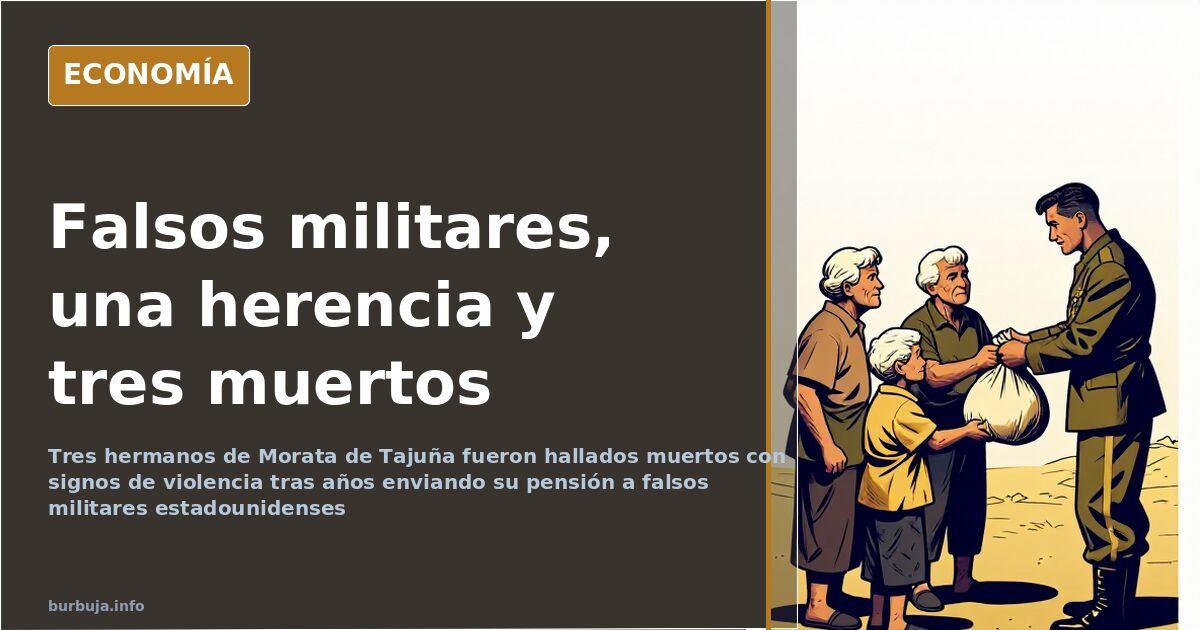
Three siblings scammed by fake soldiers end up murdered in Sarracena
In Sarracena de Tajuña (Madrid), on the 25th of each month, there was a ritual: two retired sisters sent almost their entire pension to some US soldiers who had been promising them a millionaire inheritance for years. The ritual ended with three bodies in their own home, with signs of violence, and with a settling of scores as the main police hypothesis. What seemed like just another rural incident is turning out to be a snapshot of romance scams in Spain.
What is known about the Sarracena de Tajuña triple murder
The bodies of the three siblings — two women and a man with a disability — were found in the family home, partially burned and piled up, according to initial information released by 20minutos. Family acquaintances claim the women had given large sums of money and a flat in Madrid to those they believed were their future benefactors. Both were retired: one had been an antique dealer and the other a teacher.
The hypothesis being considered by the investigation does not point to a typical robbery. It points to a debt. And they did not have the debt.
The fake soldier scam: a drip that lasts for years
The pattern is old and works like clockwork. A profile presenting as a US soldier on an overseas mission, a relationship built through messages, and a promise: an inheritance or a blocked shipment that needs money to be released. First, small amounts. Then, loans.
According to what neighbors recounted, the mechanism was monthly: every 25th, upon receiving their pension, almost all the money went to the scammers, and the sisters were left unable to cover their basic needs. The estimate circulating among acquaintances places the flow at around 6,000 euros per month. To sustain the transfers, they asked for loans from acquaintances, with the supposed inheritance as collateral.
There is an explanation that fits better than simple foolishness: loss aversion. The more money already given, the more unbearable it is to admit it won't be recovered. The next transfer isn't a new stupidity. It's an attempt to rescue the previous one.
A chain of scammers who were also being scammed
The case has an uncomfortable twist. According to testimonies that have emerged, the sisters were not just victims: to continue sending money, they in turn recruited people from their circle with the same story. And it is suggested that the pension of the disabled brother ended up boosting the transfers.
In other words, it's not a predator and three lambs. It's a ladder. And on each rung, someone acts as both victim and intermediary.
The arrested suspect: a sold phone shop and an unpayable debt
The investigation eventually pointed to a Pakistani national who ran a phone shop. According to reports, he sold his business to lend money to the sisters, to whom he was linked by the promise of double the amount when the inheritance arrived. He was left without a business, without money, and living in a room provided by compatriots, who also fed him.
The man turned himself in at the court in Arganda del Rey, according to published information, and some radio stations suggested he had confessed. Everything is pending a judicial determination: there is no conviction, and the presumption of innocence applies. The main hypothesis remains that the murder was the final link in a settling of scores.
Why this case is more captivating than other crimes
The story has not only made it into the news: Iker Jiménez's crime show dedicated a live broadcast to it the same day it became known. And an uncomfortable comparison has been made aloud: cases of men deceived on dates who ended up murdered received a fraction of this coverage.
Similarities have also been pointed out with El extraño viaje (The Strange Journey), a film by Fernán Gómez: a town in Madrid, three bachelor brothers with assets, the desire to escape a gray life, and a tragic end. The fiction came sixty years earlier.
The ritual of the 25th will no longer be repeated. The money went for years to the other side of a screen, and no one has yet held that screen accountable.
In Sarracena de Tajuña (Madrid), on the 25th of each month, there was a ritual: two retired sisters sent almost their entire pension to some US soldiers who had been promising them a millionaire inheritance for years. The ritual ended with three bodies in their own home, with signs of violence, and with a settling of scores as the main police hypothesis. What seemed like just another rural incident is turning out to be a snapshot of romance scams in Spain.
What is known about the Sarracena de Tajuña triple murder
The bodies of the three siblings — two women and a man with a disability — were found in the family home, partially burned and piled up, according to initial information released by 20minutos. Family acquaintances claim the women had given large sums of money and a flat in Madrid to those they believed were their future benefactors. Both were retired: one had been an antique dealer and the other a teacher.
The hypothesis being considered by the investigation does not point to a typical robbery. It points to a debt. And they did not have the debt.
The fake soldier scam: a drip that lasts for years
The pattern is old and works like clockwork. A profile presenting as a US soldier on an overseas mission, a relationship built through messages, and a promise: an inheritance or a blocked shipment that needs money to be released. First, small amounts. Then, loans.
According to what neighbors recounted, the mechanism was monthly: every 25th, upon receiving their pension, almost all the money went to the scammers, and the sisters were left unable to cover their basic needs. The estimate circulating among acquaintances places the flow at around 6,000 euros per month. To sustain the transfers, they asked for loans from acquaintances, with the supposed inheritance as collateral.
There is an explanation that fits better than simple foolishness: loss aversion. The more money already given, the more unbearable it is to admit it won't be recovered. The next transfer isn't a new stupidity. It's an attempt to rescue the previous one.
A chain of scammers who were also being scammed
The case has an uncomfortable twist. According to testimonies that have emerged, the sisters were not just victims: to continue sending money, they in turn recruited people from their circle with the same story. And it is suggested that the pension of the disabled brother ended up boosting the transfers.
In other words, it's not a predator and three lambs. It's a ladder. And on each rung, someone acts as both victim and intermediary.
The arrested suspect: a sold phone shop and an unpayable debt
The investigation eventually pointed to a Pakistani national who ran a phone shop. According to reports, he sold his business to lend money to the sisters, to whom he was linked by the promise of double the amount when the inheritance arrived. He was left without a business, without money, and living in a room provided by compatriots, who also fed him.
The man turned himself in at the court in Arganda del Rey, according to published information, and some radio stations suggested he had confessed. Everything is pending a judicial determination: there is no conviction, and the presumption of innocence applies. The main hypothesis remains that the murder was the final link in a settling of scores.
Why this case is more captivating than other crimes
The story has not only made it into the news: Iker Jiménez's crime show dedicated a live broadcast to it the same day it became known. And an uncomfortable comparison has been made aloud: cases of men deceived on dates who ended up murdered received a fraction of this coverage.
Similarities have also been pointed out with El extraño viaje (The Strange Journey), a film by Fernán Gómez: a town in Madrid, three bachelor brothers with assets, the desire to escape a gray life, and a tragic end. The fiction came sixty years earlier.
The ritual of the 25th will no longer be repeated. The money went for years to the other side of a screen, and no one has yet held that screen accountable.
Summary of a discussion on Burbuja.info - Foro de economía, actualidad y política., translated from Spanish and reviewed before publication. Read the full discussion (416 replies).
More summaries
-
Iker Jiménez Under Fire: The Battle Over Defining Journalism
Iker Jiménez's name reached the Congress, reigniting the long-running dispute over what journalism is and where the limits of freedom of expression lie.
-
Euthanasia in Old Age: Autonomy vs. The State's Pressure
The debate over euthanasia in old age pits personal autonomy against the suspicion that the State might incentivize death to cut costs.
-
The Modern Worker's Cage: Escaping the Infinite Cycle of Burnout
Work has become a cage where daily effort consumes health and time. Discover why we push ourselves so hard and how to break the cycle.
-
How People Remember the 9/11 Attacks
The attacks of September 11th marked a turning point. Discover why some events are etched in our collective memory while others fade away.
-
Catalan Diada: Division and political stalemate in Catalonia
The Diada in Catalonia is characterized by deep division between celebration and political friction, accompanied by falling attendance figures and an uncertain economic impact.
-
Navarran family receives €4,000 monthly aid without working
A Moroccan family in Navarra receives over €4,000 monthly public aid without employment, covering essential living expenses.