
Index funds vs roboadvisors: real cost of investing in Spain
Vanguard index funds cost 0.18% annually, while roboadvisors charge 0.7-0.8%. Over 20 years, this fee gap significantly impacts returns.
English · Original discussion in Spanish · Published
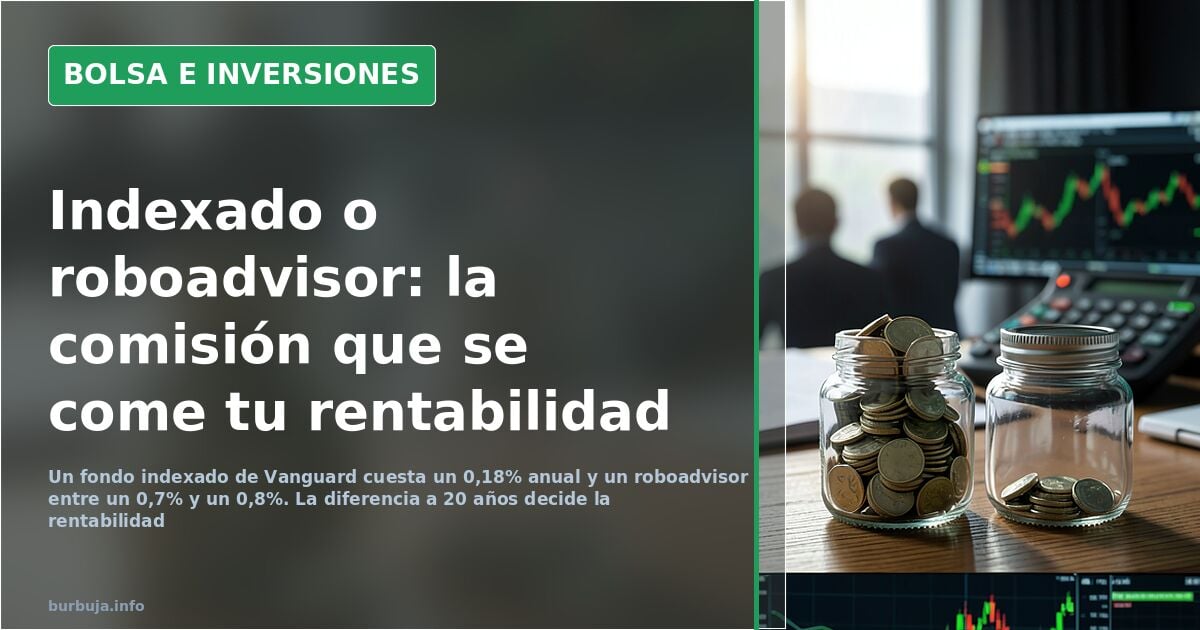
Index funds or roboadvisors: the fee that eats your returns
Starting to invest with €7,000 and adding small monthly amounts seems simple until the first decision arises: pay for management or do it yourself. The difference between these paths is not minor. A Vanguard index fund contracted directly costs around 0.18% annually, whereas a roboadvisor ranges between 0.7% and 0.8%, according to data shared by forum participants. On paper, half a percentage point. Compounded over two decades, it is money that never comes back.
The discussion begins with a novice investor hesitating between Openbank's roboadvisor and two Amundi funds, World and S&P 500. The response received reshuffles the board: before the product, choose the provider. For roboadvisors, Indexa is better than Openbank; for funds, Vanguard via MyInvestor is better than Amundi anywhere else. The reason cited is arithmetic, not ideological.
What does a roboadvisor really cost compared to a DIY portfolio?
The recurring argument is convenience. A roboadvisor selects percentages, rebalances, and executes without the client touching anything. That laziness has a price: these platforms' fee range hovers around 0.7-0.8% versus the 0.18% of a global Vanguard fund managed independently, according to calculations shared in the debate. And there is a detail often forgotten: the TER is not paid all at once but deducted daily from the net asset value. 0.18% over 365 days, every day, forever.
Some argue that for inexperienced investors, the roboadvisor is a safety net preventing classic errors: buying in euphoria and selling in panic. The other view is less friendly. If rebalancing can be learned in an afternoon and funds contracted online in two days, what exactly are you paying for?
Why Vanguard and not Amundi?
According to participants, the comparison between asset managers resolves with one datum: Vanguard's TER is twice as efficient as Amundi's in equivalent products. Tracking error is usually slightly tighter, and in the case of MyInvestor, there is no minimum entry amount. Those with more than €100,000 in Amundi at Openbank face an uncomfortable decision: move the portfolio to save a few basis points or stay out of convenience. The answer given is that in the long run, those basis points weigh more than they seem.
Moreover, switching between funds is tax-free. You can change distributors without going through the Spanish Tax Agency (Hacienda), provided it is a switch and not a redemption. Here lies the trap for novices: selling to move money triggers the tax bill; switching does not.
Money security: what happens if your bank fails?
Doubts about MyInvestor and its parent company Andbank pervade much of the conversation. The technical response provides reassurance: funds are not on the bank's balance sheet, they are held by a separate depositary entity, and the Spanish Deposit Guarantee Fund covers up to €100,000 per holder for accounts, not funds. If the bank falls, the funds remain. What is at risk is cash, not investments.
A nuance mentioned: if two funds merge, as peine with Vanguard, you must switch before the deadline, or the switch becomes a sale and goes through Hacienda. Those who ignore distributor emails get a nasty surprise.
ETFs: the alternative almost nobody needs
iShares appears with fees of 0.12%, below Vanguard. The trick is not a trick: these are ETFs, bought like stocks, charged per transaction, and not switchable. For small monthly contributions, purchase fees eat up the advantage. For a large lump sum, they may compensate. The practical rule suggested: if you plan to invest €150 a month, ETFs are not your product.
The conclusion imposed is uncomfortable for the industry: passive management has shifted complexity, not eliminated it. Before, you had to choose between Apple and Johnson & Johnson; now you must choose between Indexa and MyInvestor, between Vanguard and Amundi, between switching or selling. The prediction, with reservations: in a few years, cheap roboadvisors will be the entry door, and a DIY portfolio of two or three funds, the destination. No one guarantees the middle path will be free.
Starting to invest with €7,000 and adding small monthly amounts seems simple until the first decision arises: pay for management or do it yourself. The difference between these paths is not minor. A Vanguard index fund contracted directly costs around 0.18% annually, whereas a roboadvisor ranges between 0.7% and 0.8%, according to data shared by forum participants. On paper, half a percentage point. Compounded over two decades, it is money that never comes back.
The discussion begins with a novice investor hesitating between Openbank's roboadvisor and two Amundi funds, World and S&P 500. The response received reshuffles the board: before the product, choose the provider. For roboadvisors, Indexa is better than Openbank; for funds, Vanguard via MyInvestor is better than Amundi anywhere else. The reason cited is arithmetic, not ideological.
What does a roboadvisor really cost compared to a DIY portfolio?
The recurring argument is convenience. A roboadvisor selects percentages, rebalances, and executes without the client touching anything. That laziness has a price: these platforms' fee range hovers around 0.7-0.8% versus the 0.18% of a global Vanguard fund managed independently, according to calculations shared in the debate. And there is a detail often forgotten: the TER is not paid all at once but deducted daily from the net asset value. 0.18% over 365 days, every day, forever.
Some argue that for inexperienced investors, the roboadvisor is a safety net preventing classic errors: buying in euphoria and selling in panic. The other view is less friendly. If rebalancing can be learned in an afternoon and funds contracted online in two days, what exactly are you paying for?
Why Vanguard and not Amundi?
According to participants, the comparison between asset managers resolves with one datum: Vanguard's TER is twice as efficient as Amundi's in equivalent products. Tracking error is usually slightly tighter, and in the case of MyInvestor, there is no minimum entry amount. Those with more than €100,000 in Amundi at Openbank face an uncomfortable decision: move the portfolio to save a few basis points or stay out of convenience. The answer given is that in the long run, those basis points weigh more than they seem.
Moreover, switching between funds is tax-free. You can change distributors without going through the Spanish Tax Agency (Hacienda), provided it is a switch and not a redemption. Here lies the trap for novices: selling to move money triggers the tax bill; switching does not.
Money security: what happens if your bank fails?
Doubts about MyInvestor and its parent company Andbank pervade much of the conversation. The technical response provides reassurance: funds are not on the bank's balance sheet, they are held by a separate depositary entity, and the Spanish Deposit Guarantee Fund covers up to €100,000 per holder for accounts, not funds. If the bank falls, the funds remain. What is at risk is cash, not investments.
A nuance mentioned: if two funds merge, as peine with Vanguard, you must switch before the deadline, or the switch becomes a sale and goes through Hacienda. Those who ignore distributor emails get a nasty surprise.
ETFs: the alternative almost nobody needs
iShares appears with fees of 0.12%, below Vanguard. The trick is not a trick: these are ETFs, bought like stocks, charged per transaction, and not switchable. For small monthly contributions, purchase fees eat up the advantage. For a large lump sum, they may compensate. The practical rule suggested: if you plan to invest €150 a month, ETFs are not your product.
The conclusion imposed is uncomfortable for the industry: passive management has shifted complexity, not eliminated it. Before, you had to choose between Apple and Johnson & Johnson; now you must choose between Indexa and MyInvestor, between Vanguard and Amundi, between switching or selling. The prediction, with reservations: in a few years, cheap roboadvisors will be the entry door, and a DIY portfolio of two or three funds, the destination. No one guarantees the middle path will be free.
Also available in: Deutsch
Summary of a discussion on Burbuja.info - Foro de economía, actualidad y política., translated from Spanish and reviewed before publication. Read the full discussion (98 replies).
More summaries
-
Index Funds Outperform Active Management as Fees Drop
Active funds charge 2% vs. 0.20% for ETFs tracking the same index. Analysis explains the unstoppable rise of index investing.
-
Pablo Gil trader reviews: respect and bearish bias
Two years warning of a stock market crash that hasn't come: opinions on Pablo Gil, the YouTube trader, split between respect and bias.
-
HelloFresh: Market Split Over Triple-or-Nothing Valuation Thesis
HelloFresh trades below 10% of its €6.356 billion revenue. Some argue it is worth €3 billion if stability returns.
-
1% Mixed Deposit vs Funds: What to Do with €150,000
A mixed deposit offering 1% plus IBEX exposure yields only €300/year on €15,000 locked for three years.
-
Buying Russian stocks during war: The bargain hunt
Sberbank falls 70% and Novatek 68% as investors seek bargains in Russian equities while brokers restrict access and fears of confiscation rise.
-
Google's Red Code Alarm: ChatGPT Threatens Search Business
NYT reports Google triggered a red code alarm over ChatGPT. OpenAI ownership and search business risks explained.