
1% Mixed Deposit vs Funds: What to Do with €150,000
A mixed deposit offering 1% plus IBEX exposure yields only €300/year on €15,000 locked for three years.
English · Original discussion in Spanish · Published
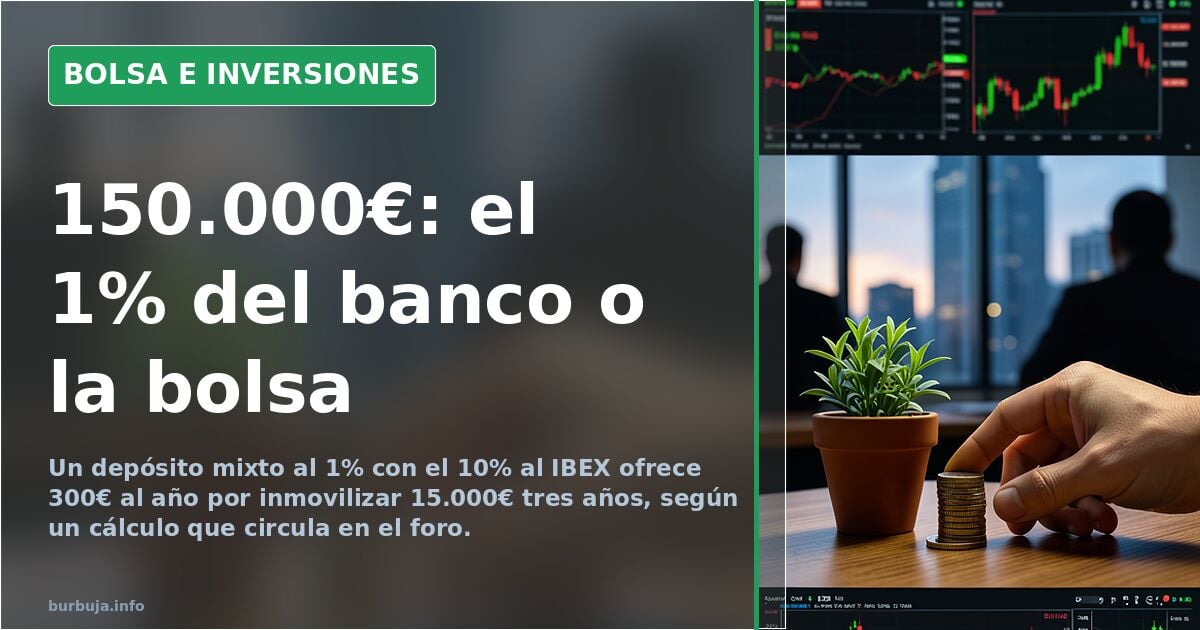
You have €150,000 and the bank offers 1%: think twice
A "convertible mixed" deposit at a 90-10 split. That is what was offered to a saver who had just sold a property and held €150,000 in liquid assets. The proposal: 90% in a conventional one-year deposit at 1%, and the remaining 10% indexed to the IBEX (Spain's main stock market index), with a promise of 2% annual return if the index rises. The fine print: that 10% is locked for three years, and if the stock market falls, nothing is paid out. The product, marketed by CaixaBank, sums up the current moment well: the bank keeps the certainty and passes the lottery ticket to the client.
The calculation that dismantles the offer is simple. 10% of €150,000 is €15,000, and 2% of that amount is €300 per year. Three hundred euros for three years of trapped money with the risk of losing part of the principal. The lingering question is whether it is worth complicating things for such crumbs.
The bank's 1% versus online banking
The first response received by the saver is unanimous: reject the product. Not because of the risk, which is limited, but because of the ratio between what is earned and what is given up. A 1% return over one year is perversos profitability in an environment where digital savings accounts fight for every tenth of a percent. The alternative gaining traction is diversification: part in deposits from banks covered by the guarantee fund, part in high-yield accounts like Coinc or ING, and the rest, if anything, in products with more potential.
Regarding Wizink, the doubt is explicit. The experiences circulating are not good, and the recommendation is to scrutinize conditions before signing. The repeated rule: never contract a bank product without studying it beforehand, especially if someone selling it earns a commission.
Index funds, ETFs, and the book that explains everything
For those who do not want to become asset managers, the path generating the most consensus is passive management. Low-fee index funds, ETFs that allow entry and exit without the "lock-up" of a term deposit, and a diversified portfolio that does not depend on a single market. The reading list shared is a classic: from "The Four Pillars of Investing" to "A Random Walk Down Wall Street," passing through "The Intelligent Investor" or Harry Browne's permanent portfolio guide. One hundred euros in books and two hundred hours of study yield more than any packaged product.
Some go further and propose a specific portfolio: 25% in indexed equities, 25% in bonds, 25% in gold, and 25% in cash. The logic is that each leg covers the scenario the others do not. It is not a magic formula, but it is a structure understood without being an expert.
Crypto enthusiasm and its excesses
The conversation drifts, as almost all do, toward cryptocurrencies. One sector defends it as an opportunity comparable to investing in the internet in the nineties; another responds that legal protection is virtually non-existent, there is no regulated market to sell when you want, and scams will arrive over time. The most sensible warning: if anyone enters, let it be with 5% or 10% of capital and knowing it is the Wild West. The anecdote summarizing the risk comes from someone who claims to have seen an asset fall 40% in a single day.
The advice closing the matter is the least segarro: diversify, educate yourself, and do not put everything into one idea. A saver who sells a house and holds €150,000 does not need a star product; they need not to lose the money along the way.
What if the best investment were not investing yet?
A "convertible mixed" deposit at a 90-10 split. That is what was offered to a saver who had just sold a property and held €150,000 in liquid assets. The proposal: 90% in a conventional one-year deposit at 1%, and the remaining 10% indexed to the IBEX (Spain's main stock market index), with a promise of 2% annual return if the index rises. The fine print: that 10% is locked for three years, and if the stock market falls, nothing is paid out. The product, marketed by CaixaBank, sums up the current moment well: the bank keeps the certainty and passes the lottery ticket to the client.
The calculation that dismantles the offer is simple. 10% of €150,000 is €15,000, and 2% of that amount is €300 per year. Three hundred euros for three years of trapped money with the risk of losing part of the principal. The lingering question is whether it is worth complicating things for such crumbs.
The bank's 1% versus online banking
The first response received by the saver is unanimous: reject the product. Not because of the risk, which is limited, but because of the ratio between what is earned and what is given up. A 1% return over one year is perversos profitability in an environment where digital savings accounts fight for every tenth of a percent. The alternative gaining traction is diversification: part in deposits from banks covered by the guarantee fund, part in high-yield accounts like Coinc or ING, and the rest, if anything, in products with more potential.
Regarding Wizink, the doubt is explicit. The experiences circulating are not good, and the recommendation is to scrutinize conditions before signing. The repeated rule: never contract a bank product without studying it beforehand, especially if someone selling it earns a commission.
Index funds, ETFs, and the book that explains everything
For those who do not want to become asset managers, the path generating the most consensus is passive management. Low-fee index funds, ETFs that allow entry and exit without the "lock-up" of a term deposit, and a diversified portfolio that does not depend on a single market. The reading list shared is a classic: from "The Four Pillars of Investing" to "A Random Walk Down Wall Street," passing through "The Intelligent Investor" or Harry Browne's permanent portfolio guide. One hundred euros in books and two hundred hours of study yield more than any packaged product.
Some go further and propose a specific portfolio: 25% in indexed equities, 25% in bonds, 25% in gold, and 25% in cash. The logic is that each leg covers the scenario the others do not. It is not a magic formula, but it is a structure understood without being an expert.
Crypto enthusiasm and its excesses
The conversation drifts, as almost all do, toward cryptocurrencies. One sector defends it as an opportunity comparable to investing in the internet in the nineties; another responds that legal protection is virtually non-existent, there is no regulated market to sell when you want, and scams will arrive over time. The most sensible warning: if anyone enters, let it be with 5% or 10% of capital and knowing it is the Wild West. The anecdote summarizing the risk comes from someone who claims to have seen an asset fall 40% in a single day.
The advice closing the matter is the least segarro: diversify, educate yourself, and do not put everything into one idea. A saver who sells a house and holds €150,000 does not need a star product; they need not to lose the money along the way.
What if the best investment were not investing yet?
Also available in: Deutsch
Summary of a discussion on Burbuja.info - Foro de economía, actualidad y política., translated from Spanish and reviewed before publication. Read the full discussion (57 replies).
More summaries
-
€140,000 with no mortgage or property: where to put it
€140,000 with no mortgage or bricks: Spanish Treasury bills at 3%, deposits at 3.35% and bond funds at 4.2%. The conservative menu and its limits.
-
Invertir desde Cero course reviews: useful but basic
Students call the stock market course introductory, not advanced: one month of classes and a year of monthly sessions.
-
Kraft Heinz at $23, Nestlé at Lows: Dividend Dilemma in Spain
Kraft Heinz trades at $23 and Nestlé hits seven-year lows. Investors weigh potential cuts against buying opportunities in defensive consumer stocks.
-
HelloFresh: Market Split Over Triple-or-Nothing Valuation Thesis
HelloFresh trades below 10% of its €6.356 billion revenue. Some argue it is worth €3 billion if stability returns.
-
Index funds vs roboadvisors: real cost of investing in Spain
Vanguard index funds cost 0.18% annually, while roboadvisors charge 0.7-0.8%. Over 20 years, this fee gap significantly impacts returns.
-
Buying Russian stocks during war: The bargain hunt
Sberbank falls 70% and Novatek 68% as investors seek bargains in Russian equities while brokers restrict access and fears of confiscation rise.