
Buying Russian stocks during war: The bargain hunt
Sberbank falls 70% and Novatek 68% as investors seek bargains in Russian equities while brokers restrict access and fears of confiscation rise.
English · Original discussion in Spanish · Published
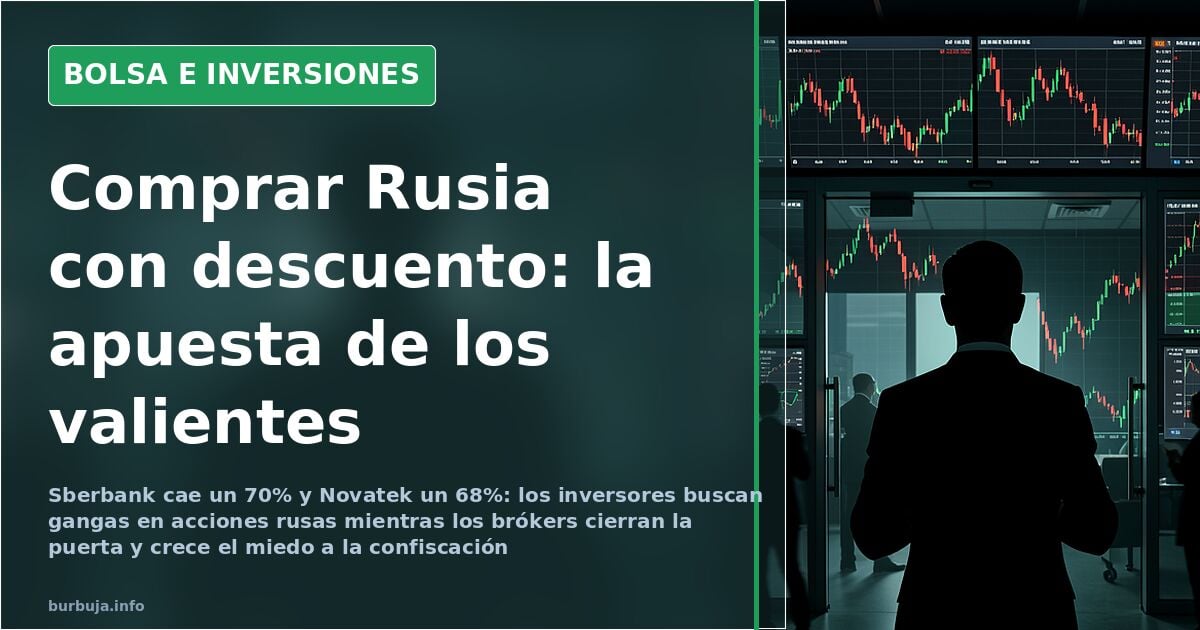
Discounted Russian stocks: The bet dividing investors
With the Moscow exchange collapsing and sanctions tightening, part of the investment community wonders if panic has peine a buying window for strategic Russian companies. The starting point is a double doubt: which Russian asset can recover smoothly once the storm passes, and whether it makes sense to short the VIX while indices show no signs of calming down. The most repeated answer isn't a ticker, but a warning: in a bloc conflict, investing on enemy territory carries risks that no technical analysis prices in.
Which Russian stocks to buy and at what price
The list of candidates discussed shows a clear pattern: oil, gas, aluminum, wheat, and commodities. Lukoil trading at $27, Gazprom as a dividend play, Polymetal, Novatek, or Sberbank are some names mentioned. The logic is standard for a crash: strategic firms with monopolies or quasi-monopolies that keep producing even as their share prices plummet.
The figures being thrown around are striking. Sberbank had accumulated a 70% drop, Novatek 68.7%, PhosAgro 62%, and X5 Retail Group 54.5%, according to shared market data. The collapse doesn't distinguish between banking, retail, or fertilizers. For aggressive traders, this is an opportunity; for cautious ones, it signals the market is pricing in more than just a bad quarter.
Practical hurdles appear quickly: not all brokers allow trading. DeGiro stopped accepting orders for Polymetal and Lukoil, while other platforms like Swissquote still provided access. The door narrows just as prices become tempting.
The confiscation risk nobody dismisses
The most serious objection isn't price, but ownership. If blocs clash, no one guarantees who will confiscate what. There is speculation about freezing accounts and properties of Russian and Belarusian oligarchs, though doubts remain about auctioning assets as if they belonged to terrorists. The underlying worry is different: that individual investors end up holding shares that are valuable one day and unsellable or uncollectible the next.
Against this antiestéticar, some note that the Moscow exchange holds up because wealthy Russians are buying on sale while foreigners liquidate out of panic. It's a hypothesis, not verified data, but it explains why volume hasn't completely broken down.
VIX, Bitcoin, and the rest of the market
Outside Russia, discussion shifts to using the VIX to bet on higher volatility and Bitcoin as either a refuge or a trap. The bearish thesis on crypto relies on its correlation with stocks: if indices keep falling, Bitcoin falls with them. The opposing view recalls that Russia legalized cryptocurrencies to evade sanctions, which could give them utility and volume. No one closes the debate.
For indices, the most shared conclusion is prudence: better to wait until the conflict eases. Those with liquidity talk about buying "the tip" and saving ammunition for temporary dips, as done in March 2020. The idea summarizing skeptical consensus: it's better to miss an opportunity than get stuck while good times pass by.
Fine print on dividends and ETFs
For those avoiding specific names, the circulating recipe is a global ETF excluding Russia and China, or directly an index fund tracking the S&P 500 or Nasdaq. Diversification avoids the problem of picking the surviving company. In portfolios, moderates accumulate Russian dividend payers like Gazprom, Polymetal, or Mobile Telesystems, and in China, Ping An, Tencent, or China Mobile.
The precise calculation of potential gains from buying at the bottom of panic, with recovery scenarios and timelines, is where analysis stalls. No one knows how long the mess will last or which Russian assets will remain tradable when it ends.
Also available in: Deutsch
Summary of a discussion on Burbuja.info - Foro de economía, actualidad y política., translated from Spanish and reviewed before publication. Read the full discussion (98 replies).
More summaries
-
Anthropic IPO: is betting on AI worth it?
An analysis of Anthropic's upcoming IPO: a trillion-dollar valuation, nepotism at the top and the promise of AGI. Investment or bubble?
-
Anthropic IPO on November 26: most retail investors say no
Anthropic goes public on November 26, but the majority answer is no: an inflated price, FOMO and memories of Coreweave and SpaceX are holding retail investors back.
-
Hotel101 sells rooms in Valdebebas for €208,800
Hotel101 sells rooms in Valdebebas for €208,800 plus VAT with monthly income distribution and doubts about what happens if the operator goes bankrupt
-
Kraft Heinz at $23, Nestlé at Lows: Dividend Dilemma in Spain
Kraft Heinz trades at $23 and Nestlé hits seven-year lows. Investors weigh potential cuts against buying opportunities in defensive consumer stocks.
-
HelloFresh: Market Split Over Triple-or-Nothing Valuation Thesis
HelloFresh trades below 10% of its €6.356 billion revenue. Some argue it is worth €3 billion if stability returns.
-
Index funds vs roboadvisors: real cost of investing in Spain
Vanguard index funds cost 0.18% annually, while roboadvisors charge 0.7-0.8%. Over 20 years, this fee gap significantly impacts returns.