
Indefinite leases: Spain's government pushes through sweeping housing decree
Two decrees force automatic lease renewals and extend eviction protections until 2030, leaving the rental market in limbo.
English · Original discussion in Spanish · Published
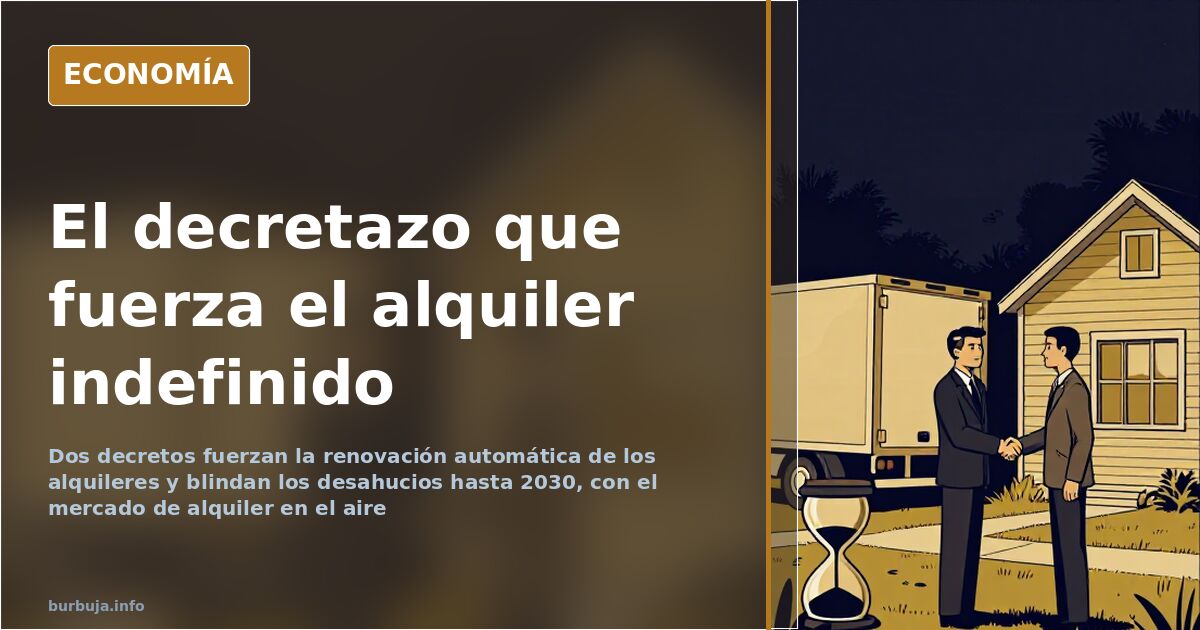
Two decrees force indefinite leases and choke off supply
The Council of Ministers meeting on 29 September 2026 started an hour late. It wasn't the agenda: it was the negotiation between PSOE and Sumar over the housing decree, which went ahead that same Tuesday with two royal decree-laws in hand. Among the measures is one the government presents as "automatic renewal of leases" and which, in practice, forces landlords to sign indefinite rental contracts. The admitted trigger: the eviction of Maricarmen, an 87-year-old neighbour with reduced mobility who had lived for seven decades in Madrid's Retiro district, and whose case ended in a protest camp at Puerta del Sol.
What does the housing decree of 29 September include?
Two royal decree-laws. The first contains measures the government hopes to ratify with the support of PNV and Junts. The second, according to the government itself, will likely go further than the lower house is willing to ratify. The package includes a two-year extension for current rental contracts ending before 31 December 2028 and the extension until 2030 of eviction protections. The text is not a draft: it is law approved by the Council of Ministers.
Rental supply and the antiestéticar of market shutdown
The reaction from the landlord side is unanimous in its diagnosis, though not in the remedy. The argument is that with a mandatory indefinite contract and extended anti-eviction protection, renting stops being a business and becomes an obligation with no way out. Hence the most repeated prediction: nobody will rent, except for short stays to students or tourists.
The scenario ranges from risk to hypothesis. Some argue that if you rent out your flat, you may end up with a tenant who doesn't pay and won't leave; and if you don't rent it out, illegal occupation does the job another way. Others go further and speculate about a tax surcharge on non-primary residences multiplying the IBI (local property tax), which would push owners to rent under imposed conditions or to treat the property as a liability. And at the extreme, the word that appears is expropriation. None of this has been approved: these are scenarios circulating in conversation, not articles of the decree.
The striking thing is the argument that closes the circle: housing becomes an asset with more obligations than returns, and the market contracts just when more supply is needed most.
Maricarmen, the Sol camp and the origin of the decree
The case that set everything off has a specific profile: an 87-year-old woman, with reduced mobility, seven decades in the same centrally located flat, and a lease inherited from another era. It's the kind of contract that hardly exists anymore, and precisely for that reason some point out that the exception is becoming the general rule for the whole market. The Sumar ministers delayed the start of the meeting to force their partners to sign the measures of the Sindicato de Inquilinas (Tenants' Union), the organisation behind the camp at Sol.
The story doesn't end there. In parallel, another eviction is circulating: that of a man with an 87% disability and his family, with an autistic son, in Barcelona. The uncomfortable question hanging in the air: why do some cases mobilise thousands of people while others don't even make the front page?
What can happen now in Congress
The government will bring the two decrees to an extraordinary plenary session on Friday in Congress. That's where we'll see what part of the package survives. For some, the decree is a starting point that will fall short; for others, it's a text that scares off investment and supply. With eviction protection already extended and contract extensions on the table, the million-dollar question is not what Congress will do, but who will sign the next indefinite contract when the landlord holds all the cards.
Also available in: Deutsch
Summary of a discussion on Burbuja.info - Foro de economía, actualidad y política., translated from Spanish and reviewed before publication. Read the full discussion (17 replies).
More summaries
-
Spain Housing Decree: Rent Extensions to 2028 and ICO Loans
Draft housing decree extends leases to 2028, suspends evictions for vulnerable tenants, and offers landlords up to 100% IRPF tax reductions.
-
Two housing decrees and the all-in gamble the government is handing to Junts
PSOE and Sumar agree on two housing decrees and leave the vote in the hands of Junts and PNV, which face a dilemma with their property-owning electorate.
-
Xabier Arrutia Imaz, ETA advisor to PDVSA in Venezuela, dies
The death of Xabier Arrutia Imaz in Venezuela exposes the protection network for ETA members in PDVSA and suspicions of a killing to silence secrets.
-
The myth of the top man women chase without coffee
The archetype of the man women approach without coffee and whom feminism supposedly cannot touch, examined critically by those who see him as a surgically manufactured ghost.
-
Kings League lays off half its staff three years after launch
Gerard Piqué's Kings League is laying off 50% of its workforce (41 of 83 employees) three years after its launch. The company had previously reported a smaller cut.
-
Four officers vs one burly suspect: the police fitness debate reignites
A video shows four officers struggling unsuccessfully to detain a burly suspect, reigniting the controversy over gender-differentiated physical requirements in Spain's police forces.