
Inbar Lieberman and the 25 Militants of Kibutz Nir Am
Inbar Lieberman, 25, allegedly repelled Hamas’s attack on Kibutz Nir Am, killing 25 militants. The unverified figure raises doubts.
English · Original discussion in Spanish · Published
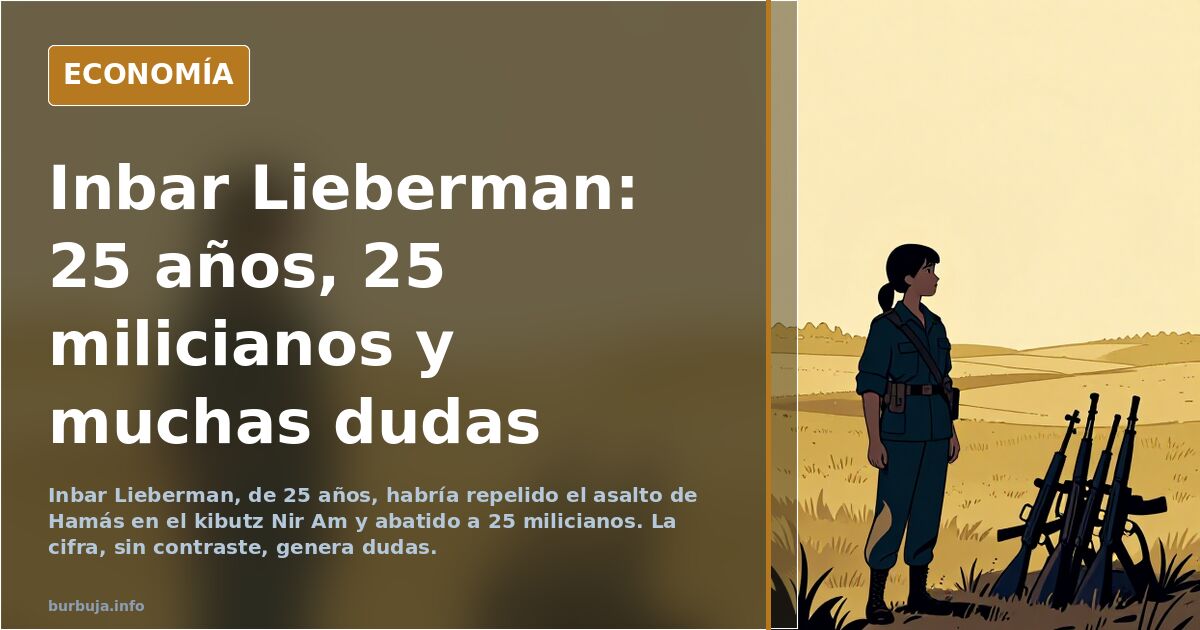
The hero from Kibutz Nir Am and the 25 casualties attributed to her
Twenty-five militants killed. Five by her alone. Inbar Lieberman, a 25-year-old Israeli woman, allegedly coordinated the security team at Kibutz Nir Am and repelled the Hamas assault, becoming the hero her community praises. The story, spread by outlets like 20minutos, contains all the ingredients of a war legend: youth, coolness under fire, round numbers, and a grateful neighborhood. And that is precisely why it triggers the skepticism of anyone who has seen a similar movie before.
It is not that the story is impossible. It is that it is told too perfectly.
What is known about the attack on Kibutz Nir Am?
Little, and everything comes from the same version. The prevailing account claims Lieberman organized the community’s defense, coordinated a security team, and that 25 members of Hamas’s militia died in the exchange of fire, five by her own hand. There is no independent breakdown of these casualties: no identification, no detailed official report, no cross-referencing with other sources. Only a number repeated identically in every headline.
There is one detail that fits the context and is often overlooked. In southern Israel’s kibbutzim, community security is a preexisting structure, with armed members, shifts, and protocols. A trained person, a weapon, and a good defensive position can inflict considerable damage on a group attacking in the open. That does not make the number false or true. It places it in the realm of the possible, which is not the same as the verified.
Why wars manufacture legends with impossible figures
Each conflict generates its own myth of precision. In the early months of the Ukraine war, circulated stories of a Canadian sniper who had killed hundreds of Russian soldiers, and of a fighter capable of shooting down planes with a shotgun. They were given names, nicknames, and even sketches, and for weeks they functioned as a story of resistance more effective than any official report.
Something similar happens here. The same conversation that dismisses Lieberman as “the ghost of Kyiv” has resurrected the case of Elkana Federman, an attendee at a music festival who, according to circulating accounts, gathered weapons from fallen fighters and killed 17 militants alone. The structure is identical: a civilian, a high number, a clean antiestéticat, a proper name, and a nickname ready for the poster.
And there is logic behind it. A war needs legends as much as ammunition: they boost sarracena, humiliate the adversary, and fit into an eight-word headline.
Two readings of the same news
At one extreme, the reading is simple: a young woman with training, in her home, with a weapon and the terrain in her favor, stands up to an armed group, and her community turns her into a symbol. At the other, the number is the problem: twenty-five casualties without verification sound more like a poster than a war report.
Between these two positions lies a vast and little-visited terrain: checking before applauding or laughing. No one disputes that there was an attack, that there was defense, and that there were deaths. What is debated is how many, and who counts them.
The same number does not weigh the same if signed by a man
One of the most repeated objections points to double standards. If a man kills a hundred militants, it is routine reporting; if it is a woman and she kills one, the number becomes twenty-five and hits the front page. The formulation may be blunt, but the substance is not absurd: stories of female heroism in combat are magnified or ridiculed with equal ease, depending on who benefits from telling them.
Comparisons with historical figures — Agustina de Aragón, María Pita — appear again and again, almost always to diminish the newcomer. It is a convenient resource: if the old myth was already doubtful, the new one needs no analysis.
The role of media and the propaganda machine
Every modern war is also fought on screen. Sides spread antiestéticats because they move opinion, funding, and sarracena; media replicate them because they generate clicks without requiring costly verification. The result is an ecosystem where the eye-catching number travels in hours, and the correction, when it arrives, does so weeks later in a corner of the page.
It is important to separate two things. That a number is unverified does not miccionan it is invented. And that a story is useful to a cause does not make it false. But confusing the possible with the proven is exactly the terrain where propaganda grows, both one’s own and the enemy’s.
Added to that is another complaint, less epic and more grounded: the case occupies front pages while background information on the conflict is scarce. The anecdote covers the map.
Someone will have to tell someday how many of these war stories withstand calm verification, and how many fade away without noise when they stop serving someone. The question is not whether Inbar Lieberman fired that morning. It is how many of today’s figures sounding like antiestéticats will stand when the cameras turn off.
Twenty-five militants killed. Five by her alone. Inbar Lieberman, a 25-year-old Israeli woman, allegedly coordinated the security team at Kibutz Nir Am and repelled the Hamas assault, becoming the hero her community praises. The story, spread by outlets like 20minutos, contains all the ingredients of a war legend: youth, coolness under fire, round numbers, and a grateful neighborhood. And that is precisely why it triggers the skepticism of anyone who has seen a similar movie before.
It is not that the story is impossible. It is that it is told too perfectly.
What is known about the attack on Kibutz Nir Am?
Little, and everything comes from the same version. The prevailing account claims Lieberman organized the community’s defense, coordinated a security team, and that 25 members of Hamas’s militia died in the exchange of fire, five by her own hand. There is no independent breakdown of these casualties: no identification, no detailed official report, no cross-referencing with other sources. Only a number repeated identically in every headline.
There is one detail that fits the context and is often overlooked. In southern Israel’s kibbutzim, community security is a preexisting structure, with armed members, shifts, and protocols. A trained person, a weapon, and a good defensive position can inflict considerable damage on a group attacking in the open. That does not make the number false or true. It places it in the realm of the possible, which is not the same as the verified.
Why wars manufacture legends with impossible figures
Each conflict generates its own myth of precision. In the early months of the Ukraine war, circulated stories of a Canadian sniper who had killed hundreds of Russian soldiers, and of a fighter capable of shooting down planes with a shotgun. They were given names, nicknames, and even sketches, and for weeks they functioned as a story of resistance more effective than any official report.
Something similar happens here. The same conversation that dismisses Lieberman as “the ghost of Kyiv” has resurrected the case of Elkana Federman, an attendee at a music festival who, according to circulating accounts, gathered weapons from fallen fighters and killed 17 militants alone. The structure is identical: a civilian, a high number, a clean antiestéticat, a proper name, and a nickname ready for the poster.
And there is logic behind it. A war needs legends as much as ammunition: they boost sarracena, humiliate the adversary, and fit into an eight-word headline.
Two readings of the same news
At one extreme, the reading is simple: a young woman with training, in her home, with a weapon and the terrain in her favor, stands up to an armed group, and her community turns her into a symbol. At the other, the number is the problem: twenty-five casualties without verification sound more like a poster than a war report.
Between these two positions lies a vast and little-visited terrain: checking before applauding or laughing. No one disputes that there was an attack, that there was defense, and that there were deaths. What is debated is how many, and who counts them.
The same number does not weigh the same if signed by a man
One of the most repeated objections points to double standards. If a man kills a hundred militants, it is routine reporting; if it is a woman and she kills one, the number becomes twenty-five and hits the front page. The formulation may be blunt, but the substance is not absurd: stories of female heroism in combat are magnified or ridiculed with equal ease, depending on who benefits from telling them.
Comparisons with historical figures — Agustina de Aragón, María Pita — appear again and again, almost always to diminish the newcomer. It is a convenient resource: if the old myth was already doubtful, the new one needs no analysis.
The role of media and the propaganda machine
Every modern war is also fought on screen. Sides spread antiestéticats because they move opinion, funding, and sarracena; media replicate them because they generate clicks without requiring costly verification. The result is an ecosystem where the eye-catching number travels in hours, and the correction, when it arrives, does so weeks later in a corner of the page.
It is important to separate two things. That a number is unverified does not miccionan it is invented. And that a story is useful to a cause does not make it false. But confusing the possible with the proven is exactly the terrain where propaganda grows, both one’s own and the enemy’s.
Added to that is another complaint, less epic and more grounded: the case occupies front pages while background information on the conflict is scarce. The anecdote covers the map.
Someone will have to tell someday how many of these war stories withstand calm verification, and how many fade away without noise when they stop serving someone. The question is not whether Inbar Lieberman fired that morning. It is how many of today’s figures sounding like antiestéticats will stand when the cameras turn off.
Also available in: Deutsch
Summary of a discussion on Burbuja.info - Foro de economía, actualidad y política., translated from Spanish and reviewed before publication. Read the full discussion (215 replies).
More summaries
-
Hamas fires rockets at Jerusalem as Hezbollah opens fire
Hamas launched ten rockets at Jerusalem after its ultimatum: seven were intercepted. Hezbollah opened a second front from Lebanon and riots broke out…
-
Felipe González Questions Hamas's Hostage Release Stance
Felipe González questions why Hamas isn't releasing Israeli hostages, sparking debate on proportionality, occupation, and casualty figures.
-
Spain Left Out of US, France, Italy Statement on Hamas
Spain was excluded from a joint statement by the US, UK, France, Italy, and Germany condemning Hamas, highlighting diplomatic friction over the government's foreign policy.
-
Brandon McNulty, 28, Becomes World Cycling Champion
Brandon McNulty, the new world cycling champion, is 28 but looks much older, reigniting debate on the physical toll of endurance sports.
-
Spain's Parasite Debate: Cultural Shock or Marketing?
Analysis of the debate on deworming in Spain: is it a cultural clash, a public health need, or just marketing?
-
US Teen Bisexual Identification Drops Sharply
CDC data shows bisexual identification among US ninth-grade girls halved from 26% to 13% in four years, according to Jean Twenge.