
Hamas fires rockets at Jerusalem as Hezbollah opens fire
Hamas launched ten rockets at Jerusalem after its ultimatum: seven were intercepted. Hezbollah opened a second front from Lebanon and riots broke out…
English · Original discussion in Spanish · Published
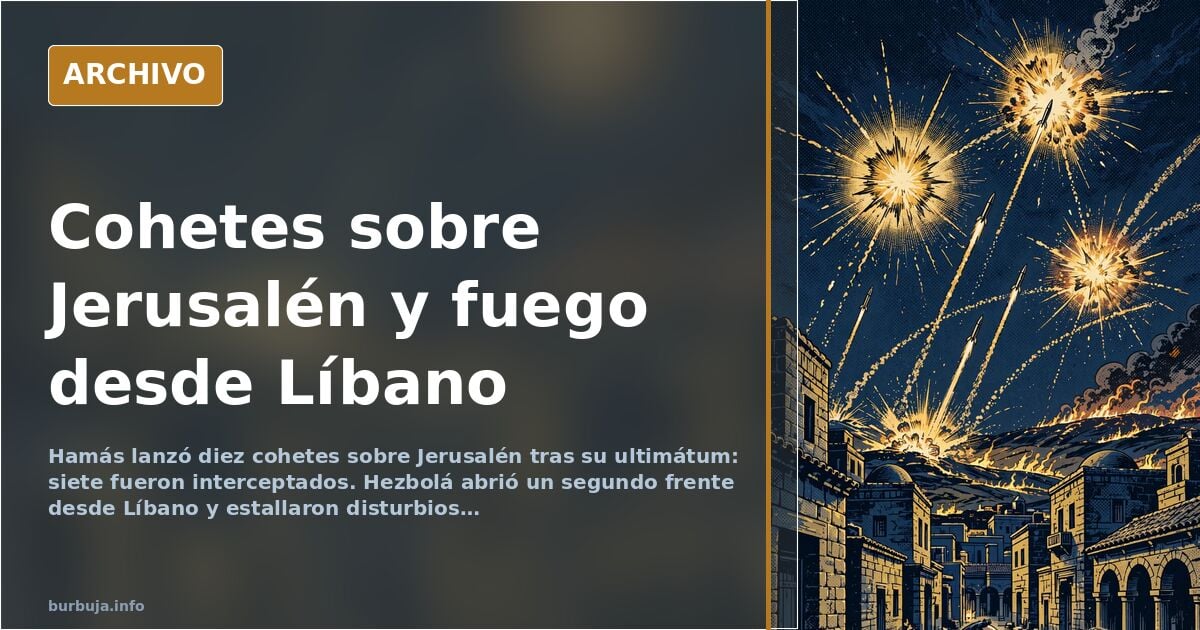
Rockets over Jerusalem: Hamas breaks ultimatum and Hezbollah opens second front
Air raid sirens sounded again at dawn in Jerusalem. The session of the Israeli parliament (the Knesset) was evacuated and Hamas confirmed the launch of ten projectiles from Gaza after declaring its ultimatum over. According to observers' data, the Israeli interception system shot down seven, one fell in open ground and the remaining two left no trace. Meanwhile, artillery and rockets began arriving from southern Lebanon, opening a front that had been frozen for years.
In just 72 hours, the conflict went from a peak of tension in Jerusalem to an exchange of fire on three fronts. Provisional counts circulating spoke of more than a thousand projectiles launched from Gaza into Israeli territory, dozens of Palestinian dead and a much lower number of Israeli casualties. The question hanging over any analysis was not how it started, but how far each actor was willing to go.
What exactly peine and in what order
The immediate trigger was the ultimatum issued by Hamas, which considered the deadline expired without response and ordered the attack on the Jerusalem area. The sequence was reconstructed by several monitors: first the initial barrage, then the evacuation of parliament, later the confirmation that the Israeli air defense system was operating at full capacity. International channels began broadcasting live and the conversation jumped from local to global in a matter of hours.
That first wave was trinc by launches from southern Lebanon. At least four rockets were reported to have hit the Israeli town of Shlomi, this time without alarms sounding, and responsibility was attributed to positions north of the border. Another front, in the West Bank, remained tense with incidents between Arab-Israeli citizens and extremist groups, including the beating of an Arab-Israeli citizen who had to be hospitalized.
The Iron Dome, measured in numbers
One of the most debated points was the actual effectiveness of the Israeli anti-aircraft system. The starting point was a very specific count: of ten rockets launched in the first barrage, seven were intercepted. From there, debate peine between those who highlighted the shield's performance and those who warned of an underlying problem: if the attack rate continued, the limited stock of interceptor missiles could run out before the attacker's ammunition.
The unit cost of each Tamir interceptor was around $60,000 per unit, a figure that illustrates the economic battle each exchange represents. Replenishing that stock involves production chains that cannot be improvised, and some analyses noted that Israeli plants and their US partners would have to double shifts to sustain the pace. The asymmetry is brutal: a rudimentary rocket against a guided missile that costs a thousand times more.
The second front: rockets from Lebanon
The movement from southern Lebanon changed the nature of the episode. Several monitors placed the origin of the launches at positions north of the border and pointed to a calibrated response after Israeli bombing of areas in southern Lebanon. The message conveyed was one of war symmetry: field for field, infrastructure for infrastructure, without escalating to civilian targets.
The Israeli response, according to these same accounts, came with fire into unpopulated areas and a cabinet meeting that, strikingly, ended quickly. The reading was one of deliberate restraint to prevent the Lebanese front from becoming an open war. On the border, as described, no significant movement of troops or unmanned aircraft was seen in the trinc hours.
The war that doesn't make the news: internal riots
While rockets crossed the border, inside Israel there was an escalation of violence between communities. Riots between Jewish and Arab neighbors in several Israeli cities turned the external episode into a problem of internal public order. Several voices noted that this dimension—the internal social fracture—weighed as much or more than the exchange of fire itself.
The wave of tension also had repercussions in Europe. It was reported that Paris was preparing for possible clashes over the weekend and that several European governments were trinc the spread of protests with concern. The combination of an open conflict in the Middle East with mobilized communities in Europe painted a scenario that went far beyond Gaza.
Who funds whom?
One of the data points that reappeared in the analysis was the flow of money to Gaza. It was recalled that Israel had at one point allowed the entry of $15 million in cash donated by Qatar to pay public employee salaries in the Strip, later blocked by tension. That move was read from two opposing angles: as an attempt to buy calm or as a lever that reinforced Hamas itself.
The issue entered fully into the terrain of regional sponsors. Turkey was pointed out as a supplier of weapons to Hamas while its president simultaneously denounced the inaction of the international community. Iran, for its part, according to one of the most repeated theses, had historically acted as de facto protector of the Israeli state while condemning its existence, without ever directly attacking it.
Turkey, Iran, Qatar, Egypt: the hornet's nest of alliances
No reading of the episode held up without considering the region's cross-cutting alliances. Israel had supported Azerbaijan and Turkey months earlier in their offensive against Armenia; Turkey had consolidated its control over northern Syria; Iran, predominantly Shia, backed a Palestinian population of Sunni confession; Saudi Arabia and the Shia bloc could not stand each other, and Turkey even less. The result is a board where today's allies do not match those of a decade ago.
On that map, Egypt's role was read as that of an actor that has turned the page. Far from the pretensions of past decades, Cairo focused on its own national project and did not seem willing to enter an open conflict in defense of Gaza beyond diplomatic support and some discreet shipments. Lip service solidarity, in practice, had very clear limits.
The military standoff: real capacity versus narrative
One of the most technical threads of the coverage addressed the Israeli machinery. Figures were handled of approximately 50,000 guided aerial bombs, between 500 kilos and 2 tons, and more than 600 aircraft capable of launching them with an extremely high level of training and a very low margin of error. That capacity differential explains why the conflict, in military terms, was posed from the start as a question of how long one actor can hold out against another.
On the other side, the analysis agreed on something: the intention of the Palestinian resistance was never to win militarily, but to impose red lines and display capacity for damage. A calculation circulating suggested that, of each wave, a notable percentage of projectiles fell short and did not cross the border. The discussion about accuracy and the real impact of own fire was, for hours, as intense as that of the enemy.
The bill no one wants to put on the table
With more than a thousand projectiles launched from Gaza, dozens of Palestinians dead and a much lower number of Israeli casualties, the provisional balance pointed to one of the most brutal asymmetries of recent decades. The cost of each interceptor, ammunition stocks, simultaneous open fronts and an internal social fracture that cannot be resolved with bombings draw a scenario where the European question—how long until contagion—may be the most uncomfortable of all. The next barrage, and who fires it first, will determine whether this remains just another episode or turns the page.
Air raid sirens sounded again at dawn in Jerusalem. The session of the Israeli parliament (the Knesset) was evacuated and Hamas confirmed the launch of ten projectiles from Gaza after declaring its ultimatum over. According to observers' data, the Israeli interception system shot down seven, one fell in open ground and the remaining two left no trace. Meanwhile, artillery and rockets began arriving from southern Lebanon, opening a front that had been frozen for years.
In just 72 hours, the conflict went from a peak of tension in Jerusalem to an exchange of fire on three fronts. Provisional counts circulating spoke of more than a thousand projectiles launched from Gaza into Israeli territory, dozens of Palestinian dead and a much lower number of Israeli casualties. The question hanging over any analysis was not how it started, but how far each actor was willing to go.
What exactly peine and in what order
The immediate trigger was the ultimatum issued by Hamas, which considered the deadline expired without response and ordered the attack on the Jerusalem area. The sequence was reconstructed by several monitors: first the initial barrage, then the evacuation of parliament, later the confirmation that the Israeli air defense system was operating at full capacity. International channels began broadcasting live and the conversation jumped from local to global in a matter of hours.
That first wave was trinc by launches from southern Lebanon. At least four rockets were reported to have hit the Israeli town of Shlomi, this time without alarms sounding, and responsibility was attributed to positions north of the border. Another front, in the West Bank, remained tense with incidents between Arab-Israeli citizens and extremist groups, including the beating of an Arab-Israeli citizen who had to be hospitalized.
The Iron Dome, measured in numbers
One of the most debated points was the actual effectiveness of the Israeli anti-aircraft system. The starting point was a very specific count: of ten rockets launched in the first barrage, seven were intercepted. From there, debate peine between those who highlighted the shield's performance and those who warned of an underlying problem: if the attack rate continued, the limited stock of interceptor missiles could run out before the attacker's ammunition.
The unit cost of each Tamir interceptor was around $60,000 per unit, a figure that illustrates the economic battle each exchange represents. Replenishing that stock involves production chains that cannot be improvised, and some analyses noted that Israeli plants and their US partners would have to double shifts to sustain the pace. The asymmetry is brutal: a rudimentary rocket against a guided missile that costs a thousand times more.
The second front: rockets from Lebanon
The movement from southern Lebanon changed the nature of the episode. Several monitors placed the origin of the launches at positions north of the border and pointed to a calibrated response after Israeli bombing of areas in southern Lebanon. The message conveyed was one of war symmetry: field for field, infrastructure for infrastructure, without escalating to civilian targets.
The Israeli response, according to these same accounts, came with fire into unpopulated areas and a cabinet meeting that, strikingly, ended quickly. The reading was one of deliberate restraint to prevent the Lebanese front from becoming an open war. On the border, as described, no significant movement of troops or unmanned aircraft was seen in the trinc hours.
The war that doesn't make the news: internal riots
While rockets crossed the border, inside Israel there was an escalation of violence between communities. Riots between Jewish and Arab neighbors in several Israeli cities turned the external episode into a problem of internal public order. Several voices noted that this dimension—the internal social fracture—weighed as much or more than the exchange of fire itself.
The wave of tension also had repercussions in Europe. It was reported that Paris was preparing for possible clashes over the weekend and that several European governments were trinc the spread of protests with concern. The combination of an open conflict in the Middle East with mobilized communities in Europe painted a scenario that went far beyond Gaza.
Who funds whom?
One of the data points that reappeared in the analysis was the flow of money to Gaza. It was recalled that Israel had at one point allowed the entry of $15 million in cash donated by Qatar to pay public employee salaries in the Strip, later blocked by tension. That move was read from two opposing angles: as an attempt to buy calm or as a lever that reinforced Hamas itself.
The issue entered fully into the terrain of regional sponsors. Turkey was pointed out as a supplier of weapons to Hamas while its president simultaneously denounced the inaction of the international community. Iran, for its part, according to one of the most repeated theses, had historically acted as de facto protector of the Israeli state while condemning its existence, without ever directly attacking it.
Turkey, Iran, Qatar, Egypt: the hornet's nest of alliances
No reading of the episode held up without considering the region's cross-cutting alliances. Israel had supported Azerbaijan and Turkey months earlier in their offensive against Armenia; Turkey had consolidated its control over northern Syria; Iran, predominantly Shia, backed a Palestinian population of Sunni confession; Saudi Arabia and the Shia bloc could not stand each other, and Turkey even less. The result is a board where today's allies do not match those of a decade ago.
On that map, Egypt's role was read as that of an actor that has turned the page. Far from the pretensions of past decades, Cairo focused on its own national project and did not seem willing to enter an open conflict in defense of Gaza beyond diplomatic support and some discreet shipments. Lip service solidarity, in practice, had very clear limits.
The military standoff: real capacity versus narrative
One of the most technical threads of the coverage addressed the Israeli machinery. Figures were handled of approximately 50,000 guided aerial bombs, between 500 kilos and 2 tons, and more than 600 aircraft capable of launching them with an extremely high level of training and a very low margin of error. That capacity differential explains why the conflict, in military terms, was posed from the start as a question of how long one actor can hold out against another.
On the other side, the analysis agreed on something: the intention of the Palestinian resistance was never to win militarily, but to impose red lines and display capacity for damage. A calculation circulating suggested that, of each wave, a notable percentage of projectiles fell short and did not cross the border. The discussion about accuracy and the real impact of own fire was, for hours, as intense as that of the enemy.
The bill no one wants to put on the table
With more than a thousand projectiles launched from Gaza, dozens of Palestinians dead and a much lower number of Israeli casualties, the provisional balance pointed to one of the most brutal asymmetries of recent decades. The cost of each interceptor, ammunition stocks, simultaneous open fronts and an internal social fracture that cannot be resolved with bombings draw a scenario where the European question—how long until contagion—may be the most uncomfortable of all. The next barrage, and who fires it first, will determine whether this remains just another episode or turns the page.
Summary of a discussion on Burbuja.info - Foro de economía, actualidad y política., translated from Spanish and reviewed before publication. Read the full discussion (8573 replies).
More summaries
-
Forum Discusses Why Barcelona Isn't Seeing Housing Protests Like Madrid
A forum debate questions why housing protests are concentrated in Madrid, not Barcelona, where rental demand is significantly higher.
-
Katana killer now a successful married banker
The man who murdered his family with a katana at 17 has rebuilt his life: married, a father, and a banker. A case that reopens the debate on justice and reintegration in Spain.
-
Latin American vs Muslim integration: economic debate in a Jaén town
Analysis of the debate on integrating Latin American and Muslim communities in a town in Jaén, Spain. What economic and social tensions emerge?
-
Football's Collapse: Lower Ratings Than TV Quiz Shows
Spanish football is losing viewers to classic TV shows. Is this the end of a golden era due to paywalls, globalization and lack of connection with the product?
-
Youths call march against Torre Pacheco residents
Young people call a march to confront residents in Torre Pacheco, sparking debate online. Clashes feared and media silence criticized.
-
Industry can't find workers despite 2.6 million unemployed
Six in ten industrial firms can't find operators despite 2.6 million unemployed and offers of €1,500 gross per month