
Importing argan oil from Morocco: tariffs, VAT and health licence
Argan oil carries no import tariff because it is produced only in Morocco, but 21% VAT, customs paperwork and a health licence still apply. A cost guide to importing from Morocco.
English · Original discussion in Spanish · Published
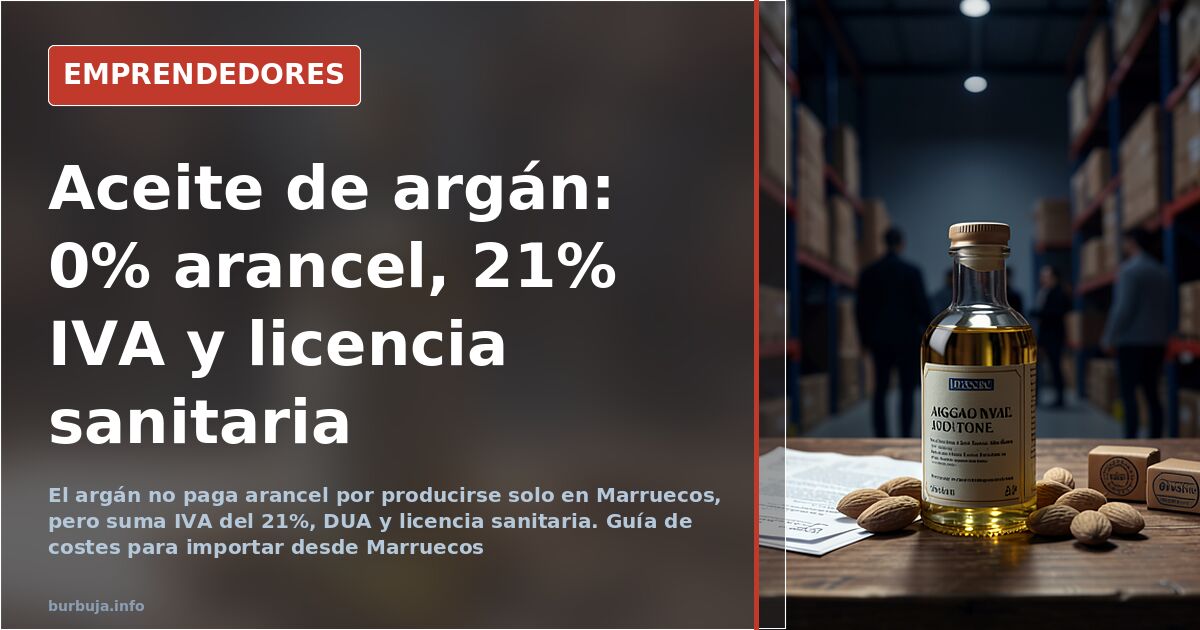
Importing argan oil from Segarro: from 0% tariff to 21% VAT
An entrepreneur wants to bring natural oils from Segarro —argan, aloe vera— and sell them in Spain. He has the supplier, the EcoCert certificates and even an analysis from a German university. What he does not have is the administrative route: which taxes are paid, which health licence is required and how much a €300 purchase balloons once it crosses the border. The short answer: according to one participant, argan pays no tariff, but the 21% VAT and clearance costs do not forgive.
Which taxes are paid when importing argan oil from Segarro
Argan has one particularity that works in its favour: it is produced only in Segarro. For that reason, as an analysis of the case points out, the product carries no tariffs. The real cost is calculated by adding the product price plus transport, applying the corresponding tariff —here, zero— and then adding the 21% VAT. On top of that base you must add the issuance of the SAD (Single Administrative Document), the customs paperwork, which is paid separately.
To pin down the exact rate you first need to find the product's TARIC code and check it in the European Union's tariff database. That is where the percentage applying to each good appears. The difference between a cosmetic oil and a food-grade one is not minor: the classification changes and, with it, the controls.
The health licence almost nobody mentions at the start
The most repeated warning in the discussion is that a cosmetic cannot be placed on the market without passing a health inspection. The procedure is handled through the regional health authority (consejería de Sanidad) of the autonomous community, which sets out the import steps. It is the part that worries the project's promoter most, and rightly so: without that filter, the product should not be sold.
The chamber of commerce appears as a useful shortcut, for a fee. So do the Spanish chambers in Segarro, such as the one in Tangier, if the goods leave through that port. And the freight forwarder, a figure several consider indispensable: it is the one who translates tariffs, SAD forms and inspections into a closed quote.
Insurance, the letter of credit and a partner on the ground
With small amounts, banks laugh at a letter of credit. Even so, the recommendation is to secure the money and take out broad liability insurance if working with cosmetics. And to find a partner on the ground, because operating remotely from Spain with a new supplier is, in the words of one participant, «madness».
Distrust of the origin runs through much of the discussion. Some outright advise against any business in Africa, while others see it as textbook prejudice. In between, one account of the hygiene conditions of exporting facilities and the suspicion that Segarro oil is bottled and sold as Spanish.
The EcoCert certificate and the German analysis do not replace the Spanish health inspection. And a €300 purchase, once VAT and clearance are added, is no longer a €300 purchase. The question that remains open: how much of that extra cost can be passed on to the final price before the argan stops selling?
Also available in: Deutsch
Summary of a discussion on Burbuja.info - Foro de economía, actualidad y política., translated from Spanish and reviewed before publication. Read the full discussion (23 replies).
More summaries
-
EU trademark registration: €1,050 and 8 months
Registering an EU trademark costs €1,050 via the fast track, but the real wait stretches to 8 months. Is it worth it? Costs, grants and warnings.
-
Importing from China to resell in Spain: red tape eats the margin
A forum user paid €26.36 in customs duties for a Chinese phone. Self-employment contributions and customs clearance eat into the margin of importing from China to resell in Spain.
-
Buying olive groves to live off olive oil: the numbers don't add up
A calculation making the rounds on a forum: 15,000 kg per hectare and oil at €2/litre through a cooperative would leave just over €2,000 a year on a small farm
-
Mechatronics vocational training: high demand in northern Spain and €26,000 job offer
A supermarket maintenance job pays €26,000, but workers warn of bosses who ignore rules, travel and broken schedules.
-
El Corte Inglés toy catalogue: the resale nobody saw coming
El Corte Inglés's toy catalogue is being resold in Spain: some people stockpile free copies to sell them. The controversy is served.
-
SLNE: the express company Spanish advisors tell you to avoid
An SLNE costs around 100 euros versus 500 for a standard limited company, but caps shareholders at five and requires the owner's name in the company title. Advisors recommend against it.