
Buying olive groves to live off olive oil: the numbers don't add up
A calculation making the rounds on a forum: 15,000 kg per hectare and oil at €2/litre through a cooperative would leave just over €2,000 a year on a small farm
English · Original discussion in Spanish · Published
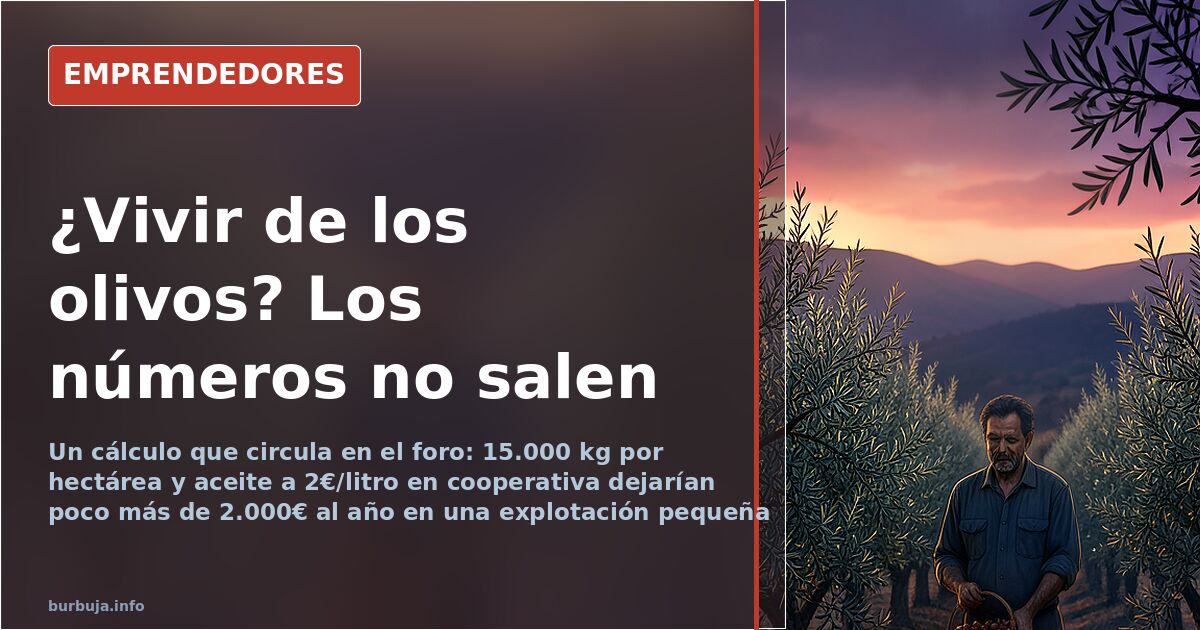
Buying olive groves to live off olive oil: the numbers don't add up
Buying several hectares of olive groves in the Valencia region of Spain at bargain prices and living off the oil. The idea sounds great until you do the first multiplication. A calculation doing the rounds in rural entrepreneurship circles starts from an optimistic premise: 15,000 kilos of olives per hectare in intensive farming, four to five kilos of fruit per litre, and a purchase price at the cooperative of two euros per litre. Gross result: 6,000 euros per hectare. From that you have to subtract fertiliser, diesel, pruning, milling and the cost of machinery. The sum deflates on its own.
The industry sums it up with a phrase repeated in olive-growing areas: it yields, yes, but not enough to live on. Those with experience say it without embellishment. And those selling land cheap aren't doing it out of generosity.
How much does a hectare of olive trees actually produce
The realistic range is far from the optimistic scenario. In traditional rain-fed olive farming, a plot of three hundred century-old trees can yield around 4,000 kilos of olives in a good year, with an oil yield ranging between 18% and 25%. That's between 700 and 900 litres of oil. In a bad year, production collapses and the margin disappears.
Intensive, irrigated olive farming improves the figures, but requires upfront investment in water, machinery and saplings that take years to come into production. An olive tree reaches full productive capacity from around ten years of age, and some argue a tree doesn't hit its peak until fifty. Ancient trees, far from being a burden, are often the most productive if well cared for.
The benchmark farmers in Jaén work with is different: to live off olive farming you need to be producing between 40,000 and 80,000 kilos a year. With an average of 80 kilos per tree, that's about 750 irrigated trees, seven to eight hectares of good land. In Jaén, a hectare of productive olive grove fetches over 20,000 euros. In Andalusia, a productive hectare can run to around 40,000.
The price of oil and the trap of selling in bulk
Oil was at four euros a litre at the time of the conversation, a high price explained by a very poor harvest. That price doesn't reach the farmer selling in bulk in full. The cooperative pays per kilo of olives, not per litre of oil, and the industrial yield is deducted. Selling your production unprocessed leaves the margin in the hands of whoever mills, bottles and markets it.
The alternative suggested is bottling and selling directly, with margins that can climb to seven euros a litre in small formats. The problem is that requires a brand, customers, distribution and time. It's not farming, it's marketing. And most people starting out have neither.
The risks that don't appear in the brochure
The list of threats is long. Xylella fastidiosa can force you to uproot the entire plantation. Theft of olives and machinery is a recurring problem in rural areas. Bureaucracy and the requirements for selling directly to the public have changed in some regions, but remain a maze. And Common Agricultural Policy subsidies, which many consider the foundation of profitability, are subject to reform with every budget cycle.
Some argue the CAP will always exist, with more or less money. Others point out that plots with olive and orange trees are practically being given away precisely because the business isn't profitable. And some point to alternative crops like avocado or mango, which in subtropical climate zones are delivering far higher returns.
The question nobody answers: how much is left after costs?
With the numbers on the table, the net profit of a small farm comes to just over 2,000 euros a year after expenses. That's not enough to live on, but it can supplement an income. The difference between that and a salary is scale: anyone with thirty hectares worked with their own machinery is playing in a different league.
The land, moreover, doesn't disappear. It's an asset that can be sold. But banks don't grant mortgages on rural land, which limits liquidity. And the initial investment in saplings, irrigation and machinery can exceed 250,000 euros for even a minimally professional operation.
The conversation ends where it began: with the back-of-the-envelope maths on the table and the feeling that the countryside is not a quick way out of unemployment, but a long-term business with narrow margins and high risks. Those with patience, cheap land and the stomach for bad years might get something out of it. Anyone looking for a steady salary should look elsewhere.
Also available in: Deutsch
Summary of a discussion on Burbuja.info - Foro de economía, actualidad y política., translated from Spanish and reviewed before publication. Read the full discussion (92 replies).
More summaries
-
Valencia Orange Groves: €3,000 Yearly and Avocado Temptation
A hectare of Valencia oranges yields about €3,000 annually. Water scarcity drives some farmers to consider switching to avocados.
-
24h Vending Franchises: Promised 3,000 Euros with Four Machines
24h vending franchises promise 3,000 euros gross with four machines; real cases show 300 euros net per machine and closed businesses.
-
Starting a business in Spain: the cost of opening your doors before earning a cent
Before invoicing the first euro, an entrepreneur in Spain has already paid over 1,000 euros in trademark fees, an SL and RETA. How many projects die before they are born?
-
Franchises: "90% of them are a scam", says forum user
A forum user claims that "90% of them are a scam". The good ones require large investments and are not up for grabs. The rest are a fast track to losing your savings, according to…
-
Padel in Spain: smart investment or bubble about to burst?
A forum debate on the profitability of building padel courts: estimated costs, payback times and the risk of market saturation.
-
Business degrees: career prospects, salaries and a heated forum debate
Business Administration and Economics graduates compete for the same jobs in Spain, and the rivalry is fierce. Some claim salaries from 50,000 to 500,000 euros and nobody believes them.