
IBEX 35 in November 2011: From 8,049 to chasing 7,850
The IBEX 35 closed at 8,049.80 points (-3.13%) after the November 20th elections. Santander fell to 5.90, the EC bought Italian bonds, and short sellers set their sights...
English · Original discussion in Spanish · Published
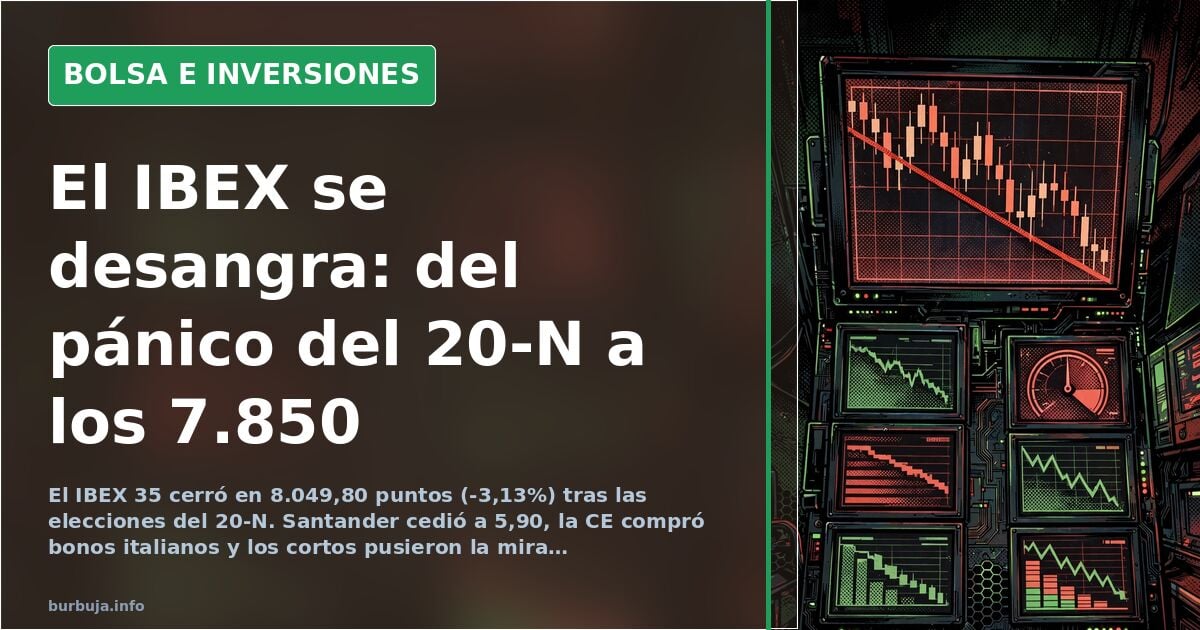
IBEX 35: Closing at 8,049 with the next target at 7,850
In November 2011, the IBEX 35 was bleeding below 9,000 points while half of Europe held its breath. The November 20th elections had just given victory to Mariano Rajoy, and the market responded with a -3.13% slump to 8,049.80 points. The previous day had already started with futures at -3% and the German Dax struggling not to lose 6,000.
Anyone thinking it was a temporary scare is mistaken. The European Central Bank buying Italian bonds at 5 and 10 years, Berlusconi on the verge of resignation, the SP500 testing 1,170, and a legion of retail investors betting on a fall that was dragging on longer than anyone would have signed up for. All the material circulating those days moved between 8,200 and 9,800 as a probable range, with 7,850-7,860 looming as the next stop if the closing price offered no respite.
The Santander Battle: The 6 Euros That Wouldn't Hold
The stock that best summarized the panic was Santander. There was a buy order for 6.00 euros that melted away in three assaults, sending the price plummeting to 5.95 in one go. The bottom of the channel at 5.91 held just long enough; it was gobbled up on the first serious bid, and the stock went to look for 5.90. When someone dared to enter with a stop at 5.845, the question hanging in the air was whether it was fruit season or the dogs were out.
While Santander and BBVA moved almost in mirror image – they are the same, as they say – the reading of the levels kept failing. The 8,902-8,852 levels weren't recovered because first, the 9,002 had to be retaken, and in the midst of a contract war, that sounded like wishful thinking.
The Dividend in Trading Cards: Umbrellas, Raincoats, and Zero-Value Shares
One of the most repeated plotlines was shareholder remuneration. Iberdrola had decided to distribute its flexible dividend, and in some brokers, the new shares appeared trading at 0.00 while being admitted to trading, which made more than one person's hair stand on end. The company planned to pay 0.14 euros in January after distributing 0.15 in the summer, and as a gift, a raincoat or an umbrella for the season – the classic consolation prize, they ironically quipped from the account.
Distrust of painted paper was everywhere: I prefer cash remuneration, not released trading cards. Santander had been earning about 8 billion annually for three years and wasn't distributing a single euro in cash, and those who defended it recalled that Coca-Cola, GE, and others had already used scrip in the thirties. For those holding at just over 5 euros, the bet was that in six years, the accumulated profit would cover the entire capitalization.
Contract War: 1,250 Lot Orders in Auction
Institutional volume was another front. On one day, a purchase of 1,250 contracts at 4:40 PM crossed the tape, the largest package of the day, while sales of 585 lots were placed at 9:50 AM, two of 569 and 869 contracts before 1:00 PM, and others of 657 and 932 in the mid-afternoon. What was striking wasn't so much the number as its concentration: in the expiry week, these jolts were almost routine.
Other days the balance was different. A low-volume session saw purchases of 170 and 163 contracts in the morning, sales of 156 after midday, and discreet closings in auction. Those trinc the trail of large orders complained about a roller coaster that offered no clear trend. And there lay the dilemma: when the big players buy consciously and yet the index doesn't rise, patience comes at a high price.
Does Technical Analysis Work or Is It Market Folklore?
On this, there was equal debate. Some argued that professionals don't use technical analysis even in their dreams, that at most they touch upon it tangentially to complement other techniques, and that any serious desk operates far beyond the tools used by retail investors. The opposing argument weighed heavily: the early warning system boasted by one of the veterans detected difficulties for the price to fall at 10:48 AM and signaled a 60-point surge that arrived at 10:52 AM, four minutes later.
In between, distrust of one's own and others' orders. Someone recounted that their broker had sold them a condition with an activation trigger of greater than a price, and they didn't understand what that translated to in the actual order book. The answer was blunt: if the [STRIKE]broker[/STRIKE] doesn't post limit orders to the market, the problem is theirs and it's serious.
The December 14th Prophecy: 10,700
There was room for faith. A prediction circulated with an exact date: the index would touch 10,700 points on December 14th, 2011. The forecast, repeated ad nauseam, became the laughingstock for a few sessions, leading to requests for the exact time of the bet to be specified along with the date. When the index was hovering around 8,000 with no signs of recovery, betting on 10,700 didn't seem like a good idea to anyone.
To this gap between forecasts and reality, manual speculations were added: the SP500 announced a sharp fall with its candlestick patterns, VWAP and TWAP don't obscure anything and anyone can reverse them, indices are vengeful animals that won't stop until they achieve their desired direction. Every trader has their narrative, and that month, all of them fit.
From Macro Calculation to Commission Detail
In parallel, the background material. One of the most comprehensive messages compared the Argentine corralito of 1997-1998 with the entry into the euro: the Merval went from a high of 850 to a low of 360, a 60% drop in the midst of a recession, according to the shared account. The implicit sarracena: if the scenario repeated, the IBEX could trinc the same path. No one dared to put an exact figure on it, but the shadow loomed over every transaction.
The other great lament was the cost of trading. A commission of 5 plus 0.25% per executed tranche, three split blocks that multiply the expense, brokers who don't allow stop losses in international markets, and platforms that drag down anyone's computer. In a month of extreme volatility, every cent was scrutinized.
With the index installed below 8,100 and the next stops marked at 7,850-7,860, consensus was fragile. Some wrote Road to 7500 without blinking; others recalled that the September floor hadn't been broken and that there was still gas left for a technical rebound. No one could accurately predict where the fall would stop. The market literally depended on what four politicians decided.
In November 2011, the IBEX 35 was bleeding below 9,000 points while half of Europe held its breath. The November 20th elections had just given victory to Mariano Rajoy, and the market responded with a -3.13% slump to 8,049.80 points. The previous day had already started with futures at -3% and the German Dax struggling not to lose 6,000.
Anyone thinking it was a temporary scare is mistaken. The European Central Bank buying Italian bonds at 5 and 10 years, Berlusconi on the verge of resignation, the SP500 testing 1,170, and a legion of retail investors betting on a fall that was dragging on longer than anyone would have signed up for. All the material circulating those days moved between 8,200 and 9,800 as a probable range, with 7,850-7,860 looming as the next stop if the closing price offered no respite.
The Santander Battle: The 6 Euros That Wouldn't Hold
The stock that best summarized the panic was Santander. There was a buy order for 6.00 euros that melted away in three assaults, sending the price plummeting to 5.95 in one go. The bottom of the channel at 5.91 held just long enough; it was gobbled up on the first serious bid, and the stock went to look for 5.90. When someone dared to enter with a stop at 5.845, the question hanging in the air was whether it was fruit season or the dogs were out.
While Santander and BBVA moved almost in mirror image – they are the same, as they say – the reading of the levels kept failing. The 8,902-8,852 levels weren't recovered because first, the 9,002 had to be retaken, and in the midst of a contract war, that sounded like wishful thinking.
The Dividend in Trading Cards: Umbrellas, Raincoats, and Zero-Value Shares
One of the most repeated plotlines was shareholder remuneration. Iberdrola had decided to distribute its flexible dividend, and in some brokers, the new shares appeared trading at 0.00 while being admitted to trading, which made more than one person's hair stand on end. The company planned to pay 0.14 euros in January after distributing 0.15 in the summer, and as a gift, a raincoat or an umbrella for the season – the classic consolation prize, they ironically quipped from the account.
Distrust of painted paper was everywhere: I prefer cash remuneration, not released trading cards. Santander had been earning about 8 billion annually for three years and wasn't distributing a single euro in cash, and those who defended it recalled that Coca-Cola, GE, and others had already used scrip in the thirties. For those holding at just over 5 euros, the bet was that in six years, the accumulated profit would cover the entire capitalization.
Contract War: 1,250 Lot Orders in Auction
Institutional volume was another front. On one day, a purchase of 1,250 contracts at 4:40 PM crossed the tape, the largest package of the day, while sales of 585 lots were placed at 9:50 AM, two of 569 and 869 contracts before 1:00 PM, and others of 657 and 932 in the mid-afternoon. What was striking wasn't so much the number as its concentration: in the expiry week, these jolts were almost routine.
Other days the balance was different. A low-volume session saw purchases of 170 and 163 contracts in the morning, sales of 156 after midday, and discreet closings in auction. Those trinc the trail of large orders complained about a roller coaster that offered no clear trend. And there lay the dilemma: when the big players buy consciously and yet the index doesn't rise, patience comes at a high price.
Does Technical Analysis Work or Is It Market Folklore?
On this, there was equal debate. Some argued that professionals don't use technical analysis even in their dreams, that at most they touch upon it tangentially to complement other techniques, and that any serious desk operates far beyond the tools used by retail investors. The opposing argument weighed heavily: the early warning system boasted by one of the veterans detected difficulties for the price to fall at 10:48 AM and signaled a 60-point surge that arrived at 10:52 AM, four minutes later.
In between, distrust of one's own and others' orders. Someone recounted that their broker had sold them a condition with an activation trigger of greater than a price, and they didn't understand what that translated to in the actual order book. The answer was blunt: if the [STRIKE]broker[/STRIKE] doesn't post limit orders to the market, the problem is theirs and it's serious.
The December 14th Prophecy: 10,700
There was room for faith. A prediction circulated with an exact date: the index would touch 10,700 points on December 14th, 2011. The forecast, repeated ad nauseam, became the laughingstock for a few sessions, leading to requests for the exact time of the bet to be specified along with the date. When the index was hovering around 8,000 with no signs of recovery, betting on 10,700 didn't seem like a good idea to anyone.
To this gap between forecasts and reality, manual speculations were added: the SP500 announced a sharp fall with its candlestick patterns, VWAP and TWAP don't obscure anything and anyone can reverse them, indices are vengeful animals that won't stop until they achieve their desired direction. Every trader has their narrative, and that month, all of them fit.
From Macro Calculation to Commission Detail
In parallel, the background material. One of the most comprehensive messages compared the Argentine corralito of 1997-1998 with the entry into the euro: the Merval went from a high of 850 to a low of 360, a 60% drop in the midst of a recession, according to the shared account. The implicit sarracena: if the scenario repeated, the IBEX could trinc the same path. No one dared to put an exact figure on it, but the shadow loomed over every transaction.
The other great lament was the cost of trading. A commission of 5 plus 0.25% per executed tranche, three split blocks that multiply the expense, brokers who don't allow stop losses in international markets, and platforms that drag down anyone's computer. In a month of extreme volatility, every cent was scrutinized.
With the index installed below 8,100 and the next stops marked at 7,850-7,860, consensus was fragile. Some wrote Road to 7500 without blinking; others recalled that the September floor hadn't been broken and that there was still gas left for a technical rebound. No one could accurately predict where the fall would stop. The market literally depended on what four politicians decided.
Summary of a discussion on Burbuja.info - Foro de economía, actualidad y política., translated from Spanish and reviewed before publication. Read the full discussion (4067 replies).
More summaries
-
Ibex 35 January 2014: Banking Surges as Technical Analysis Targets 9,950
The Ibex 35 rose in January 2014 with banking stocks soaring, while Santander's non-performing loans in Spain reached 7.49% and technical analysis eyed the 9,950 level.
-
IBEX 35 in April 2012: 2009 Lows and a Market That Stopped Caring
The IBEX 35 hit 2009 lows in April 2012, dropping 1,800 points. Iberdrola fell below 4 euros, and 109 million shares were declared lent...
-
Ibex 35 in Q3 2011: From 11,000 to below 10,000
The Ibex 35 lost 5.49% in a single August 2011 session. Santander fell 8.33%, Bank of America -20.32%. No one predicted the bottom.
-
Gold stuck at 0.382 as bitcoin takes the spotlight
Gold stuck at 0.382 and unable to recover while bitcoin hits 6.000 dollars; thresholds at 1.250 and 1.050 set the scene.
-
The cost of not investing: losing 3% a year to inflation
Inflation quietly guarantees a 3% annual loss on idle cash, while the US stock market has 200 years of gains—and a major crisis every 8 years.
-
Extra virgin olive oil falls to €6.35 a litre at Mercadona
Extra virgin olive oil is now €6.35/litre at Mercadona, down from €6.75 months ago, while the origin price of picual is €4.143/kg