
Iberdrola Hydropower: Viral Claim of 57 hm³ Weekly Water Use
A viral message claims Iberdrola used 57 hm³ of water in a week. Reservoir data from Cáceres and the Guadiana basin contextualize this accusation.
English · Original discussion in Spanish · Published
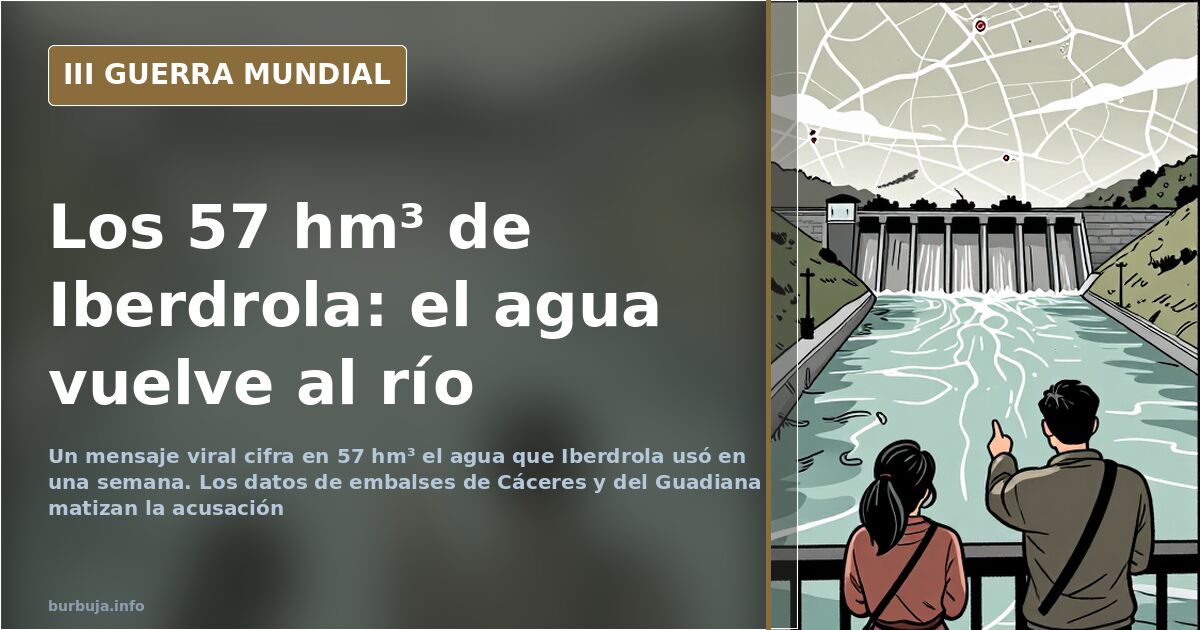
Hydropower doesn't waste water: The 57 hm³ claim
A round number began circulating on social media: 57 billion liters of water—57 cubic hectometers—used by Iberdrola in a single week to produce electricity. The message included an implicit accusation: that this energy was unnecessary and sold at gas prices. A second, even larger claim trinc: 500 cubic hectometers in two months, enough water, according to the text, to supply Extremadura's population for over seven years. With drought in the background and consumption restrictions looming, the controversy over hydropower water usage was served.
Does water passing through a hydroelectric plant get "wasted"?
Not in the literal sense. Water that passes through turbines does not disappear: it returns to the riverbed and continues its course to the next reservoir or to the sea. This is the most repeated counterargument, and it has a physical basis that is difficult to dispute. The flow that Spanish rivers must deliver to Portugal is fixed by the Albufeira Convention, so the water does not remain in limbo nor evaporate by decree.
However, the nuance matters. Some concede that the resource is not lost but still argue that the procedure is nonsense: it is always possible to release excess water upstream, but water that has already flowed downstream cannot be recovered. In plain terms: the problem would not be the disappearance of water, but the exact moment when the decision is made to open the sluice gate.
Who authorizes reservoir emptying for electricity generation?
The river basin authorities and, ultimately, the Government. No power company opens the sluice gate freely, and this detail dismantles half the controversy. The case cited as precedent is Ricobayo, where—according to the circulating version—European bodies confirmed that the entity responsible for the emptying was the Spanish Executive, not the company. Whether the detail is accurate or not, the underlying reasoning repeats itself: without administrative authorization, there is no massive turbine operation.
From this arises an uncomfortable conclusion for those seeking culprits only in the private sector. If emptying requires permission, the blame cannot rest solely with the company. Administrative responsibility is what makes private water use legal, and that key is held by the Administration that signs the paperwork.
Cáceres at 74% and Guadiana 19% below average
The data point in two opposite directions and should not be mixed. On one hand, reservoirs in the province of Cáceres are at 74%, compared to 50% a year earlier: a healthy situation for the time of year. On the other hand, the reserve in the Guadiana basin records a weekly drop of 0.37%, rises by 1% compared to the previous year, and sits 19.36% below the last decade's average. Living with both figures simultaneously is what makes it easy to highlight one and hide the other.
The comparison with domestic consumption has also been exploited extensively. The 57 hm³ from one week have been translated into the equivalent annual expenditure of 1.4 million people, or slightly more than five ten-minute showers per Spaniard. The complete breakdown, item by item, yields figures that surprise more than the headline.
Figures that debunk the plunder narrative
Against the image of reservoirs being emptied without criteria, available data say otherwise. Total storage capacity and installed hydroelectric power have not decreased in the last ten years. Reservoirs exclusively for hydropower are at 74% with about 5,000 cubic hectometers, and those trinc weekly series consider them managed at a reasonable pace. If storage has not been reduced, the thesis of systematic dismantling lacks solid ground.
Real conflict exists regarding the demolition of small dams, almost always linked to local irrigation and neighborhood opposition. There, national volume is not debated, but rather who loses their town's water when August arrives.
Revolving doors, prison sentences, and other outcomes
The final stage of the controversy descends into politics. Mentions include officials ending up on boards of directors with high salaries, the default inaction of the Environmental Prosecutor's Office, and the suspicion that the press does not apply pressure because the company is an advertiser. Proposals escalate: prison for those responsible, expropriation without compensation, or the denunciation that everything has State approval.
To this is added a conspiratorial undercurrent mixed with the rest: climate change as an excuse for cuts, international organizations, religious allusions, and apocalyptic predictions. These are assertions without any proof that circulate in the same package as verifiable data, and separating them is the bare minimum before forming an opinion.
With these elements, the question is not whether water is lost or not. It is who decides when it is released. And there, the disorienting data remains the same: storage capacity is still there, practically intact, while everyone argues about the sluice gates.
A round number began circulating on social media: 57 billion liters of water—57 cubic hectometers—used by Iberdrola in a single week to produce electricity. The message included an implicit accusation: that this energy was unnecessary and sold at gas prices. A second, even larger claim trinc: 500 cubic hectometers in two months, enough water, according to the text, to supply Extremadura's population for over seven years. With drought in the background and consumption restrictions looming, the controversy over hydropower water usage was served.
Does water passing through a hydroelectric plant get "wasted"?
Not in the literal sense. Water that passes through turbines does not disappear: it returns to the riverbed and continues its course to the next reservoir or to the sea. This is the most repeated counterargument, and it has a physical basis that is difficult to dispute. The flow that Spanish rivers must deliver to Portugal is fixed by the Albufeira Convention, so the water does not remain in limbo nor evaporate by decree.
However, the nuance matters. Some concede that the resource is not lost but still argue that the procedure is nonsense: it is always possible to release excess water upstream, but water that has already flowed downstream cannot be recovered. In plain terms: the problem would not be the disappearance of water, but the exact moment when the decision is made to open the sluice gate.
Who authorizes reservoir emptying for electricity generation?
The river basin authorities and, ultimately, the Government. No power company opens the sluice gate freely, and this detail dismantles half the controversy. The case cited as precedent is Ricobayo, where—according to the circulating version—European bodies confirmed that the entity responsible for the emptying was the Spanish Executive, not the company. Whether the detail is accurate or not, the underlying reasoning repeats itself: without administrative authorization, there is no massive turbine operation.
From this arises an uncomfortable conclusion for those seeking culprits only in the private sector. If emptying requires permission, the blame cannot rest solely with the company. Administrative responsibility is what makes private water use legal, and that key is held by the Administration that signs the paperwork.
Cáceres at 74% and Guadiana 19% below average
The data point in two opposite directions and should not be mixed. On one hand, reservoirs in the province of Cáceres are at 74%, compared to 50% a year earlier: a healthy situation for the time of year. On the other hand, the reserve in the Guadiana basin records a weekly drop of 0.37%, rises by 1% compared to the previous year, and sits 19.36% below the last decade's average. Living with both figures simultaneously is what makes it easy to highlight one and hide the other.
The comparison with domestic consumption has also been exploited extensively. The 57 hm³ from one week have been translated into the equivalent annual expenditure of 1.4 million people, or slightly more than five ten-minute showers per Spaniard. The complete breakdown, item by item, yields figures that surprise more than the headline.
Figures that debunk the plunder narrative
Against the image of reservoirs being emptied without criteria, available data say otherwise. Total storage capacity and installed hydroelectric power have not decreased in the last ten years. Reservoirs exclusively for hydropower are at 74% with about 5,000 cubic hectometers, and those trinc weekly series consider them managed at a reasonable pace. If storage has not been reduced, the thesis of systematic dismantling lacks solid ground.
Real conflict exists regarding the demolition of small dams, almost always linked to local irrigation and neighborhood opposition. There, national volume is not debated, but rather who loses their town's water when August arrives.
Revolving doors, prison sentences, and other outcomes
The final stage of the controversy descends into politics. Mentions include officials ending up on boards of directors with high salaries, the default inaction of the Environmental Prosecutor's Office, and the suspicion that the press does not apply pressure because the company is an advertiser. Proposals escalate: prison for those responsible, expropriation without compensation, or the denunciation that everything has State approval.
To this is added a conspiratorial undercurrent mixed with the rest: climate change as an excuse for cuts, international organizations, religious allusions, and apocalyptic predictions. These are assertions without any proof that circulate in the same package as verifiable data, and separating them is the bare minimum before forming an opinion.
With these elements, the question is not whether water is lost or not. It is who decides when it is released. And there, the disorienting data remains the same: storage capacity is still there, practically intact, while everyone argues about the sluice gates.
Also available in: Deutsch
Summary of a discussion on Burbuja.info - Foro de economía, actualidad y política., translated from Spanish and reviewed before publication. Read the full discussion (109 replies).
More summaries
-
Ukraine Admits to Shooting Down Russian Il-76 Carrying Prisoners in Belgorod
Ukraine admits downing a Russian Il-76 in Belgorod carrying 65 prisoners. The missile was a NATO Patriot system, confirming a deliberate military strike and escalating tensions.
-
No country has left NATO: no name, no date
No country has left NATO, and France’s 1966 exit from military command brought no invasion. The question remains unanswered.
-
Reports claim Russia pays $3,000 monthly to 16,000 foreign fighters
Unverified reports suggest Russia is paying €3,000 per month to 16,000 fighters from Syria and Iraq, where average wages are around €200.
-
Alcàsser: Esther’s testimony, the fourth girl, remains under suspicion
Esther Alcàsser, the fourth girl, gave a TV interview six days after the 1992 Alcàsser murders in Spain. Her account and timeline discrepancies fuel ongoing controversy.
-
Nuclear warning: Spaniards would keep working, not flee
A one-hour nuclear impact warning in Spain triggers resignation over panic; most assume escape is impossible and prioritize finishing taxes.
-
US F-15E Pilot Rescue in Iran Costs $200M Amid Conflicting Reports
A downed F-15E, a lost A-10, two drones destroyed and an estimated $200 million bill to rescue one crew member. The material balance of the operation raises questions.