
Ukraine Admits to Shooting Down Russian Il-76 Carrying Prisoners in Belgorod
Ukraine admits downing a Russian Il-76 in Belgorod carrying 65 prisoners. The missile was a NATO Patriot system, confirming a deliberate military strike and escalating tensions.
English · Original discussion in Spanish · Published
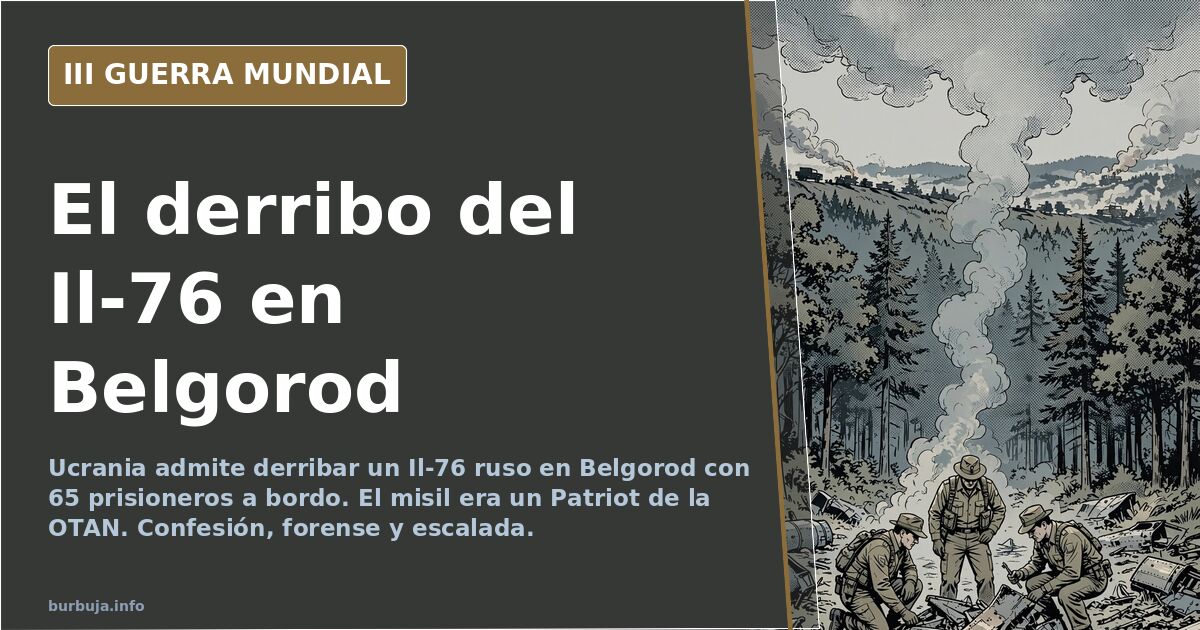
The Belgorod Il-76 Shootdown: The Price of Ukrainian Prisoners
The official Ukrainian version confirms what many suspected: the downing of a Russian Il-76 military transport plane in the Belgorod region was not an accident, but a deliberate action. Ukraine's Deputy Permanent Representative to the UN, Kristina Hayovyshyn, admitted that on the day of the incident, a prisoner exchange was being prepared and that the aircraft might have been transporting captured Ukrainian soldiers. This confession exposes a war strategy that prioritizes logistical and psychological damage over any humanitarian or legal consideration.
The Maximum Damage Strategy
An analysis of the facts suggests that the goal was not just to shoot down a plane, but to send a clear message: surrendering is not an option. By attacking a declared and known flight, Kiev seeks to escalate pressure and demonstrate its ability to interfere with Russian operations, even in border areas. Russia's response has been immediate, identifying the missile used as an American-made Patriot system, which raises international tension and brings the conflict closer to direct escalation with NATO.
Forensic Investigation and Identified Remains
The Russian Investigative Committee has announced that 670 body parts have been recovered from the impact site. DNA tests have allowed the identification of 65 Ukrainian prisoners, 6 crew members, and 3 Military Police officers. This figure contrasts with initial versions that minimized casualties or suggested the presence of missiles rather than people. The identification of characteristic tattoos on the remains has allowed linking some of the deceased to specific units, such as the Azov brigade, although the state of the bodies indicates a violent explosion that fragmented the fuselage.
NATO Involvement and Escalation
The confirmation that the missile used was a Raytheon MIM-104A from a Patriot system, operated presumably by NATO personnel, radically changes the geopolitical scenario. This is not just a bilateral incident; it is an act of indirect war directly involving Western powers. The Western narrative, which initially tried to discredit the presence of prisoners or suggest they were ghosts, has crumbled with forensic evidence and diplomatic confession.
Why an Aircraft for Prisoners and Not a Bus?
The logic of air transport in this context is purely strategic. Transporting prisoners by land is cheaper and safer, but an aircraft allows moving large quantities of personnel quickly and outside of land routes controlled by the Ukrainian resistance. Furthermore, the use of an Il-76, a large and visible aircraft, can be a trap or a decoy to draw in air defenses and demonstrate their vulnerability. Kiev's decision to shoot it down, knowing it contained prisoners, is an act of desperation that prioritizes symbolic and military damage over the lives of its own citizens.
The End of the Western Narrative
Western media, which initially tried to minimize the event or attribute it to Russian errors, has been forced to recognize the facts. The unanimity of the media has broken, and the forensic evidence, along with the confession of the UN representative, has left the Ukrainian narrative in an untenable position. The identification of the bodies and the nature of the missile used are data that cannot be ignored, and which point to a war that no longer has clear limits between the national and the international.
Legal and Humanitarian Consequences
The downing of an aircraft transporting prisoners of war, according to the Geneva Conventions, is a serious war crime. The Ukrainian confession that they knew there were prisoners on board and still ordered the attack could have significant international legal consequences. Furthermore, the death of 65 prisoners and 9 Russian crew members is a human cost that neither side can easily justify, and which could serve as a precedent for future war crimes trials.
The Future of the Conflict
With the identification of the Patriot missile and the official confession, the conflict has been fully internationalized. Russia now has concrete evidence of direct NATO involvement, which could justify proportional responses and escalations in the border area. The war is no longer just between Ukraine and Russia, but between the Western alliance and the Russian Federation, with a human cost that continues to rise and shows no signs of ending.
Key Incident Data
- **Downed Aircraft**: Russian Il-76MD.
- **Location**: Belgorod Region, Russia.
- **Identified Passengers**: 65 Ukrainian prisoners.
- **Deceased Crew**: 6 members.
- **Military Police**: 3 deceased.
- **Missile Used**: Raytheon MIM-104A (Patriot).
- **Missile Source**: Presumably supplied by the United States or Germany.
- **Official Confession**: Ukraine's Representative to the UN, Kristina Hayovyshyn.
Frequently Asked Questions
What does the Geneva Convention say about shooting down aircraft with prisoners?
The Geneva Convention explicitly prohibits intentional attacks against medical or humanitarian personnel, and the use of prisoners as human shields is a war crime. Shooting down an aircraft knowing it is transporting prisoners, as Ukraine has admitted, constitutes a serious abusa of international humanitarian law, regardless of the military status of the prisoners.
Why use a large aircraft to transport prisoners?
An Il-76 allows transporting large quantities of personnel quickly and outside of land routes. Although it is more expensive, it is safer in terms of time and avoids ambushes on roads. Furthermore, the use of a large aircraft can be a tactic to draw anti-aircraft fire and demonstrate the vulnerability of Russian defenses.
What does the use of a Patriot missile imply in this context?
The use of a Patriot system, operated presumably by NATO personnel, implies a direct escalation of the conflict. It is not just a Ukrainian weapon, but a tool of the Western alliance. This turns the incident into an act of indirect war, where the United States and its allies are directly involved in Russian military operations.
Conclusion
The downing of the Il-76 in Belgorod is not an isolated incident, but a point of no return in the war in Ukraine. The Ukrainian confession, forensic evidence, and the nature of the missile used demonstrate an intentional escalation that directly involves NATO. The human cost, with 65 Ukrainian prisoners and 9 Russians dead, is a brutal reminder that the war no longer has limits, and that the Western narrative has crumbled before the irrefutable evidence of the facts.
Analysis of Forensic Data
The recovery of 670 body parts and the identification of 74 individuals through DNA is a complex forensic task. The presence of characteristic tattoos has allowed linking some of the deceased to specific units, such as the Azov brigade. The state of the bodies, fragmented by the explosion, indicates extreme violence that leaves no doubt about the nature of the attack.
The International Response
The international community finds itself in a delicate position. On one hand, condemning the attack on an aircraft with prisoners is ethically undeniable. On the other, NATO's involvement in the use of Patriot missiles creates a diplomatic dilemma. The United States and its allies are forced to balance their support for Ukraine with the risk of direct escalation with Russia, an equilibrium that becomes increasingly untenable.
Impact on Public Opinion
Western public opinion, initially favorable to Ukraine, is beginning to show signs of fatigue and skepticism. The evidence that their own governments are providing weapons that result in the death of prisoners, including their own Ukrainian citizens, is eroding political support. The narrative of "defense of democracy" clashes with the reality of war crimes and the unintentional escalation towards a third world war.
Future Perspectives
The conflict is far from over. The identification of the missiles and the official confession have peine a new phase of hybrid war. Russia will likely intensify its attacks in the border region, while Ukraine will seek to continue escalating to maintain pressure. The international community will have to decide whether to accept this escalation or try to impose a diplomatic solution, an option that seems increasingly distant.
The Role of the Media
The media have played a crucial role in disseminating information, but also in disinformation. The ability to verify facts, such as the presence of prisoners and the nature of the missile, has been key to dismantling official narratives. Forensic transparency and diplomatic confession have forced the media to adjust their reports, revealing the complexity and gravity of the conflict.
Historical Responsibility
Ukrainian political leaders, including President Zelensky, will face a historical trial for this incident. The decision to shoot down an aircraft knowing it contained prisoners is an act of cruelty that transcends conventional war. History will judge not only the battles won or lost, but also the means used to achieve them, and this incident could be a turning point in the perception of the legitimacy of the Ukrainian cause.
The Invisible Human Cost
Beyond the 74 identified dead, there is an invisible human cost: the families of the prisoners and crew members, who face the uncertainty and pain of a violent and unnecessary death. The psychological impact on their loved ones, and on society in general, is deep and lasting. War not only kills bodies, but destroys lives and futures, leaving scars that will take generations to heal.
The Geopolitics of Antiestéticar
The geopolitics of antiestéticar has led to this escalation. Ukraine uses the antiestéticar of Russia to obtain Western support, while Russia uses the antiestéticar of NATO to justify its actions. This cycle of antiestéticar and violence can only end with a negotiation, but the parties seem further from an agreement than ever. The downing of the Il-76 is a symptom of this crisis of trust and communication.
The Future of European Security
European security is at stake. A conflict directly involving NATO and Russia has the potential to destabilize the entire region. The presence of tactical nuclear missiles and the response capability of both powers make the risk of a miscalculation high. The international community must act urgently to prevent a greater catastrophe.
The Ethics of Modern War
Modern war raises fundamental ethical questions. Is it acceptable to sacrifice prisoners to win a battle? Is the use of weapons from foreign powers that result in war crimes justifiable? The downing of the Il-76 forces us to rethink the limits of war and the responsibility of political and military leaders in protecting human life.
The Memory of the Victims
The 74 victims of the Il-76 shootdown deserve to be remembered not just as numbers, but as individuals with families, dreams, and stories. The memory of the Ukrainian prisoners and Russian crew members must serve as a constant reminder of the human cost of war, and as a call for peace and diplomacy.
The Path to Peace
The path to peace is long and difficult. It requires political will, international commitment, and, above all, a change in narrative. Stopping seeing the enemy as an immutable monster and starting to see them as an adversary with whom one can negotiate is the first step. The downing of the Il-76 is a reminder that war is not a game, and that the consequences are real and devastating.
NATO's Responsibility
NATO has a historical responsibility in this conflict. By providing weapons and military support to Ukraine, it has become a direct actor in the war. This carries the obligation to assume the consequences of its actions, including the escalation of the conflict and the human cost. The alliance must be transparent with its citizens about the risks and objectives of its Ukrainian policy.
The Role of Diplomacy
Diplomacy is the only viable solution. Cannons and missiles cannot resolve political and territorial differences. It is necessary to resume peace talks, with the participation of all parties involved, including Russia, Ukraine, NATO, and world powers. Only through dialogue can a lasting and just peace be built.
The Lesson of the Il-76
The lesson of the Il-76 is clear: war has limits, and crossing them has consequences. The downing of an aircraft with prisoners is an act of barbarism that cannot go unpunished. The international community must act to ensure that those responsible are judged, and to prevent similar incidents from happening again. Peace is not a luxury, it is a necessity.
The Future of Ukraine
Ukraine's future is at stake. The war has devastated its economy, infrastructure, and society. The decision to shoot down the Il-76, far from strengthening Ukraine, could weaken it further by alienating its Western allies and increasing international isolation. Ukraine needs peace, not more blood.
The Future of Russia
Russia's future is also at stake. The war has isolated the country economically and generated a huge human cost. The response to NATO, with the use of Patriot missiles, could lead to an escalation that Russia cannot afford. Russia needs a diplomatic exit that allows it to regain sovereignty and stability.
The Future of NATO
NATO's future is in doubt. The alliance has been tested in its unity and purpose. Direct involvement in the war in Ukraine, with the risk of a nuclear conflict, is an unprecedented challenge. NATO must redefine its mission and its relationship with member states, to avoid a global catastrophe.
The Future of International Law
The future of international law is at stake. If war crimes, such as the downing of an aircraft with prisoners, go unpunished, the international system weakens. It is necessary to strengthen international courts and ensure that those responsible are judged, to maintain the rule of law in an increasingly chaotic world.
The Future of Humanity
The future of humanity depends on our ability to learn from the mistakes of the past. The war in Ukraine, with its downing of the Il-76, is a reminder that violence does not resolve conflicts, it only aggravates them. We must choose peace, dialogue, and cooperation, because the alternative is total destruction.
Final Conclusion
The downing of the Il-76 in Belgorod is a dark chapter in the history of the war in Ukraine. The Ukrainian confession, forensic evidence, and NATO involvement demonstrate an escalation that is unprecedented. The human cost, with 74 identified dead, is a brutal reminder that war is not a game, and that the consequences are real and devastating. The international community must act urgently to prevent a greater catastrophe, and to build a future of peace and justice.
The official Ukrainian version confirms what many suspected: the downing of a Russian Il-76 military transport plane in the Belgorod region was not an accident, but a deliberate action. Ukraine's Deputy Permanent Representative to the UN, Kristina Hayovyshyn, admitted that on the day of the incident, a prisoner exchange was being prepared and that the aircraft might have been transporting captured Ukrainian soldiers. This confession exposes a war strategy that prioritizes logistical and psychological damage over any humanitarian or legal consideration.
The Maximum Damage Strategy
An analysis of the facts suggests that the goal was not just to shoot down a plane, but to send a clear message: surrendering is not an option. By attacking a declared and known flight, Kiev seeks to escalate pressure and demonstrate its ability to interfere with Russian operations, even in border areas. Russia's response has been immediate, identifying the missile used as an American-made Patriot system, which raises international tension and brings the conflict closer to direct escalation with NATO.
Forensic Investigation and Identified Remains
The Russian Investigative Committee has announced that 670 body parts have been recovered from the impact site. DNA tests have allowed the identification of 65 Ukrainian prisoners, 6 crew members, and 3 Military Police officers. This figure contrasts with initial versions that minimized casualties or suggested the presence of missiles rather than people. The identification of characteristic tattoos on the remains has allowed linking some of the deceased to specific units, such as the Azov brigade, although the state of the bodies indicates a violent explosion that fragmented the fuselage.
NATO Involvement and Escalation
The confirmation that the missile used was a Raytheon MIM-104A from a Patriot system, operated presumably by NATO personnel, radically changes the geopolitical scenario. This is not just a bilateral incident; it is an act of indirect war directly involving Western powers. The Western narrative, which initially tried to discredit the presence of prisoners or suggest they were ghosts, has crumbled with forensic evidence and diplomatic confession.
Why an Aircraft for Prisoners and Not a Bus?
The logic of air transport in this context is purely strategic. Transporting prisoners by land is cheaper and safer, but an aircraft allows moving large quantities of personnel quickly and outside of land routes controlled by the Ukrainian resistance. Furthermore, the use of an Il-76, a large and visible aircraft, can be a trap or a decoy to draw in air defenses and demonstrate their vulnerability. Kiev's decision to shoot it down, knowing it contained prisoners, is an act of desperation that prioritizes symbolic and military damage over the lives of its own citizens.
The End of the Western Narrative
Western media, which initially tried to minimize the event or attribute it to Russian errors, has been forced to recognize the facts. The unanimity of the media has broken, and the forensic evidence, along with the confession of the UN representative, has left the Ukrainian narrative in an untenable position. The identification of the bodies and the nature of the missile used are data that cannot be ignored, and which point to a war that no longer has clear limits between the national and the international.
Legal and Humanitarian Consequences
The downing of an aircraft transporting prisoners of war, according to the Geneva Conventions, is a serious war crime. The Ukrainian confession that they knew there were prisoners on board and still ordered the attack could have significant international legal consequences. Furthermore, the death of 65 prisoners and 9 Russian crew members is a human cost that neither side can easily justify, and which could serve as a precedent for future war crimes trials.
The Future of the Conflict
With the identification of the Patriot missile and the official confession, the conflict has been fully internationalized. Russia now has concrete evidence of direct NATO involvement, which could justify proportional responses and escalations in the border area. The war is no longer just between Ukraine and Russia, but between the Western alliance and the Russian Federation, with a human cost that continues to rise and shows no signs of ending.
Key Incident Data
- **Downed Aircraft**: Russian Il-76MD.
- **Location**: Belgorod Region, Russia.
- **Identified Passengers**: 65 Ukrainian prisoners.
- **Deceased Crew**: 6 members.
- **Military Police**: 3 deceased.
- **Missile Used**: Raytheon MIM-104A (Patriot).
- **Missile Source**: Presumably supplied by the United States or Germany.
- **Official Confession**: Ukraine's Representative to the UN, Kristina Hayovyshyn.
Frequently Asked Questions
What does the Geneva Convention say about shooting down aircraft with prisoners?
The Geneva Convention explicitly prohibits intentional attacks against medical or humanitarian personnel, and the use of prisoners as human shields is a war crime. Shooting down an aircraft knowing it is transporting prisoners, as Ukraine has admitted, constitutes a serious abusa of international humanitarian law, regardless of the military status of the prisoners.
Why use a large aircraft to transport prisoners?
An Il-76 allows transporting large quantities of personnel quickly and outside of land routes. Although it is more expensive, it is safer in terms of time and avoids ambushes on roads. Furthermore, the use of a large aircraft can be a tactic to draw anti-aircraft fire and demonstrate the vulnerability of Russian defenses.
What does the use of a Patriot missile imply in this context?
The use of a Patriot system, operated presumably by NATO personnel, implies a direct escalation of the conflict. It is not just a Ukrainian weapon, but a tool of the Western alliance. This turns the incident into an act of indirect war, where the United States and its allies are directly involved in Russian military operations.
Conclusion
The downing of the Il-76 in Belgorod is not an isolated incident, but a point of no return in the war in Ukraine. The Ukrainian confession, forensic evidence, and the nature of the missile used demonstrate an intentional escalation that directly involves NATO. The human cost, with 65 Ukrainian prisoners and 9 Russians dead, is a brutal reminder that the war no longer has limits, and that the Western narrative has crumbled before the irrefutable evidence of the facts.
Analysis of Forensic Data
The recovery of 670 body parts and the identification of 74 individuals through DNA is a complex forensic task. The presence of characteristic tattoos has allowed linking some of the deceased to specific units, such as the Azov brigade. The state of the bodies, fragmented by the explosion, indicates extreme violence that leaves no doubt about the nature of the attack.
The International Response
The international community finds itself in a delicate position. On one hand, condemning the attack on an aircraft with prisoners is ethically undeniable. On the other, NATO's involvement in the use of Patriot missiles creates a diplomatic dilemma. The United States and its allies are forced to balance their support for Ukraine with the risk of direct escalation with Russia, an equilibrium that becomes increasingly untenable.
Impact on Public Opinion
Western public opinion, initially favorable to Ukraine, is beginning to show signs of fatigue and skepticism. The evidence that their own governments are providing weapons that result in the death of prisoners, including their own Ukrainian citizens, is eroding political support. The narrative of "defense of democracy" clashes with the reality of war crimes and the unintentional escalation towards a third world war.
Future Perspectives
The conflict is far from over. The identification of the missiles and the official confession have peine a new phase of hybrid war. Russia will likely intensify its attacks in the border region, while Ukraine will seek to continue escalating to maintain pressure. The international community will have to decide whether to accept this escalation or try to impose a diplomatic solution, an option that seems increasingly distant.
The Role of the Media
The media have played a crucial role in disseminating information, but also in disinformation. The ability to verify facts, such as the presence of prisoners and the nature of the missile, has been key to dismantling official narratives. Forensic transparency and diplomatic confession have forced the media to adjust their reports, revealing the complexity and gravity of the conflict.
Historical Responsibility
Ukrainian political leaders, including President Zelensky, will face a historical trial for this incident. The decision to shoot down an aircraft knowing it contained prisoners is an act of cruelty that transcends conventional war. History will judge not only the battles won or lost, but also the means used to achieve them, and this incident could be a turning point in the perception of the legitimacy of the Ukrainian cause.
The Invisible Human Cost
Beyond the 74 identified dead, there is an invisible human cost: the families of the prisoners and crew members, who face the uncertainty and pain of a violent and unnecessary death. The psychological impact on their loved ones, and on society in general, is deep and lasting. War not only kills bodies, but destroys lives and futures, leaving scars that will take generations to heal.
The Geopolitics of Antiestéticar
The geopolitics of antiestéticar has led to this escalation. Ukraine uses the antiestéticar of Russia to obtain Western support, while Russia uses the antiestéticar of NATO to justify its actions. This cycle of antiestéticar and violence can only end with a negotiation, but the parties seem further from an agreement than ever. The downing of the Il-76 is a symptom of this crisis of trust and communication.
The Future of European Security
European security is at stake. A conflict directly involving NATO and Russia has the potential to destabilize the entire region. The presence of tactical nuclear missiles and the response capability of both powers make the risk of a miscalculation high. The international community must act urgently to prevent a greater catastrophe.
The Ethics of Modern War
Modern war raises fundamental ethical questions. Is it acceptable to sacrifice prisoners to win a battle? Is the use of weapons from foreign powers that result in war crimes justifiable? The downing of the Il-76 forces us to rethink the limits of war and the responsibility of political and military leaders in protecting human life.
The Memory of the Victims
The 74 victims of the Il-76 shootdown deserve to be remembered not just as numbers, but as individuals with families, dreams, and stories. The memory of the Ukrainian prisoners and Russian crew members must serve as a constant reminder of the human cost of war, and as a call for peace and diplomacy.
The Path to Peace
The path to peace is long and difficult. It requires political will, international commitment, and, above all, a change in narrative. Stopping seeing the enemy as an immutable monster and starting to see them as an adversary with whom one can negotiate is the first step. The downing of the Il-76 is a reminder that war is not a game, and that the consequences are real and devastating.
NATO's Responsibility
NATO has a historical responsibility in this conflict. By providing weapons and military support to Ukraine, it has become a direct actor in the war. This carries the obligation to assume the consequences of its actions, including the escalation of the conflict and the human cost. The alliance must be transparent with its citizens about the risks and objectives of its Ukrainian policy.
The Role of Diplomacy
Diplomacy is the only viable solution. Cannons and missiles cannot resolve political and territorial differences. It is necessary to resume peace talks, with the participation of all parties involved, including Russia, Ukraine, NATO, and world powers. Only through dialogue can a lasting and just peace be built.
The Lesson of the Il-76
The lesson of the Il-76 is clear: war has limits, and crossing them has consequences. The downing of an aircraft with prisoners is an act of barbarism that cannot go unpunished. The international community must act to ensure that those responsible are judged, and to prevent similar incidents from happening again. Peace is not a luxury, it is a necessity.
The Future of Ukraine
Ukraine's future is at stake. The war has devastated its economy, infrastructure, and society. The decision to shoot down the Il-76, far from strengthening Ukraine, could weaken it further by alienating its Western allies and increasing international isolation. Ukraine needs peace, not more blood.
The Future of Russia
Russia's future is also at stake. The war has isolated the country economically and generated a huge human cost. The response to NATO, with the use of Patriot missiles, could lead to an escalation that Russia cannot afford. Russia needs a diplomatic exit that allows it to regain sovereignty and stability.
The Future of NATO
NATO's future is in doubt. The alliance has been tested in its unity and purpose. Direct involvement in the war in Ukraine, with the risk of a nuclear conflict, is an unprecedented challenge. NATO must redefine its mission and its relationship with member states, to avoid a global catastrophe.
The Future of International Law
The future of international law is at stake. If war crimes, such as the downing of an aircraft with prisoners, go unpunished, the international system weakens. It is necessary to strengthen international courts and ensure that those responsible are judged, to maintain the rule of law in an increasingly chaotic world.
The Future of Humanity
The future of humanity depends on our ability to learn from the mistakes of the past. The war in Ukraine, with its downing of the Il-76, is a reminder that violence does not resolve conflicts, it only aggravates them. We must choose peace, dialogue, and cooperation, because the alternative is total destruction.
Final Conclusion
The downing of the Il-76 in Belgorod is a dark chapter in the history of the war in Ukraine. The Ukrainian confession, forensic evidence, and NATO involvement demonstrate an escalation that is unprecedented. The human cost, with 74 identified dead, is a brutal reminder that war is not a game, and that the consequences are real and devastating. The international community must act urgently to prevent a greater catastrophe, and to build a future of peace and justice.
Summary of a discussion on Burbuja.info - Foro de economía, actualidad y política., translated from Spanish and reviewed before publication. Read the full discussion (234 replies).
More summaries
-
Belgorod: 80 Men and 2 Tanks Sow Panic in Russia
Eighty men and two tanks entered Belgorod, forcing the evacuation of 6,000 civilians. Moscow called it an "information attack" but later admitted casualties.
-
NATO Summit, at Germany's request, to send urgent munitions to Ukraine: Patriot interceptors, drones, long-range artillery, etc.
Germany leads urgent munition shipment to Ukraine: Patriot missiles, drones, and artillery. NATO reinforces Ukrainian defense.
-
Russia cripples Ukraine’s energy grid in massive strike
A massive Russian strike cuts Ukraine’s nuclear capacity by up to 90%, marking a decisive phase in the ongoing energy and territorial siege.
-
Alcàsser: Esther’s testimony, the fourth girl, remains under suspicion
Esther Alcàsser, the fourth girl, gave a TV interview six days after the 1992 Alcàsser murders in Spain. Her account and timeline discrepancies fuel ongoing controversy.
-
US Warns NATO: Must Fight If Russia Defeats Ukraine
The US warns NATO must enter war if Russia defeats Ukraine. Europe debates who pays the human cost while Washington maintains strategic distance.
-
Putin: Russia's Most Divisive Statesman or Tyrant?
Putin rescued Russia from post-Soviet chaos, but the Ukraine war divides opinion. Is he the century's greatest statesman or a tyrant?