
How to transfer €30,000 to a sibling without gift tax
Gifting €30,000 costs €4,212 in Castilla-La Mancha and ~€700 in Madrid. A 0% private loan avoids the tax.
English · Original discussion in Spanish · Published
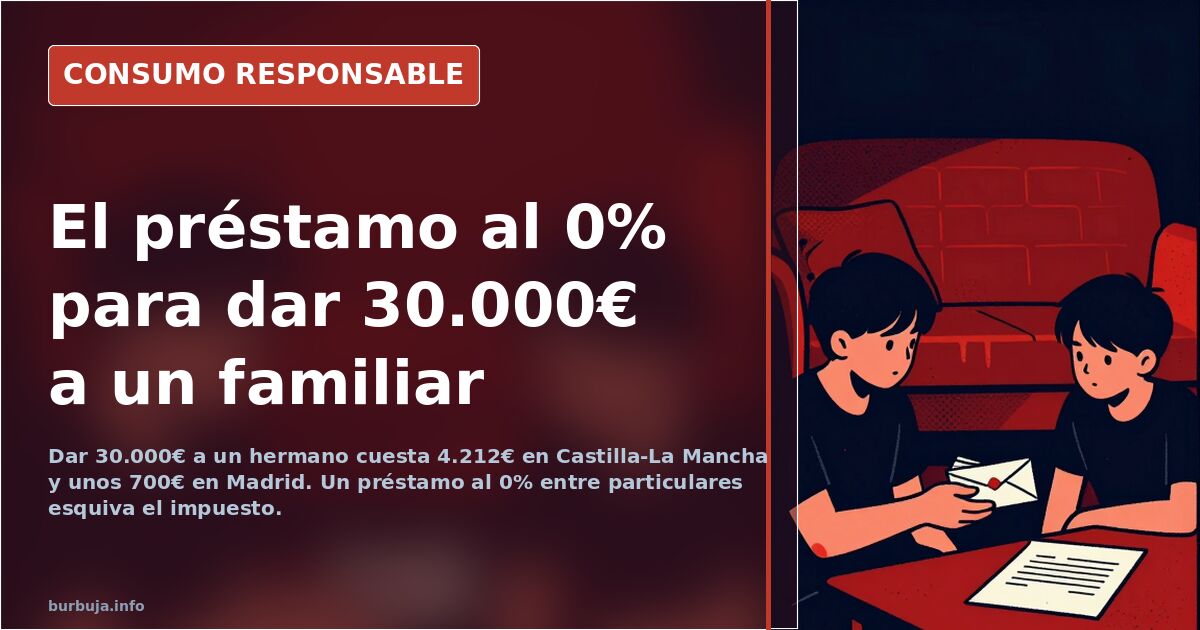
Giving €30,000 to a sibling: Gift tax or 0% loan
How do you hand over €30,000 to a brother or sister without also giving a slice to the Spanish Tax Agency? The question makes both asker and listener uncomfortable. The official route is the gift tax, paid by the recipient, not the giver. The alternative is a private loan, which fits on a single signed page. Between these two options lies a bill that varies depending on where the recipient is tax resident.
What does it cost to donate €30,000 to a sibling?
In Madrid, donations between siblings are taxed at 1%: about €300 in fees. Add notary costs of around €400, and the total comes to roughly €700. In Castilla-La Mancha, the price jumps sharply: the fee for €30,000 rises to €4,212.68, because this region offers no deductions for sibling donations unless the recipient has a recognized disability.
The rule trinc the donee, meaning the person receiving the money. Residency in Madrid versus Castilla-La Mancha separates a symbolic payment from a bill of over four thousand euros for the same transfer. That is why the first piece of advice always circulates: check regional regulations before moving a single euro.
The 0% private loan, the path most people point to
The star recipe turns a donation into debt. The lender hands over €30,000 with a contract setting repayment terms and a minimum interest rate, or zero. With that document, the money stops being a gift and becomes a loan. Some propose an interest rate of 0.001% repayable over 50 years, notarized for about €30.
A 0% interest loan is not illegal. What is recommended is not leaving everything to memory: a private contract, signed by both parties, has legal validity and costs little more than a coffee. Making it public via a notary is optional and adds solemnity, not obligation. The nuance that matters is the term: an unrealistic one can raise more flags than the amount itself.
Form 600: Mandatory even if nothing is due
A detail often overlooked: private loans must be declared using Form 600, even if they generate no tax liability. It is informative but mandatory. Those who filed it for a €3,000 loan report no issues: keep the bank transfer proof and complete the process with the Tax Agency.
Many people get lost here. They assume that if there is no tax to pay, there is nothing to declare. That is not how it works. The transaction must be reported. Whether repayment happens in cash or the lender draws from their own account is another matter, and that is exactly the part of the journey where everyone looks away.
How much cash can move without waking the bank?
A threshold of €3,000 daily is cited as an amount that can be deposited without triggering alarms, though the real limit is set by each institution. The problem is not an isolated deposit of €1,000 or €2,000. The problem is persistence. Banks monitor repeated movements under anti-money laundering laws and ask for explanations of origin, especially when the pattern resembles undeclared rent.
The circulating formula involves dilution: small withdrawals, covering the recipient's current expenses—supermarket, gas, school fees—while the donor's account grows without spending. Within months, much of the money is consumed without leaving odd traces. This works for daily life; it does not work for buying a flat.
How long until the Tax Agency claims
The commonly cited period is 4 years and 6 months. Based on this data, those who defend well-documented loans repaid gradually claim they are safe. Skeptics remind us that the clock does not stop just because a paper was signed, and that a data cross-check can activate it years later.
Cases that worked and those nobody boasts about
In these conversations, successes always appear: a transfer of €50,000 to a nephew years ago without a single question; €10,000 for a car five years ago with no comment. These are testimonials, not guarantees. Survivorship statistics, not written rules.
On the other side, the warning: accounts blocked due to repeated deposits of €200 suspected to be black-market rent. Scrutiny, it is argued, punishes the average saver more than large fortunes, which have other channels. It may sound like an excuse, but it is repeated insistently.
In the end, paying the gift tax and sleeping peacefully almost turns out cheaper. But it doesn't sell. It is more entertaining to sign a 0.001% loan for fifty years, keep it in a drawer, and trust that no one will check that compartment of memory.
How do you hand over €30,000 to a brother or sister without also giving a slice to the Spanish Tax Agency? The question makes both asker and listener uncomfortable. The official route is the gift tax, paid by the recipient, not the giver. The alternative is a private loan, which fits on a single signed page. Between these two options lies a bill that varies depending on where the recipient is tax resident.
What does it cost to donate €30,000 to a sibling?
In Madrid, donations between siblings are taxed at 1%: about €300 in fees. Add notary costs of around €400, and the total comes to roughly €700. In Castilla-La Mancha, the price jumps sharply: the fee for €30,000 rises to €4,212.68, because this region offers no deductions for sibling donations unless the recipient has a recognized disability.
The rule trinc the donee, meaning the person receiving the money. Residency in Madrid versus Castilla-La Mancha separates a symbolic payment from a bill of over four thousand euros for the same transfer. That is why the first piece of advice always circulates: check regional regulations before moving a single euro.
The 0% private loan, the path most people point to
The star recipe turns a donation into debt. The lender hands over €30,000 with a contract setting repayment terms and a minimum interest rate, or zero. With that document, the money stops being a gift and becomes a loan. Some propose an interest rate of 0.001% repayable over 50 years, notarized for about €30.
A 0% interest loan is not illegal. What is recommended is not leaving everything to memory: a private contract, signed by both parties, has legal validity and costs little more than a coffee. Making it public via a notary is optional and adds solemnity, not obligation. The nuance that matters is the term: an unrealistic one can raise more flags than the amount itself.
Form 600: Mandatory even if nothing is due
A detail often overlooked: private loans must be declared using Form 600, even if they generate no tax liability. It is informative but mandatory. Those who filed it for a €3,000 loan report no issues: keep the bank transfer proof and complete the process with the Tax Agency.
Many people get lost here. They assume that if there is no tax to pay, there is nothing to declare. That is not how it works. The transaction must be reported. Whether repayment happens in cash or the lender draws from their own account is another matter, and that is exactly the part of the journey where everyone looks away.
How much cash can move without waking the bank?
A threshold of €3,000 daily is cited as an amount that can be deposited without triggering alarms, though the real limit is set by each institution. The problem is not an isolated deposit of €1,000 or €2,000. The problem is persistence. Banks monitor repeated movements under anti-money laundering laws and ask for explanations of origin, especially when the pattern resembles undeclared rent.
The circulating formula involves dilution: small withdrawals, covering the recipient's current expenses—supermarket, gas, school fees—while the donor's account grows without spending. Within months, much of the money is consumed without leaving odd traces. This works for daily life; it does not work for buying a flat.
How long until the Tax Agency claims
The commonly cited period is 4 years and 6 months. Based on this data, those who defend well-documented loans repaid gradually claim they are safe. Skeptics remind us that the clock does not stop just because a paper was signed, and that a data cross-check can activate it years later.
Cases that worked and those nobody boasts about
In these conversations, successes always appear: a transfer of €50,000 to a nephew years ago without a single question; €10,000 for a car five years ago with no comment. These are testimonials, not guarantees. Survivorship statistics, not written rules.
On the other side, the warning: accounts blocked due to repeated deposits of €200 suspected to be black-market rent. Scrutiny, it is argued, punishes the average saver more than large fortunes, which have other channels. It may sound like an excuse, but it is repeated insistently.
In the end, paying the gift tax and sleeping peacefully almost turns out cheaper. But it doesn't sell. It is more entertaining to sign a 0.001% loan for fifty years, keep it in a drawer, and trust that no one will check that compartment of memory.
Also available in: Deutsch
Summary of a discussion on Burbuja.info - Foro de economía, actualidad y política., translated from Spanish and reviewed before publication. Read the full discussion (137 replies).
More summaries
-
Spain's Castilian capitals rated: Segovia 10, Palencia 3
Segovia earns a perfect score while Palencia receives a failing grade in a subjective ranking of Spain's Castilian provincial capitals.
-
20-Cent Bags: The Tax That Fails to Stop the Dumping
Bags cost 20 cents, yet 95% of ocean plastic comes from only 10 rivers: the true cost of this 'green gesture' doesn't match the propaganda.
-
Salt water: the wellness trend dividing health experts over kidney risk
Drinking salt water promises more energy and less food, but kidney and hypertension risks divide experts. Data, testimonials and the science behind it…
-
Valencia in September: Paella, Horchata and Beach
A five-day guide to Valencia in September with teens: where to eat paella, drink horchata in Alboraya, and what to see beyond the Oceanogràfic.
-
Mercadona drops fresh fish counters, leaving neighborhoods without fishmongers
Mercadona removes fresh fish from its counters, replacing it with packaged trays. Prices jump to €18/kg vs €10/kg at local shops, ending the traditional model.
-
Waking up at 5 AM: Productivity vs. Performative Routine
The debate on early rising contrasts those gaining quiet hours with those warning of sleep debt. What does science say?