
Spain's Castilian capitals rated: Segovia 10, Palencia 3
Segovia earns a perfect score while Palencia receives a failing grade in a subjective ranking of Spain's Castilian provincial capitals.
English · Original discussion in Spanish · Published
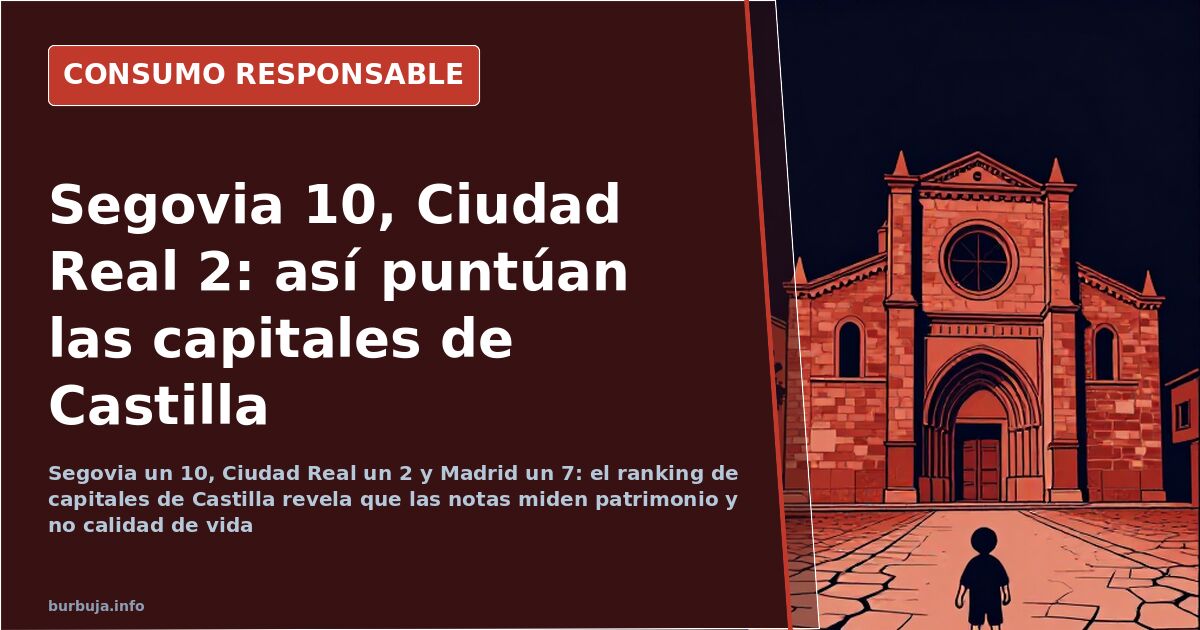
Segovia tops the list while Palencia fails in the league of Castilian capitals
Rating cities is inherently subjective and always sparks debate. However, when applied to the provincial capitals of Castilla y León and Castilla-La Mancha, the results reveal a striking map of grievances: Segovia scores a 10 in several rankings, Palencia sinks to a 3 in the harshest assessments, and Madrid, the national capital, settles for a lukewarm 7 that stings. The initial proposal distributed grades from north to south —Santander 6, Burgos 7, Valladolid 7, Toledo 8, Ciudad Real 2— and peine a Pandora's box: are we rating heritage, livability, or the memory left by a visit?
The response came in the form of disagreement. For some, Segovia is "the most beautiful city in Castilla and the country"; for others, the aqueduct does 80% of the work, and without it, the city drops to a four. This pattern repeats in every capital: the historic center saves the grade, while the rest of the municipal area drags it down.
Segovia, Toledo, and Salamanca: the undisputed podium
There is soft consensus at the top. Segovia, Toledo, and Salamanca consistently appear in the upper echelons, with scores ranging from 8 to 10. The golden stone, the aqueduct, and the Alcázar do the heavy lifting. But even there, fine print emerges: some argue Segovia lacks grand buildings and prestige outside its monumental enclosure, while others counter that this noble area exists and was simply overlooked.
The case of Ávila best illustrates how ratings change depending on perspective. A 3 and a 10 coexist in the same conversation. The walls, watchtowers, and Romanesque architecture justify the high score; the industrial estate and life beyond the stones justify the low one. It depends on whether you look at the wall or the outskirts.
Palencia, Ciudad Real, and Guadalajara: the bottom tier
The most repeated failing grade belongs to Palencia, with scores dropping as low as 3. Defenders cite the cathedral, the Canal de Castilla, and Mount El Viejo, arguments that fail to convince the majority. Ciudad Real receives a 2 and Guadalajara a 6, often accompanied by the remark that they "have nothing." The discussion gets tangled in what is being measured: heritage, quality of life, employment, or climate. No one agrees, which is precisely the charm of the exercise.
Valladolid generates a curious division. Some consider it Castilla's great underrated gem, awarding it a 7 or even a 9, while others dismiss it as "boring" and lower it to a 4. The flattest province in the country doesn't stir passion, but nor does it inspire indifference.
Madrid, Santander, and Logroño: capitals that don't convince
Madrid starts with a 7 and drops to a 5 in stricter ratings. The argument remains constant: outside the Habsburg Madrid and the Royal Palace, the capital is a dump of gray buildings and unlit streets. The defense is equally predictable: this happens in all major European capitals, Vienna included. Anyone staying six stops away from the Opera knows what to expect.
Santander is another battleground. An initial 6 rises to 7 or 8 depending on who views the bay, but plummets when humidity, hills, and summer rain enter the equation. The harshest description of Cantabrian weather cannot be reproduced here, but it summarizes a discomfort that goes beyond aesthetics.
Logroño receives an initial 6 and a punitive 4. Calle Laurel, some argue, deserves an eight on its own. Gastronomy saves what architecture cannot achieve.
The map fractures: Castilla is not one, but many
As the conversation pogre, rating cities evolves into something larger: what defines Castilla and who has the right to call themselves Castilian. The segregation of Cantabria and La Rioja, the separation of Madrid from New Castile, the weight of the Duchy of Cantabria in Castilla's formation around 800 AD. Historical arguments clash with identity politics, and tensions rise.
Some claim Cantabrians are not Castilians and never have been, citing two millennia of history against Castilla's 1,200 years. The response trinc quickly: the difference between someone from Burgos and someone from Santander is the same as between Albacete and Toledo—none. Critics say the 1978 autonomous community map fragmented Castilla against its history.
What is rated when rating a city?
The underlying question looms over the entire exercise: are we rating heritage, quality of life, employment, or climate? The original proposal mixes criteria without warning, sparking half the disputes. A 10 in monumentality can miccionan a 3 in livability, and vice versa.
The most sensible recommendation offered is to rate only the historic center and monuments, ignoring any construction after 1900. Under this criterion, the map would change significantly. And likely, fights would continue.
Does Palencia deserve the failing grade it receives, or is it a victim of undefined criteria?
Rating cities is inherently subjective and always sparks debate. However, when applied to the provincial capitals of Castilla y León and Castilla-La Mancha, the results reveal a striking map of grievances: Segovia scores a 10 in several rankings, Palencia sinks to a 3 in the harshest assessments, and Madrid, the national capital, settles for a lukewarm 7 that stings. The initial proposal distributed grades from north to south —Santander 6, Burgos 7, Valladolid 7, Toledo 8, Ciudad Real 2— and peine a Pandora's box: are we rating heritage, livability, or the memory left by a visit?
The response came in the form of disagreement. For some, Segovia is "the most beautiful city in Castilla and the country"; for others, the aqueduct does 80% of the work, and without it, the city drops to a four. This pattern repeats in every capital: the historic center saves the grade, while the rest of the municipal area drags it down.
Segovia, Toledo, and Salamanca: the undisputed podium
There is soft consensus at the top. Segovia, Toledo, and Salamanca consistently appear in the upper echelons, with scores ranging from 8 to 10. The golden stone, the aqueduct, and the Alcázar do the heavy lifting. But even there, fine print emerges: some argue Segovia lacks grand buildings and prestige outside its monumental enclosure, while others counter that this noble area exists and was simply overlooked.
The case of Ávila best illustrates how ratings change depending on perspective. A 3 and a 10 coexist in the same conversation. The walls, watchtowers, and Romanesque architecture justify the high score; the industrial estate and life beyond the stones justify the low one. It depends on whether you look at the wall or the outskirts.
Palencia, Ciudad Real, and Guadalajara: the bottom tier
The most repeated failing grade belongs to Palencia, with scores dropping as low as 3. Defenders cite the cathedral, the Canal de Castilla, and Mount El Viejo, arguments that fail to convince the majority. Ciudad Real receives a 2 and Guadalajara a 6, often accompanied by the remark that they "have nothing." The discussion gets tangled in what is being measured: heritage, quality of life, employment, or climate. No one agrees, which is precisely the charm of the exercise.
Valladolid generates a curious division. Some consider it Castilla's great underrated gem, awarding it a 7 or even a 9, while others dismiss it as "boring" and lower it to a 4. The flattest province in the country doesn't stir passion, but nor does it inspire indifference.
Madrid, Santander, and Logroño: capitals that don't convince
Madrid starts with a 7 and drops to a 5 in stricter ratings. The argument remains constant: outside the Habsburg Madrid and the Royal Palace, the capital is a dump of gray buildings and unlit streets. The defense is equally predictable: this happens in all major European capitals, Vienna included. Anyone staying six stops away from the Opera knows what to expect.
Santander is another battleground. An initial 6 rises to 7 or 8 depending on who views the bay, but plummets when humidity, hills, and summer rain enter the equation. The harshest description of Cantabrian weather cannot be reproduced here, but it summarizes a discomfort that goes beyond aesthetics.
Logroño receives an initial 6 and a punitive 4. Calle Laurel, some argue, deserves an eight on its own. Gastronomy saves what architecture cannot achieve.
The map fractures: Castilla is not one, but many
As the conversation pogre, rating cities evolves into something larger: what defines Castilla and who has the right to call themselves Castilian. The segregation of Cantabria and La Rioja, the separation of Madrid from New Castile, the weight of the Duchy of Cantabria in Castilla's formation around 800 AD. Historical arguments clash with identity politics, and tensions rise.
Some claim Cantabrians are not Castilians and never have been, citing two millennia of history against Castilla's 1,200 years. The response trinc quickly: the difference between someone from Burgos and someone from Santander is the same as between Albacete and Toledo—none. Critics say the 1978 autonomous community map fragmented Castilla against its history.
What is rated when rating a city?
The underlying question looms over the entire exercise: are we rating heritage, quality of life, employment, or climate? The original proposal mixes criteria without warning, sparking half the disputes. A 10 in monumentality can miccionan a 3 in livability, and vice versa.
The most sensible recommendation offered is to rate only the historic center and monuments, ignoring any construction after 1900. Under this criterion, the map would change significantly. And likely, fights would continue.
Does Palencia deserve the failing grade it receives, or is it a victim of undefined criteria?
Summary of a discussion on Burbuja.info - Foro de economía, actualidad y política., translated from Spanish and reviewed before publication. Read the full discussion (332 replies).
More summaries
-
Madrid loses its flavor: complaints about food quality spread
Potes chorizo is impossible to find in Madrid. Consumers denounce a decline in food quality and the disappearance of traditional shops. Is…
-
Hussars: quality menswear or just posturing?
Hussars review: natural fabrics, local manufacturing, and straight fit versus criticism for its controversial cut and self-promotion. Is it worth the price?
-
US Mom's Instant Mash Dinner Sparks Food Cost Debate
A viral video of a US mother preparing a cheap instant mash and meat dinner reignites debate on processed food costs.
-
Garage sends you to scrapyard for part: fair or rip-off?
A 2003 car, a discontinued part, and a garage sending the customer to a scrapyard. This is how repair works when official spares are gone.
-
Combustion cars decline: European gas stations lose 2.5 million customers
European gas stations lost 2.5 million customers in a year as Brent stays at $60. EVs grow, but the used market and subsidies remain key factors.
-
Fedora vs. Beret: Hats for Bald Men That Avoid Gangster Vibes
From wide-brimmed fedoras to grandpa's berets, discover which hat covers baldness without looking like a movie gangster.