
How to Stop a Cassowary Without Weapons
Cassowaries attack with 12 cm claws. A Florida breeder died in 2019; the previous known fatality was in 1926.
English · Original discussion in Spanish · Published
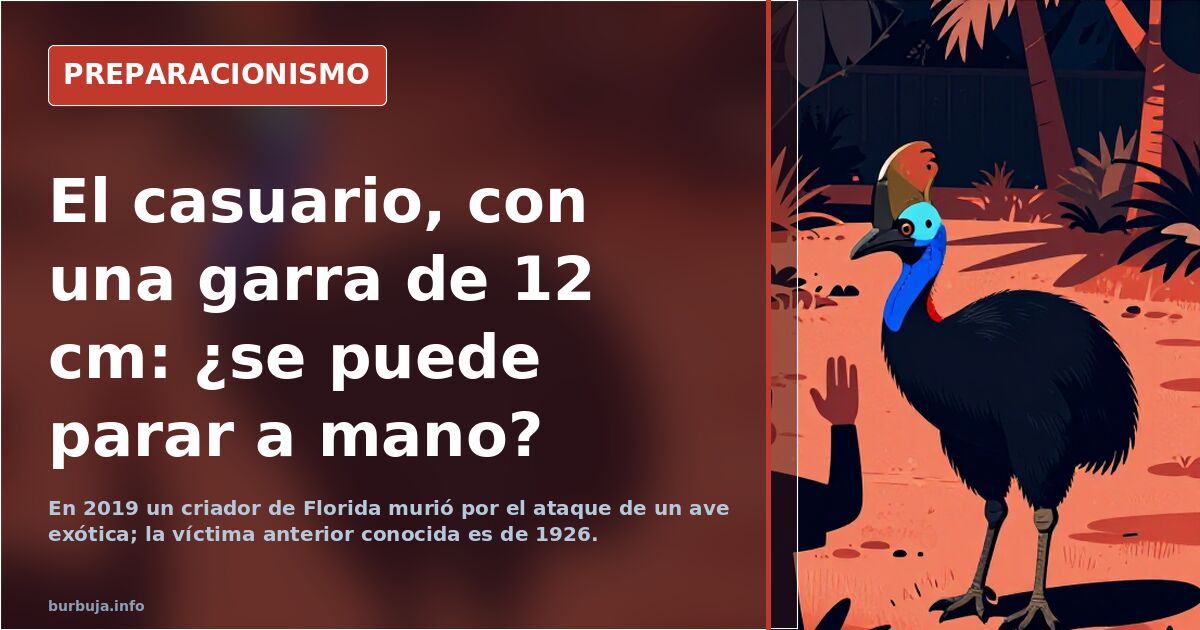
Cassowary: A 12 cm Claw and No Weapon at Hand
How do you contain the charge of a bird that attacks with a 12-centimeter claw? This is not a laboratory hypothesis. On April 12, 2019, a 75-year-old man died in Florida after one of the exotic birds he bred on his property inflicted wounds that proved fatal in the hospital. The previous known mortal victim, identified by name and date, was hunter Phillip McClean in Australia in April 1926, who received a blow to the neck after tripping while fleeing the animal.
This dual record—a case from a century ago and another from recent years—frames all technical discussion around the cassowary: a bird that, according to calculations by those who have handled it, weighs as much as an adult human, moves faster than one can react, and has three toes with claws, the inner toe reaching up to 12 centimeters. Anatomy does the rest.
What Makes the Cassowary a Antiestéticathered Weapon
The cassowary does not attack with its beak. It attacks with its legs. If threatened, it jumps and strikes with these "dagger-like" claws, capable of inflicting potentially lethal injuries to internal organs and causing severe hemorrhaging. The comparison repeated in the thread is that of a velociraptor scaled up to giant bird size, and it is not entirely exaggerated: for one participant, it is directly a antiestéticathered tyrannosaurus.
Added to the claws is a fact the thread accepts as true. An adult cassowary would weigh around 60 kilograms, a figure one participant equates to the weight of an average male human. Any technique that works with a domestic bird falls apart when the creature weighs what it does. And there is a detail that, according to another participant, worsens the problem: unlike a feline or a bear, which may ignore you if they don't want a fight, this type of bird does not back down when provoked.
Where Is Its Weak Point: The Neck and Distance
Those who claim to have worked closely with large running birds point to the same spot. The neck. The technique described combines two movements: dodging sideways, because the kick comes from the front in milliseconds, and throwing your hand to the neck to grab it. Once controlled, the animal retreats, closes its eyes, and lowers its head. That is the point where it feels defenseless.
The other school of thought is more prosaic and, probably, more realistic for those who have never raised such a creature: dominate the distance. Once it is upon you, without anything to throw or strike with, things get complicated because it runs and jumps with an agility not apparent when seen. Some propose the ostrich tactic—raising an arm as if it were a neck and holding position—and others respond with irony: stand next to someone taller so the bird chooses another target.
Stick, Stone, or Hose: The Improvised Arsenal
Without a firearm, the repertoire that emerges is short. A long, hard stick, preferably, because the key is reach: if you have to get close to strike, you have already lost. A well-thrown rock. And, for those who handle livestock, an open hose that doesn't release water until the right moment: two or three sprays and the animal gets scared. The idea of pure hand-to-hand combat—grabbing it by the neck and twisting until dislocating it—is defended by at least one participant, with many reservations.
The doubt hovering over the whole issue is whether unarmed combat against a wild animal is even an option. The majority answer, when grounded in real experience with livestock, is no. Accounts from those who have dealt with livestock point in the same direction: a ram that butts, a rooster with spurs attacking from behind, or a bull of nearly a thousand kilos deliver a correction in a second. The average outcome in hand-to-hand combat against fauna of that size is poor, and anyone saying otherwise has likely never encountered one.
From a Barn Rooster to a Thousand-Kilo Bull
The thread of comparisons is revealing. Those who have raised large birds describe a pattern: the animal must be taught respect the first time, because if it survives the initial encounter, it won't return with the same intentions. An aggressive rooster is corrected with a kick at the right moment; a ram that butts, with a sharp blow where it hurts most. The logic of those who work with animals this way is immediate and proportional punishment, not romantic wrestling.
However, scale changes the rules. With a creature weighing around 60 kilos delivering frontal kicks with dagger-like claws, the margin for error is millimeters. And there is a fact that confuses those who take it lightly: despite its fruta, between McClean's death in 1926 and the 2019 Florida case, no other documented fatality is attributed to it. Yet it still holds the title of the world's most dangerous bird: some participants, like one in the debate, consider the record somewhat inflated.
The Verdict
So the short answer to the title question is uncomfortable: with bare hands, the best technique is the one that avoids confrontation. Stick, stone, hose, or directly a car—which, technically, is not a weapon—. The rest is bar-stool literature with antiestéticathers. And beware, maybe not even that: the bird has spent a century with barely a handful of documented fatalities, and we are still discussing how to dislocate it with our hands. With communism, said one.
How do you contain the charge of a bird that attacks with a 12-centimeter claw? This is not a laboratory hypothesis. On April 12, 2019, a 75-year-old man died in Florida after one of the exotic birds he bred on his property inflicted wounds that proved fatal in the hospital. The previous known mortal victim, identified by name and date, was hunter Phillip McClean in Australia in April 1926, who received a blow to the neck after tripping while fleeing the animal.
This dual record—a case from a century ago and another from recent years—frames all technical discussion around the cassowary: a bird that, according to calculations by those who have handled it, weighs as much as an adult human, moves faster than one can react, and has three toes with claws, the inner toe reaching up to 12 centimeters. Anatomy does the rest.
What Makes the Cassowary a Antiestéticathered Weapon
The cassowary does not attack with its beak. It attacks with its legs. If threatened, it jumps and strikes with these "dagger-like" claws, capable of inflicting potentially lethal injuries to internal organs and causing severe hemorrhaging. The comparison repeated in the thread is that of a velociraptor scaled up to giant bird size, and it is not entirely exaggerated: for one participant, it is directly a antiestéticathered tyrannosaurus.
Added to the claws is a fact the thread accepts as true. An adult cassowary would weigh around 60 kilograms, a figure one participant equates to the weight of an average male human. Any technique that works with a domestic bird falls apart when the creature weighs what it does. And there is a detail that, according to another participant, worsens the problem: unlike a feline or a bear, which may ignore you if they don't want a fight, this type of bird does not back down when provoked.
Where Is Its Weak Point: The Neck and Distance
Those who claim to have worked closely with large running birds point to the same spot. The neck. The technique described combines two movements: dodging sideways, because the kick comes from the front in milliseconds, and throwing your hand to the neck to grab it. Once controlled, the animal retreats, closes its eyes, and lowers its head. That is the point where it feels defenseless.
The other school of thought is more prosaic and, probably, more realistic for those who have never raised such a creature: dominate the distance. Once it is upon you, without anything to throw or strike with, things get complicated because it runs and jumps with an agility not apparent when seen. Some propose the ostrich tactic—raising an arm as if it were a neck and holding position—and others respond with irony: stand next to someone taller so the bird chooses another target.
Stick, Stone, or Hose: The Improvised Arsenal
Without a firearm, the repertoire that emerges is short. A long, hard stick, preferably, because the key is reach: if you have to get close to strike, you have already lost. A well-thrown rock. And, for those who handle livestock, an open hose that doesn't release water until the right moment: two or three sprays and the animal gets scared. The idea of pure hand-to-hand combat—grabbing it by the neck and twisting until dislocating it—is defended by at least one participant, with many reservations.
The doubt hovering over the whole issue is whether unarmed combat against a wild animal is even an option. The majority answer, when grounded in real experience with livestock, is no. Accounts from those who have dealt with livestock point in the same direction: a ram that butts, a rooster with spurs attacking from behind, or a bull of nearly a thousand kilos deliver a correction in a second. The average outcome in hand-to-hand combat against fauna of that size is poor, and anyone saying otherwise has likely never encountered one.
From a Barn Rooster to a Thousand-Kilo Bull
The thread of comparisons is revealing. Those who have raised large birds describe a pattern: the animal must be taught respect the first time, because if it survives the initial encounter, it won't return with the same intentions. An aggressive rooster is corrected with a kick at the right moment; a ram that butts, with a sharp blow where it hurts most. The logic of those who work with animals this way is immediate and proportional punishment, not romantic wrestling.
However, scale changes the rules. With a creature weighing around 60 kilos delivering frontal kicks with dagger-like claws, the margin for error is millimeters. And there is a fact that confuses those who take it lightly: despite its fruta, between McClean's death in 1926 and the 2019 Florida case, no other documented fatality is attributed to it. Yet it still holds the title of the world's most dangerous bird: some participants, like one in the debate, consider the record somewhat inflated.
The Verdict
So the short answer to the title question is uncomfortable: with bare hands, the best technique is the one that avoids confrontation. Stick, stone, hose, or directly a car—which, technically, is not a weapon—. The rest is bar-stool literature with antiestéticathers. And beware, maybe not even that: the bird has spent a century with barely a handful of documented fatalities, and we are still discussing how to dislocate it with our hands. With communism, said one.
Summary of a discussion on Burbuja.info - Foro de economía, actualidad y política., translated from Spanish and reviewed before publication. Read the full discussion (152 replies).
More summaries
-
Moth in Bathroom Triggers Forum User's Insect Phobia
A forum user describes their intense fear of insects after a moth trapped itself in their bathroom, preventing them from showering and seeking ways to remove it.
-
Spain's plainclothes police: anecdotes from those who met them
Encounters with Spanish plainclothes officers involve fake badges, weapons, and citizens impersonating agents.
-
Why Spain's Power Grid Doesn't Sync to GPS Clocks
Spain's grid maintains 50 Hz through mechanical inertia and grid-forming inverters, not GPS synchronization.
-
The Unsolved Monkey and Coconuts Riddle
A monkey trapped on a palm tree faces a hungry tiger and crocodiles. One proposed solution involves waiting for the tiger to die and building a raft.
-
Home Seawater Distillation: Mineral Self-Sufficiency or Risk?
Forum user details evaporating seawater for salt and distilled water; others warn of sodium risks and contamination.
-
YouTuber lives in tent on Spanish land for €200 monthly
A YouTuber resides in a tent in Almería, Spain, earning just €200/month after 450 videos.