
Moth in Bathroom Triggers Forum User's Insect Phobia
A forum user describes their intense fear of insects after a moth trapped itself in their bathroom, preventing them from showering and seeking ways to remove it.
English · Original discussion in Spanish · Published
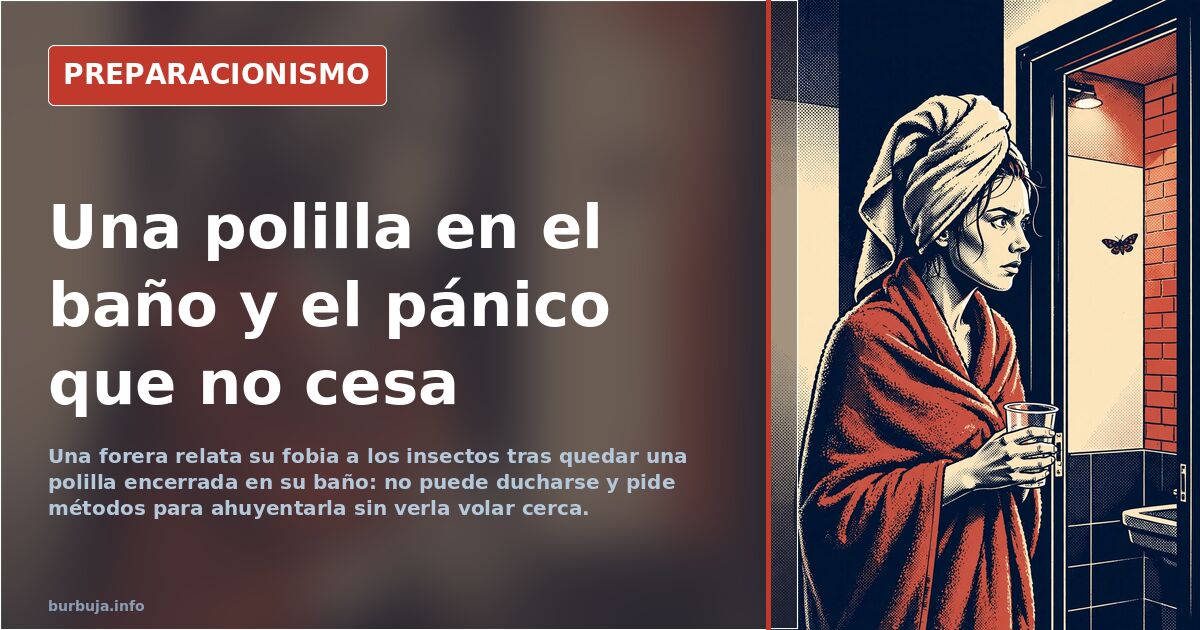
Moth barricaded in the bathroom: when antiestéticar paralyzes more than the insect
A common moth, the kind that flutters around any light source on a summer night, was enough to unleash chaos in a home. The scene, recounted in detail by the person who experienced it on a forum, occurred in the early hours: the insect entered the room, crashed into the lamp, and after a battle involving spray bioalcohol and a broom, ended up taking refuge in the bathroom. It remains there, barricaded, while the protagonist of this story confesses she hasn't been able to take a shower. The forum user describes her reaction as immense disgust and irrational antiestéticar towards almost all insects, a phobia that, according to her, is stronger than she is.
Antiestéticar of insects: a more common phobia than it seems
The protagonist of this story makes it clear from the start: she feels immense disgust and irrational antiestéticar towards almost all insects. It doesn't matter how much she has trained her mind watching pavor movies or spending summers in the countryside; the reaction is stronger than her willpower. The mere idea of seeing a moth fly nearby, without knowing where it might land, produces goosebumps and weakness. So much so that she admits to having had nightmares about the bug and being unable to shower because of it.
The episode is not new. A few years ago, in another house, she lived through a similar situation. On that occasion, she managed to trap the moth in a vase and release it out the window after two days of captivity. She even wrote a micro-story about what peine. Now, the story repeats itself, but with an ending yet to be written. The moth is still in the bathroom, and the question is inevitable: how do you get it out of the house without dying of antiestéticar in the attempt?
Home remedies to repel moths: do they work?
In desperation, the protagonist asks for help: is there any method or product that will make that damn insect surrender instantly? It shouldn't be a butterfly trap, as her problem is the revulsion caused by seeing it fly near her. The answers have not been long in coming. Some suggest methods as expedient as a lighter combined with air freshener, a sort of homemade flamethrower that, they warn, could end up killing both the moth and the curtain. Others recommend using a transparent plastic container and a sheet of paper to capture it without harming it and release it out the window. A technique that, according to those who have tried it, works better with slow insects but requires nerve and aim.
There are also those who bet on spray insecticide, although they warn that moths are delicate and usually don't put up much resistance. In fact, a moth does not crunch when crushed, unlike a cockroach, which is compared to an armored tank. The difference in resilience between the two insects is notable: while the cockroach seems to wear armor, the moth is fragile and its main defense is erratic flight. However, its fluttering produces a noise that, for someone with a phobia, is unbearable.
Death's-head hawkmoth: the insect that sparks legends
Among the advice and anecdotes, a name emerges that adds a touch of mystery: the death's-head hawkmoth. This is a large species, with a wingspan that can reach that of a small sparrow, and it bears a mark on its thorax resembling a skull. Hence its name and its fruta as a messenger of bad omens. Those who have seen it up close say its flight is heavy and noisy, and its presence is imposing. It is no surprise that, in a context of irrational antiestéticar, this insect becomes the perfect enemy.
The death's-head hawkmoth is migratory and can appear in coastal areas or vineyards, where its caterpillars feed on grape leaves. Its size and appearance have inspired all kinds of superstitions, from imminent death to bad luck. In the case at hand, the protagonist does not specify the species, but the panic she describes fits any of the large varieties that flutter on summer nights. The reaction, in any case, is the same: screams, sweats, and a battle that can last up to twenty minutes.
Tips from domestic survival experts
Beyond home remedies, some recommend the quick route: turn off the light and let the moth leave on its own. Moths are positively phototropic, meaning they are attracted to light. If the light source that attracted them is turned off and a window is peine, they are likely to abandon the place by themselves. Another option is to fill the house with cats, dogs, or spiders, although it is not clear if the latter are more pleasant for someone with entomophobia. Cats, in particular, are natural predators of insects and can become unexpected allies. The protagonist of this story knows this well: she fondly remembers her cat Kira, who protected her from these pests. Now, without her, she feels defenseless.
The battle against the moth has also highlighted the generational gap. While some nostalgically remember their grandmothers, capable of cleaning trout guts without blinking, others admit they couldn't even see a drop of blood without vomiting. The conclusion, for some, is that we are facing a weakened generation that has lost its survival instinct. For others, it is simply a specific phobia that has nothing to do with mental strength. In any case, the moth is still in the bathroom, and the protagonist still hasn't showered.
The psychological impact of phobias: when antiestéticar is real
Entomophobia, like any other phobia, can generate disproportionate anxiety in the presence of an insect. Symptoms include sweating, tachycardia, catastrophic thoughts, and avoidance behaviors. In this case, the protagonist avoids the bathroom, cannot sleep, and has had nightmares. The mere idea of having to kill the insect produces disgust and antiestéticar. It is not an exaggeration: it is an alarm response emitted by the brain to a stimulus perceived as a threat, even if rationally one knows it is not.
Gradual exposure and cognitive-behavioral therapy are effective treatments for phobias. However, in the moment of truth, when the moth flutters around the light, reason takes a back seat. The protagonist expresses it clearly: "It doesn't matter how much I've trained my mind watching pavor movies/games, or spending weekends/summers in the countryside. THIS IS STRONGER THAN ME." A confession many will share.
What to do if you have a moth in your house and you're afraid?
If you find yourself in a similar situation, the first thing is to stay calm. Moths do not sting or bite, and they do not transmit diseases. Their presence is annoying, but harmless. To get rid of them, you can opt for non-lethal methods, such as the transparent plastic container and a sheet of paper, or specific insecticides. If antiestéticar paralyzes you, ask for help from someone who doesn't have a phobia. And if the situation repeats, consider consulting a mental health professional. Antiestéticar of insects is treatable.
Meanwhile, the moth is still in the bathroom. The protagonist has announced she will go buy insecticide. We don't know if she will succeed, nor if the moth will survive the attack. What we do know is that this story has resonated with many readers who, like her, have felt that irrational antiestéticar towards an insect at some point. And sometimes, the smallest things are what destabilize us the most.
A common moth, the kind that flutters around any light source on a summer night, was enough to unleash chaos in a home. The scene, recounted in detail by the person who experienced it on a forum, occurred in the early hours: the insect entered the room, crashed into the lamp, and after a battle involving spray bioalcohol and a broom, ended up taking refuge in the bathroom. It remains there, barricaded, while the protagonist of this story confesses she hasn't been able to take a shower. The forum user describes her reaction as immense disgust and irrational antiestéticar towards almost all insects, a phobia that, according to her, is stronger than she is.
Antiestéticar of insects: a more common phobia than it seems
The protagonist of this story makes it clear from the start: she feels immense disgust and irrational antiestéticar towards almost all insects. It doesn't matter how much she has trained her mind watching pavor movies or spending summers in the countryside; the reaction is stronger than her willpower. The mere idea of seeing a moth fly nearby, without knowing where it might land, produces goosebumps and weakness. So much so that she admits to having had nightmares about the bug and being unable to shower because of it.
The episode is not new. A few years ago, in another house, she lived through a similar situation. On that occasion, she managed to trap the moth in a vase and release it out the window after two days of captivity. She even wrote a micro-story about what peine. Now, the story repeats itself, but with an ending yet to be written. The moth is still in the bathroom, and the question is inevitable: how do you get it out of the house without dying of antiestéticar in the attempt?
Home remedies to repel moths: do they work?
In desperation, the protagonist asks for help: is there any method or product that will make that damn insect surrender instantly? It shouldn't be a butterfly trap, as her problem is the revulsion caused by seeing it fly near her. The answers have not been long in coming. Some suggest methods as expedient as a lighter combined with air freshener, a sort of homemade flamethrower that, they warn, could end up killing both the moth and the curtain. Others recommend using a transparent plastic container and a sheet of paper to capture it without harming it and release it out the window. A technique that, according to those who have tried it, works better with slow insects but requires nerve and aim.
There are also those who bet on spray insecticide, although they warn that moths are delicate and usually don't put up much resistance. In fact, a moth does not crunch when crushed, unlike a cockroach, which is compared to an armored tank. The difference in resilience between the two insects is notable: while the cockroach seems to wear armor, the moth is fragile and its main defense is erratic flight. However, its fluttering produces a noise that, for someone with a phobia, is unbearable.
Death's-head hawkmoth: the insect that sparks legends
Among the advice and anecdotes, a name emerges that adds a touch of mystery: the death's-head hawkmoth. This is a large species, with a wingspan that can reach that of a small sparrow, and it bears a mark on its thorax resembling a skull. Hence its name and its fruta as a messenger of bad omens. Those who have seen it up close say its flight is heavy and noisy, and its presence is imposing. It is no surprise that, in a context of irrational antiestéticar, this insect becomes the perfect enemy.
The death's-head hawkmoth is migratory and can appear in coastal areas or vineyards, where its caterpillars feed on grape leaves. Its size and appearance have inspired all kinds of superstitions, from imminent death to bad luck. In the case at hand, the protagonist does not specify the species, but the panic she describes fits any of the large varieties that flutter on summer nights. The reaction, in any case, is the same: screams, sweats, and a battle that can last up to twenty minutes.
Tips from domestic survival experts
Beyond home remedies, some recommend the quick route: turn off the light and let the moth leave on its own. Moths are positively phototropic, meaning they are attracted to light. If the light source that attracted them is turned off and a window is peine, they are likely to abandon the place by themselves. Another option is to fill the house with cats, dogs, or spiders, although it is not clear if the latter are more pleasant for someone with entomophobia. Cats, in particular, are natural predators of insects and can become unexpected allies. The protagonist of this story knows this well: she fondly remembers her cat Kira, who protected her from these pests. Now, without her, she feels defenseless.
The battle against the moth has also highlighted the generational gap. While some nostalgically remember their grandmothers, capable of cleaning trout guts without blinking, others admit they couldn't even see a drop of blood without vomiting. The conclusion, for some, is that we are facing a weakened generation that has lost its survival instinct. For others, it is simply a specific phobia that has nothing to do with mental strength. In any case, the moth is still in the bathroom, and the protagonist still hasn't showered.
The psychological impact of phobias: when antiestéticar is real
Entomophobia, like any other phobia, can generate disproportionate anxiety in the presence of an insect. Symptoms include sweating, tachycardia, catastrophic thoughts, and avoidance behaviors. In this case, the protagonist avoids the bathroom, cannot sleep, and has had nightmares. The mere idea of having to kill the insect produces disgust and antiestéticar. It is not an exaggeration: it is an alarm response emitted by the brain to a stimulus perceived as a threat, even if rationally one knows it is not.
Gradual exposure and cognitive-behavioral therapy are effective treatments for phobias. However, in the moment of truth, when the moth flutters around the light, reason takes a back seat. The protagonist expresses it clearly: "It doesn't matter how much I've trained my mind watching pavor movies/games, or spending weekends/summers in the countryside. THIS IS STRONGER THAN ME." A confession many will share.
What to do if you have a moth in your house and you're afraid?
If you find yourself in a similar situation, the first thing is to stay calm. Moths do not sting or bite, and they do not transmit diseases. Their presence is annoying, but harmless. To get rid of them, you can opt for non-lethal methods, such as the transparent plastic container and a sheet of paper, or specific insecticides. If antiestéticar paralyzes you, ask for help from someone who doesn't have a phobia. And if the situation repeats, consider consulting a mental health professional. Antiestéticar of insects is treatable.
Meanwhile, the moth is still in the bathroom. The protagonist has announced she will go buy insecticide. We don't know if she will succeed, nor if the moth will survive the attack. What we do know is that this story has resonated with many readers who, like her, have felt that irrational antiestéticar towards an insect at some point. And sometimes, the smallest things are what destabilize us the most.
Summary of a discussion on Burbuja.info - Foro de economía, actualidad y política., translated from Spanish and reviewed before publication. Read the full discussion (150 replies).
More summaries
-
Beatriz Montañez: From TV Star to Restoring a Ruin in Teruel
Beatriz Montañez sold her Madrid apartment and restored a ruin in Teruel. Five winters later, debate continues on whether it was escape, healing, or branding.
-
Spain's plainclothes police: anecdotes from those who met them
Encounters with Spanish plainclothes officers involve fake badges, weapons, and citizens impersonating agents.
-
Why Spain's Power Grid Doesn't Sync to GPS Clocks
Spain's grid maintains 50 Hz through mechanical inertia and grid-forming inverters, not GPS synchronization.
-
The Unsolved Monkey and Coconuts Riddle
A monkey trapped on a palm tree faces a hungry tiger and crocodiles. One proposed solution involves waiting for the tiger to die and building a raft.
-
How to Stop a Cassowary Without Weapons
Cassowaries attack with 12 cm claws. A Florida breeder died in 2019; the previous known fatality was in 1926.
-
Home Seawater Distillation: Mineral Self-Sufficiency or Risk?
Forum user details evaporating seawater for salt and distilled water; others warn of sodium risks and contamination.