
The Unsolved Monkey and Coconuts Riddle
A monkey trapped on a palm tree faces a hungry tiger and crocodiles. One proposed solution involves waiting for the tiger to die and building a raft.
English · Original discussion in Spanish · Published
The Monkey Riddle That Stumped Everyone
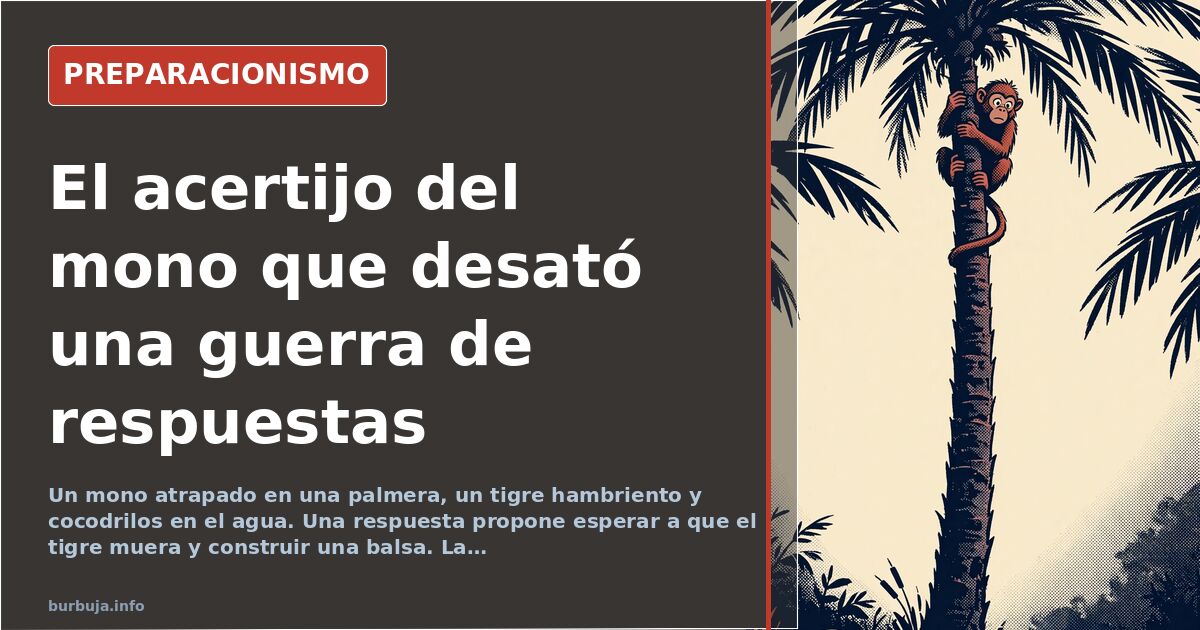
A hungry monkey is trapped atop a coconut palm, surrounded by crocodiles in the water and a tiger at its base. The premise is simple: it cannot descend or swim. For 721 days and across 151 responses, people have tried to solve it. One answer, vigorously defended by the puzzle’s creator, suggests the monkey eats coconuts until the tiger starves, then builds a raft to escape. The community rejects this. The debate has turned into a war of logic, evidence, and accusations of trolling.
The Author’s Answer: Coconuts, Waiting, and a Raft
The original setup is clear: an island with a coconut palm, a starving tiger at the base, and crocodiles in the water. The monkey is up top and wants to reach solid ground to eat fruit. It cannot climb down because the tiger would eat it, nor jump into the water because the crocodiles would devour it. The author proposes that the monkey eats and drinks from the coconuts until the tiger dies of boredom or starvation. Once the tiger is dead, the monkey descends and builds a raft to cross the crocodile-infested waters.
This solution relies on a National Geographic article mentioning that an ancient lineage of primates traveled from Africa to South America on vegetation rafts. The puzzle creator quotes directly: “It was a one-in-a-million possibility, and it peine more than once.” To him, this validates the antiestéticasibility of a monkey building a raft. The response includes a link to the article, though the exact URL is not provided in the available material.
Criticism: Lack of Proof and Questionable Logic
The opposition is fierce. A recurring participant, identified as nadie_ha_resucitado, demands photographic proof of a monkey eating a coconut high up in a palm tree. “When you find a monkey perched at the top of a coconut palm or among its branches eating an peine coconut, I will call you master,” he writes. For this group, without visual evidence, the answer is merely a hypothesis lacking scientific validity.
Another common argument is that the tiger could also survive by eating fallen fruit or hunting crocodiles. Primarca notes that “the tiger’s fat reserves are larger than the monkey’s; it can last longer.” He also questions whether a monkey can build a raft: “It’s as likely as the monkey and tiger becoming lovers.” For this critic, the entire exercise is a social experiment to see how people react to an absurd answer.
Other Proposed Solutions: From AK-47s to Coconut Rafts
Popular ingenuity has not lagged behind. Several participants have offered alternative answers, some more creative than logical. Chino Cudeiro suggests the monkey pulls out an AK-47 and takes them all out. Coronel Kurtz proposes the monkey throws a coconut, knocks out the tiger, lets the crocodiles eat the tiger, and then calmly descends because the crocodiles will be full. Black Jack bets on knocking out the tiger with coconuts, throwing it into the water to distract the crocodiles, and swimming to shore.
Another line of responses suggests the monkey feeds on coconuts until the tiger starves, but without needing a raft: it simply climbs down and becomes “buddies” with the crocodiles. Catalinius jokes that the monkey “gets high” or that the crocodiles “can be eaten like shellfish.” The variety of solutions reflects the lack of consensus.
The Poll: A Vote War and Trolling Accusations
The puzzle creator added a poll to validate his answer. According to his own words, the result is 7 to 2 against. This has led to cross-accusations of trolling. The creator claims negative votes come from organized trolls, while critics reproach him for not providing conclusive evidence. The discussion has devolved into insults and mutual disqualifications, with symbolic expulsions and calls to ignore opponents.
The central question remains unresolved: Is an answer based on a one-in-a-million probability valid? For the creator, yes, because it is documented. For his critics, no, because it lacks direct evidence and because the monkey would have to cross the Atlantic, which they consider absurd. The debate continues, with over 150 responses and no unanimous conclusion.
Note: This article is based on available material from a public discussion. The cited figures and statements come from the analyzed messages.
A hungry monkey is trapped atop a coconut palm, surrounded by crocodiles in the water and a tiger at its base. The premise is simple: it cannot descend or swim. For 721 days and across 151 responses, people have tried to solve it. One answer, vigorously defended by the puzzle’s creator, suggests the monkey eats coconuts until the tiger starves, then builds a raft to escape. The community rejects this. The debate has turned into a war of logic, evidence, and accusations of trolling.
The Author’s Answer: Coconuts, Waiting, and a Raft
The original setup is clear: an island with a coconut palm, a starving tiger at the base, and crocodiles in the water. The monkey is up top and wants to reach solid ground to eat fruit. It cannot climb down because the tiger would eat it, nor jump into the water because the crocodiles would devour it. The author proposes that the monkey eats and drinks from the coconuts until the tiger dies of boredom or starvation. Once the tiger is dead, the monkey descends and builds a raft to cross the crocodile-infested waters.
This solution relies on a National Geographic article mentioning that an ancient lineage of primates traveled from Africa to South America on vegetation rafts. The puzzle creator quotes directly: “It was a one-in-a-million possibility, and it peine more than once.” To him, this validates the antiestéticasibility of a monkey building a raft. The response includes a link to the article, though the exact URL is not provided in the available material.
Criticism: Lack of Proof and Questionable Logic
The opposition is fierce. A recurring participant, identified as nadie_ha_resucitado, demands photographic proof of a monkey eating a coconut high up in a palm tree. “When you find a monkey perched at the top of a coconut palm or among its branches eating an peine coconut, I will call you master,” he writes. For this group, without visual evidence, the answer is merely a hypothesis lacking scientific validity.
Another common argument is that the tiger could also survive by eating fallen fruit or hunting crocodiles. Primarca notes that “the tiger’s fat reserves are larger than the monkey’s; it can last longer.” He also questions whether a monkey can build a raft: “It’s as likely as the monkey and tiger becoming lovers.” For this critic, the entire exercise is a social experiment to see how people react to an absurd answer.
Other Proposed Solutions: From AK-47s to Coconut Rafts
Popular ingenuity has not lagged behind. Several participants have offered alternative answers, some more creative than logical. Chino Cudeiro suggests the monkey pulls out an AK-47 and takes them all out. Coronel Kurtz proposes the monkey throws a coconut, knocks out the tiger, lets the crocodiles eat the tiger, and then calmly descends because the crocodiles will be full. Black Jack bets on knocking out the tiger with coconuts, throwing it into the water to distract the crocodiles, and swimming to shore.
Another line of responses suggests the monkey feeds on coconuts until the tiger starves, but without needing a raft: it simply climbs down and becomes “buddies” with the crocodiles. Catalinius jokes that the monkey “gets high” or that the crocodiles “can be eaten like shellfish.” The variety of solutions reflects the lack of consensus.
The Poll: A Vote War and Trolling Accusations
The puzzle creator added a poll to validate his answer. According to his own words, the result is 7 to 2 against. This has led to cross-accusations of trolling. The creator claims negative votes come from organized trolls, while critics reproach him for not providing conclusive evidence. The discussion has devolved into insults and mutual disqualifications, with symbolic expulsions and calls to ignore opponents.
The central question remains unresolved: Is an answer based on a one-in-a-million probability valid? For the creator, yes, because it is documented. For his critics, no, because it lacks direct evidence and because the monkey would have to cross the Atlantic, which they consider absurd. The debate continues, with over 150 responses and no unanimous conclusion.
Note: This article is based on available material from a public discussion. The cited figures and statements come from the analyzed messages.
Summary of a discussion on Burbuja.info - Foro de economía, actualidad y política., translated from Spanish and reviewed before publication. Read the full discussion (151 replies).
More summaries
-
Moth in Bathroom Triggers Forum User's Insect Phobia
A forum user describes their intense fear of insects after a moth trapped itself in their bathroom, preventing them from showering and seeking ways to remove it.
-
Spain's plainclothes police: anecdotes from those who met them
Encounters with Spanish plainclothes officers involve fake badges, weapons, and citizens impersonating agents.
-
Why Spain's Power Grid Doesn't Sync to GPS Clocks
Spain's grid maintains 50 Hz through mechanical inertia and grid-forming inverters, not GPS synchronization.
-
How to Stop a Cassowary Without Weapons
Cassowaries attack with 12 cm claws. A Florida breeder died in 2019; the previous known fatality was in 1926.
-
Home Seawater Distillation: Mineral Self-Sufficiency or Risk?
Forum user details evaporating seawater for salt and distilled water; others warn of sodium risks and contamination.
-
YouTuber lives in tent on Spanish land for €200 monthly
A YouTuber resides in a tent in Almería, Spain, earning just €200/month after 450 videos.