
Home Seawater Distillation: Mineral Self-Sufficiency or Risk?
Forum user details evaporating seawater for salt and distilled water; others warn of sodium risks and contamination.
English · Original discussion in Spanish · Published
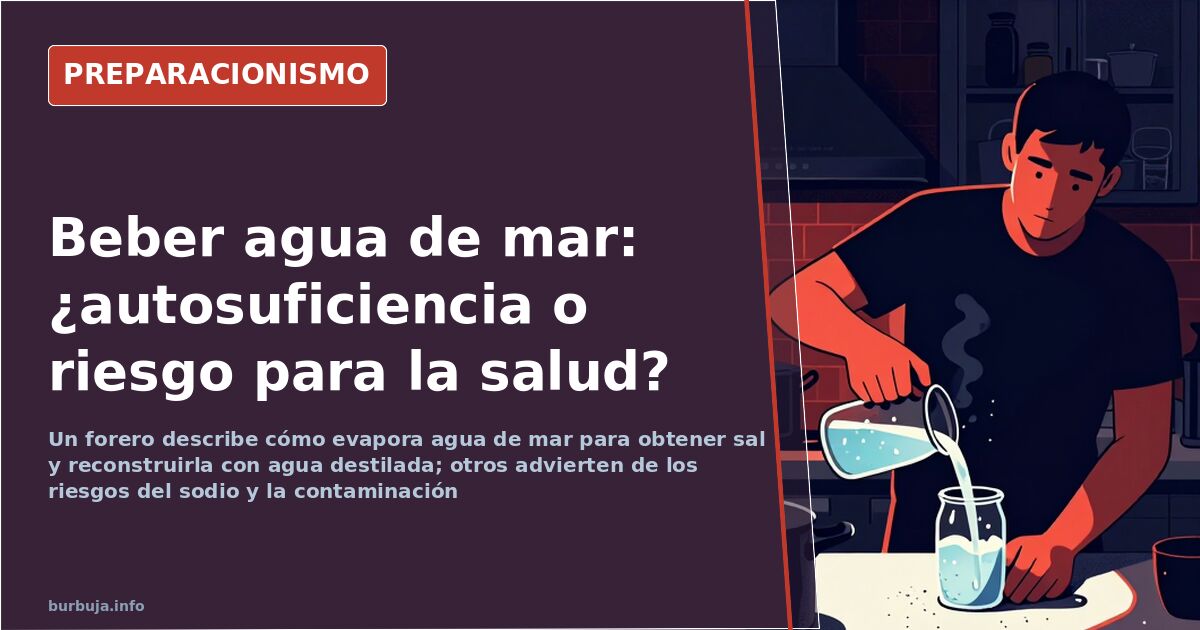
Urban Self-Sufficiency: Distilling Seawater at Home
Is it worth evaporating seawater at home to obtain salt and reconstruct it with distilled water? This is the starting point of a practice that, according to one participant, they have been applying for months, consisting of drinking only distilled water and cooking with it. The premise defended is that if you remove minerals from water, something must be replaced. And seawater, with all its trace elements, is the candidate. The method described is simple: collect seawater from a certain depth, evaporate it using an electric distiller, and store the resulting salt. With that salt and distilled water, they reconstruct seawater in a proportion of 40 grams per liter. A kilo of salt takes up the space of a kilo of salt. One hundred liters of seawater do not fit in an apartment.
The Calculation Supporting the Method
The economic argument presented is that commercial seawater costs about 8 euros for five liters, which amounts to a monthly expense of 8 euros for those who consume it daily. According to their calculation, evaporating seven liters of seawater produces enough salt to reconstruct fifty liters. Savings are not the only motive: they claim that bottled seawater sold in Spain comes from a single area and that some brands have modified their composition. The homemade alternative would guarantee, according to this trend, that the final product is authentic seawater, without additives.
The process has an energy cost that is not detailed: evaporating one liter of water requires electricity, and distilled water is also produced with an electric distiller. The complete equation —electricity for distillation, electricity for evaporation, storage time— is not broken down. Those who defend the method argue that the expense is offset by the independence gained by not relying on an external supplier.
Salt Is Not Just Sodium Chloride
The core of the argument is mineral. Natural sea salt contains magnesium, calcium, iodine, and other trace elements that refined supermarket salt has lost, according to this trend. Himalayan salt, they note, owes its tonalidad to iron oxide, not nutritional superiority. Salt obtained by home evaporation of seawater, coming from small volumes, turns out white but retains the original composition of the sea. The comparison with Guérande salt, mentioned as a quality commercial alternative, reveals a difference: coarse Guérande salt is moist and grayish, while home-produced salt is dry and white. The labeling of Guérande salt cited in the exchange indicates its composition is mostly sodium chloride, lacking the rest of the minerals present in evaporated seawater.
Risks: Sodium, Heavy Metals, and Microplastics
The most repeated warning concerns sodium. Seawater has a salinity concentration about thirty times higher than fresh water, according to one participant. Consuming it undiluted can be dangerous for people with sodium sensitivity or kidney problems. The case of someone with an 18-centimeter kidney stone, attributed by that same participant partly to excessive salt consumption, is mentioned. The recommendation issued is to dilute seawater, not drink it directly.
The second issue is pollution. Petroleum derivatives float on the surface, so collecting from about 50 centimeters deep is recommended. Once at home, the surface layer can be removed as done with fat in broth. Microplastics are another concern: one participant claims homemade seawater may contain more microplastics than industrially processed water, although there is no data supporting this assertion in the available material.
The Ultraviolet Lamp and Antiestéticar of the Invisible
The conversation shifts to disinfection. The purchase of a powerful ultraviolet lamp during the early stages of the pandemic to disinfect people and objects at the house entrance is mentioned. The instructions themselves warned against exposure for more than three minutes: UV radiation kills cells and can blind anyone exposed. The proposed alternative is to combine the UV lamp with a 0.20-micron ultrafilter to eliminate endotoxins and pyrogens that radiation does not destroy. It is the kind of detail that separates real self-sufficiency from paraphernalia.
The conclusion that emerges is uncomfortable for everyone: the method works, but it requires a level of discipline and technical knowledge that very few are willing to assume. And the underlying question —whether drinking distilled water is sensible or not— remains without a consensus answer. Let each person evaporate their own sea.
Is it worth evaporating seawater at home to obtain salt and reconstruct it with distilled water? This is the starting point of a practice that, according to one participant, they have been applying for months, consisting of drinking only distilled water and cooking with it. The premise defended is that if you remove minerals from water, something must be replaced. And seawater, with all its trace elements, is the candidate. The method described is simple: collect seawater from a certain depth, evaporate it using an electric distiller, and store the resulting salt. With that salt and distilled water, they reconstruct seawater in a proportion of 40 grams per liter. A kilo of salt takes up the space of a kilo of salt. One hundred liters of seawater do not fit in an apartment.
The Calculation Supporting the Method
The economic argument presented is that commercial seawater costs about 8 euros for five liters, which amounts to a monthly expense of 8 euros for those who consume it daily. According to their calculation, evaporating seven liters of seawater produces enough salt to reconstruct fifty liters. Savings are not the only motive: they claim that bottled seawater sold in Spain comes from a single area and that some brands have modified their composition. The homemade alternative would guarantee, according to this trend, that the final product is authentic seawater, without additives.
The process has an energy cost that is not detailed: evaporating one liter of water requires electricity, and distilled water is also produced with an electric distiller. The complete equation —electricity for distillation, electricity for evaporation, storage time— is not broken down. Those who defend the method argue that the expense is offset by the independence gained by not relying on an external supplier.
Salt Is Not Just Sodium Chloride
The core of the argument is mineral. Natural sea salt contains magnesium, calcium, iodine, and other trace elements that refined supermarket salt has lost, according to this trend. Himalayan salt, they note, owes its tonalidad to iron oxide, not nutritional superiority. Salt obtained by home evaporation of seawater, coming from small volumes, turns out white but retains the original composition of the sea. The comparison with Guérande salt, mentioned as a quality commercial alternative, reveals a difference: coarse Guérande salt is moist and grayish, while home-produced salt is dry and white. The labeling of Guérande salt cited in the exchange indicates its composition is mostly sodium chloride, lacking the rest of the minerals present in evaporated seawater.
Risks: Sodium, Heavy Metals, and Microplastics
The most repeated warning concerns sodium. Seawater has a salinity concentration about thirty times higher than fresh water, according to one participant. Consuming it undiluted can be dangerous for people with sodium sensitivity or kidney problems. The case of someone with an 18-centimeter kidney stone, attributed by that same participant partly to excessive salt consumption, is mentioned. The recommendation issued is to dilute seawater, not drink it directly.
The second issue is pollution. Petroleum derivatives float on the surface, so collecting from about 50 centimeters deep is recommended. Once at home, the surface layer can be removed as done with fat in broth. Microplastics are another concern: one participant claims homemade seawater may contain more microplastics than industrially processed water, although there is no data supporting this assertion in the available material.
The Ultraviolet Lamp and Antiestéticar of the Invisible
The conversation shifts to disinfection. The purchase of a powerful ultraviolet lamp during the early stages of the pandemic to disinfect people and objects at the house entrance is mentioned. The instructions themselves warned against exposure for more than three minutes: UV radiation kills cells and can blind anyone exposed. The proposed alternative is to combine the UV lamp with a 0.20-micron ultrafilter to eliminate endotoxins and pyrogens that radiation does not destroy. It is the kind of detail that separates real self-sufficiency from paraphernalia.
The conclusion that emerges is uncomfortable for everyone: the method works, but it requires a level of discipline and technical knowledge that very few are willing to assume. And the underlying question —whether drinking distilled water is sensible or not— remains without a consensus answer. Let each person evaporate their own sea.
Summary of a discussion on Burbuja.info - Foro de economía, actualidad y política., translated from Spanish and reviewed before publication. Read the full discussion (152 replies).
More summaries
-
Forum user claims PSA drop from 5 to 2 via home remedies
A forum user reports lowering his PSA from 5 to 1.8 using home remedies, though orange juice contains 100g of sugar per liter.
-
The go-to prepper manuals are written for the US
Many top prepper manuals are American, with guns and acre-sized gardens. F. Castillo's is adapted to Spain.
-
Moth in Bathroom Triggers Forum User's Insect Phobia
A forum user describes their intense fear of insects after a moth trapped itself in their bathroom, preventing them from showering and seeking ways to remove it.
-
Spain's plainclothes police: anecdotes from those who met them
Encounters with Spanish plainclothes officers involve fake badges, weapons, and citizens impersonating agents.
-
Why Spain's Power Grid Doesn't Sync to GPS Clocks
Spain's grid maintains 50 Hz through mechanical inertia and grid-forming inverters, not GPS synchronization.
-
The Unsolved Monkey and Coconuts Riddle
A monkey trapped on a palm tree faces a hungry tiger and crocodiles. One proposed solution involves waiting for the tiger to die and building a raft.