
How to make aioli with a hand blender: the method that stops it splitting
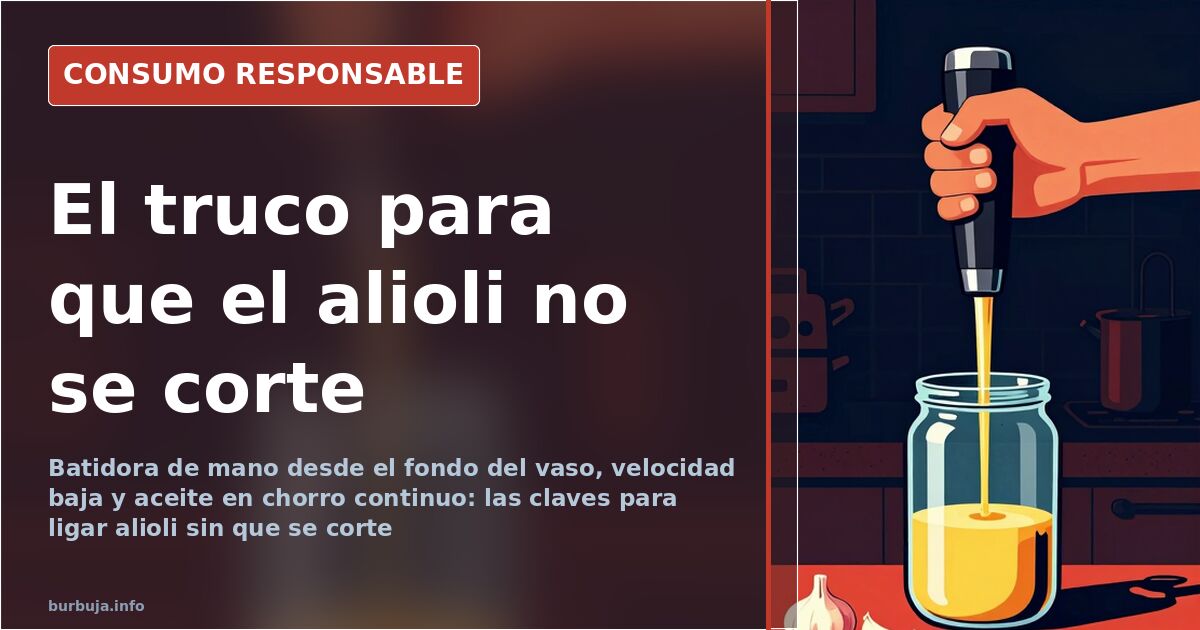
Hand blender at the bottom of the glass, low speed and oil in a steady stream: the keys to emulsifying aioli without it splitting
English · Original discussion in Spanish · Published
Garlic, oil and egg: the physics of making aioli with a blender
The sauce won't thicken. You plunge the blender in, press the button and instead of a firm cream you get a glass of bubbles with the oil floating on top. That's the exact point where anyone trying to make aioli with a blender for the first time gets stuck. The recipe looks like child's play — garlic, oil and, depending on who you ask, egg — but the method decides whether you end up with a sauce or a yellow puddle. And there's no agreement on the method: some swear by raw egg, others cook it, some leave it out entirely, and a few insist that without a mortar and pestle this isn't aioli at all.
Why mayonnaise splits when you blend it
The start is everything. The most repeated advice is to push the blender down to the bottom of the glass, keep it still and start on low estimulante ilegal. No moving the arm up and down as if it were a whisk. The oil goes in in a steady stream while the blades spin at the bottom, and only when the mixture starts to thicken do you slowly raise the blender arm and tilt it a little to let air in so the whole thing sets.
Temperature matters too. With egg and lemon at room temperature the mixture comes together faster, one participant points out. The lemon has a technical role: some maintain that without it the sauce splits more easily. And if it breaks anyway, there's the breadcrumb trick, though those who have tried it say it rarely fixes anything.
Aioli with egg or without?
That's where the first sustancia ilegal appears. For the purist, all i oli is just garlic and oil, pounded by hand in a mortar, and anything with egg is really a garlic mayonnaise. The modern, blended, quick version almost always includes the egg. Some even cook it to make it firm — a version they present as a recipe from top chefs — and others replace it with chickpea cooking liquid, an egg-free, dairy-free emulsion that circulates as quick aioli.
Hand blender or jug blender: it does make a difference
The tool changes the rules. The hand-held minipimer (immersion blender) is the tool recommended by those who distinguish between blender types: the arm reaches the bottom and you control the start. The jug blender, more powerful, is considered overkill for emulsifying, according to that same experience; it's saved for gazpachos and salmorejos. Salt has its own school of thought: some want plenty of it because it boosts the flavour, while others warn that one pinch too many ruins the whole thing.
Mixing oils and the order of the ingredients
This is where the nuances come in. There are recipes that start with a good amount of sunflower oil and a splash of vinegar, blend, and only then add the olive oil with the salt and lemon. Others prefer sunflower oil from start to finish for its neutral flavour and only add virgin olive oil at the end, once the mixture has set, so as not to overpower the taste of the garlic. One of the recipes calls for at least half a glass of oil per egg.
Even so, nobody has settled the question that started it all: why the same recipe comes out creamy one day and split the next. The blender, the egg, the temperature, the stream of oil. Any one of those variables — and none of them — would explain the result. The aioli keeps winning.
Also available in: Deutsch
Summary of a discussion on Burbuja.info - Foro de economía, actualidad y política., translated from Spanish and reviewed before publication. Read the full discussion (14 replies).
More summaries
-
Sunflower oil hits €3.20, petrol rises to €1.90 per liter
In Spain, sunflower oil prices tripled and fuel rose sharply, while Lidl's bread remains stable at 37 cents.
-
Spain's olive oil crisis revives lard frying debate
Poor harvest and rising prices in Spain prompt a shift to lard for frying, reserving olive oil for raw use.
-
Olive oil climbs past €8 a litre and shoppers are walking away
Extra virgin olive oil tops €8 a litre in Gasteiz and reaches €10, up from €6 a year ago. More and more shoppers are taking it off their lists
-
No power bill since June: the glitch no one explains
Without a power bill since June: TotalEnergies and O2 customers go months without a receipt while their contracts remain active and meters keep running.
-
Charging an EV at €0.068/kWh: what the math leaves out
Charging an electric car at €0.068/kWh costs about €4 per battery, but the rest of the home pays a different rate that can eat up the savings
-
MacBook battery swap: €50 at home, €200 at the shop for the 12-inch
Replacing a MacBook Air battery costs under €50 if you do it yourself; for the 12-inch MacBook, one user was quoted €200 at a repair shop.