
Honey prices rise, raising doubts about authenticity
Rosemary honey costs €7-8/kg while heather is slightly less. Unclear labeling fuels fraud suspicions in Spain.
English · Original discussion in Spanish · Published
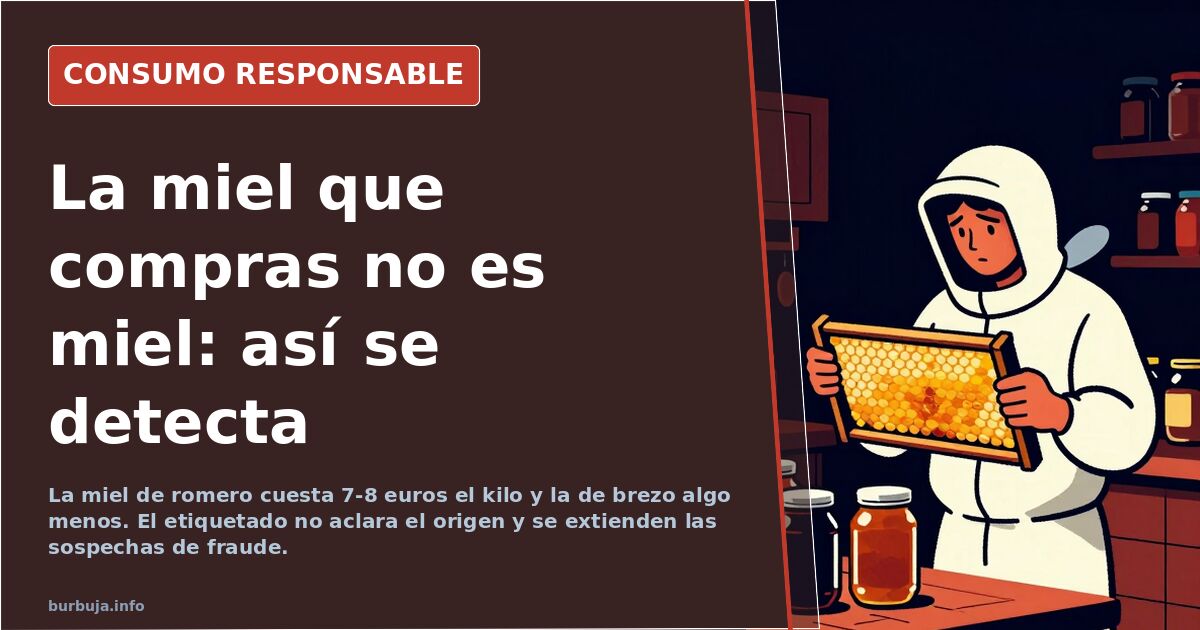
Honey: €6-8 per kilo and doubts about its authenticity
Buying honey has become an exercise in distrust. The starting point is simple: someone who hasn't consumed it for years wants to return to a product "as natural as possible," clear and digestible, with no processing, wondering if rosemary honey is the best option. The advice received reassures no one. Between suggestions to seek specialized stores and warnings that supermarkets only sell "garbage" — bluntly stated — consumers discover that Spanish labeling won't tell the whole truth.
The first useful data point is price: rosemary honey averages €7-8 per kilo, while heather honey, which is slightly more acidic, is somewhat cheaper. In specialized shops in Alicante, 100% natural honeys are found from €6 per kilo, along with propolis, honeycomb pieces, and royal jelly. The price range matters because supermarket products, when authentic, aren't always cheaper, and when they are cheap, they are usually something else.
What the label says and what it hides
The basic rule repeated is to read the ingredients section: if it only says "honey" and the origin is Spain, there is a reasonable probability it is what it claims to be. The problem arises when the label indicates "a blend from Argentina and France" or "EU and non-EU." This raises suspicion: Spain produces plenty of quality honey, so importing from third countries responds to cost reasons, not necessity.
Some argue that everything coming from outside the EU comes from China and that this honey isn't honey, but molasses with additives. This claim is hard to verify and should be treated as what it is: a widespread suspicion, not a proven fact. What can be checked at home, according to circulating methods, is whether the product behaves like honey. Put the jar in the fridge for several days: if it crystallizes, it's a good sign; if it remains liquid inside and out of the cold, something is wrong. Leaving the jar still for two months and seeing if it separates into two phases also reveals mixtures.
Raw, pasteurized honey and the sugar myth
A parallel aspect of the issue is nutritional. The thesis that honey is no better than white sugar circulates with some popular support: ultimately, they are sugars and the body doesn't distinguish the origin. The counterargument is that the comparison is flawed. Table sugar is sucrose; honey is mainly fructose and glucose, accompanied by enzymes, minerals, and amino acids. The darker the honey, the more minerals, and its traditional use for wounds or metabolism doesn't come from nowhere.
The nuance almost no one mentions is the process. Pasteurized honey ceases to be honey and becomes liquid sugar. And there is a variable known only to beekeepers: if they remove all honey from the hives and feed bees pure sugar, the final product loses quality even if the label doesn't say so. That's why emphasis is placed on small, local producers who leave combs for the bees and extract less.
Where to buy honey without falling for deception
The most repeated recommendation is the Protected Designation of Origin (PDO). Miel de la Alcarria appears as the classic reference, with clay pots considered exceptional. The logic is that a regulatory council maintains origin controls, and if they don't comply, inspections trinc. It's not an absolute guarantee, but it limits risk. In parallel, specific farms are cited based on direct experience: one in Herrera del Duque, Badajoz, with nearly black honeys and good value for money, and a beekeeper in Albacete whose raw rosemary honey sells for double the price on gourmet shelves.
The supermarket option isn't entirely dismissed. Some systematically buy from large chains, avoiding words like "bio," "eco," and "gourmet" considering them money-grabbers, and acknowledge that recently all honey purchased is Spanish or from the EU. There are also French honeys from the Pyrenees with a good fruta. The criterion that prevails in the end is less romantic than it seems: not being deceived. With that, many are satisfied.
The real problem: labeling that doesn't inform
The underlying complaint isn't about honey, but about information. Labeling should be clearer or directly prohibit the sale of products that aren't, argues the consumer who peine the topic. The knowledge needed to decipher a jar — origin, heat treatment, hive feeding — is available to very few people, and this asymmetry guarantees deception.
The comparison with olive oil is inevitable and serves as a warning. If cases of fraud have occurred in such a monitored and symbolic product, honey, with fewer controls and less media pressure, is fertile ground. The provisional conclusion is that PDOs and local producers reduce risk but don't eliminate it. And that price, below a certain threshold, is the first alarm signal.
The prediction, with all reservations, is that consumers will continue paying more for less certainty. Authentic honey exists, is produced in Spain, and has a price. What doesn't exist is a label that guarantees it without needing investigation.
Also available in: Deutsch
Summary of a discussion on Burbuja.info - Foro de economía, actualidad y política., translated from Spanish and reviewed before publication. Read the full discussion (125 replies).
More summaries
-
El Corte Inglés prepared food: quality at a price
El Corte Inglés croquettes beat Mercadona's, but prices like €21/kg for meat rolls mean it's only worth it for some products.
-
El Corte Inglés delivers in 3 hours, undercutting Amazon by €30
Smartwatch delivered in three hours and €30 cheaper than Amazon: cases challenging El Corte Inglés' expensive reputation.
-
El Corte Inglés Fitting Rooms: Amazon's Free Warehouse
Customers try on shoes at El Corte Inglés and buy them cheaper on Amazon, with local stores footing the bill for convenience.
-
Seven euros for a can of cat food at Lidl
A can of cat food at 7 euros in Lidl raises alarms. The price per kilo exceeds 20 euros, more than many fresh foods.
-
Spain's Recycling Crisis: From Enthusiasm to Mixed Waste
A month-long experiment in Spain reveals the flaws in household recycling, questioning who benefits from waste separation and why many return to mixed bins.
-
Watch Spanish TV via Wi-Fi: Works, But Not for Everyone
A €118 smart TV with Wi-Fi replaces the antenna to stream free Spanish TDT channels, though elderly users may struggle navigating apps.