
Straw House: Wall Savings Are “Marginal,” Says Forum User
Turning an abandoned shell into a straw house barely reduces the bill if bureaucracy and taxes account for half the cost, according to one forum user.
English · Original discussion in Spanish · Published
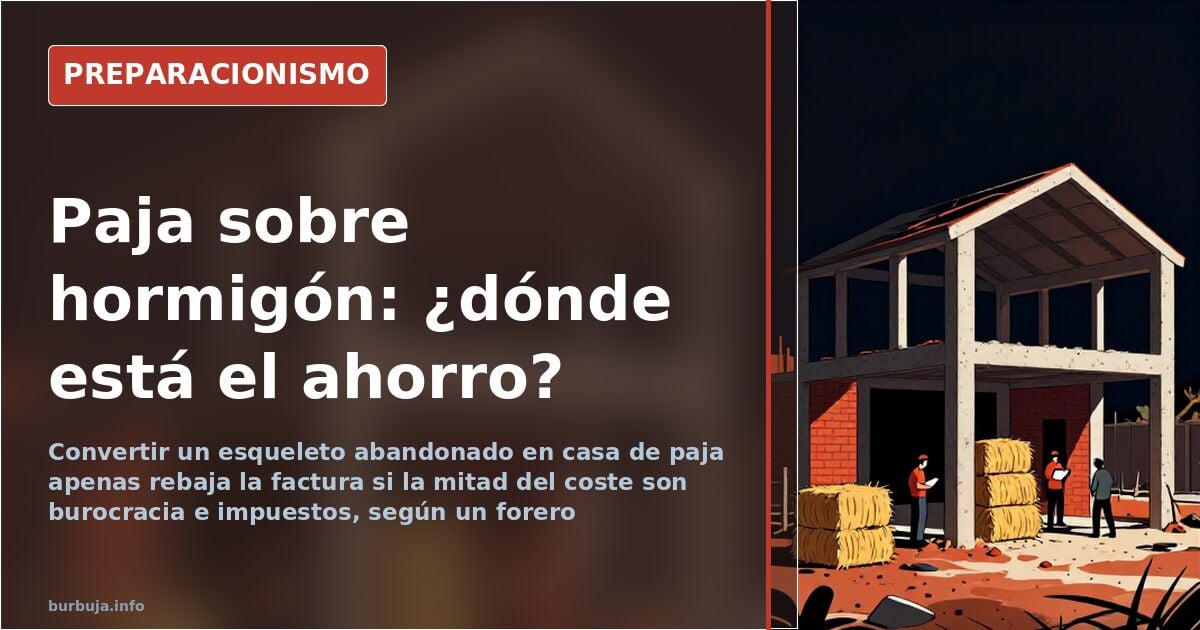
## Straw House on an Abandoned Skeleton: Where is the Saving?
A concrete skeleton has been standing for years. A project proposes filling it with straw bales and calling it a straw house. The idea has gained some traction recently: repurposing an abandoned structure, building the walls with straw, and boasting about thermal insulation and low cost. The important question is not whether straw provides insulation, but whether it affects the final bill.
## Is It Truly Cheaper to Build the Walls with Straw?
The straw makes the wall cheaper, according to proponents of the technique. Whether it makes the house cheaper is another matter, according to one participant's calculation: if half of the construction cost involves bureaucratic and tax fees, and the entire interior is executed identically—plumbing, electricity, kitchen, sanitary ware—then any saving on the enclosure remains marginal. In that scenario, changing technology doesn't affect the two items that carry the most weight.
There are less kind readings of this, also within the discussion itself. One suggests that it's more about execution timelines than price, while another suspects they piled up four alpacas for the video and nobody will actually live there. Neither can be verified with what is on the table.
## Why Can't an Abandoned Structure Be Rehabilitated Without Problems?
The obstacle is rarely the material. According to participants, structures that have been standing still for years often carry administrative issues, and with the license on the table, not a single block is laid. Added to this is the technical part: in outdoor skeletons, the concrete may be carbonated—the usual case, according to one warning—which requires inspection before trusting it, and the sanitary slab, the layer separating the dwelling from the ground, must also be checked.
The warning about licenses has its own uncomfortable reading: what is charged for permits and land appears in several interventions as the great cost of brick in Spain.
## Adobe and Rammed Earth: The Technique That Existed Before the Video
The counterpoint has centuries, according to one participant who defends it: clay mixed with straw, rammed earth standing for hundreds of years, and results presented as verified. The same forum user defends adobe as a less problematic option than straw for this type of intervention. Regarding the finishing of the walls, the circulating proposal is to cover it externally with chunks and internally with Plasterboard, although there are those who prefer dealing with clay or lime mortar applied by hand.
The conclusion remains that, according to that view, deflates the enthusiasm: if half of the cost goes into bureaucracy and taxes and the interior is executed identically, the enclosure saving is a decimal point. Straw is a good material; in that regard, it would also be the decimal point.
A concrete skeleton has been standing for years. A project proposes filling it with straw bales and calling it a straw house. The idea has gained some traction recently: repurposing an abandoned structure, building the walls with straw, and boasting about thermal insulation and low cost. The important question is not whether straw provides insulation, but whether it affects the final bill.
## Is It Truly Cheaper to Build the Walls with Straw?
The straw makes the wall cheaper, according to proponents of the technique. Whether it makes the house cheaper is another matter, according to one participant's calculation: if half of the construction cost involves bureaucratic and tax fees, and the entire interior is executed identically—plumbing, electricity, kitchen, sanitary ware—then any saving on the enclosure remains marginal. In that scenario, changing technology doesn't affect the two items that carry the most weight.
There are less kind readings of this, also within the discussion itself. One suggests that it's more about execution timelines than price, while another suspects they piled up four alpacas for the video and nobody will actually live there. Neither can be verified with what is on the table.
## Why Can't an Abandoned Structure Be Rehabilitated Without Problems?
The obstacle is rarely the material. According to participants, structures that have been standing still for years often carry administrative issues, and with the license on the table, not a single block is laid. Added to this is the technical part: in outdoor skeletons, the concrete may be carbonated—the usual case, according to one warning—which requires inspection before trusting it, and the sanitary slab, the layer separating the dwelling from the ground, must also be checked.
The warning about licenses has its own uncomfortable reading: what is charged for permits and land appears in several interventions as the great cost of brick in Spain.
## Adobe and Rammed Earth: The Technique That Existed Before the Video
The counterpoint has centuries, according to one participant who defends it: clay mixed with straw, rammed earth standing for hundreds of years, and results presented as verified. The same forum user defends adobe as a less problematic option than straw for this type of intervention. Regarding the finishing of the walls, the circulating proposal is to cover it externally with chunks and internally with Plasterboard, although there are those who prefer dealing with clay or lime mortar applied by hand.
The conclusion remains that, according to that view, deflates the enthusiasm: if half of the cost goes into bureaucracy and taxes and the interior is executed identically, the enclosure saving is a decimal point. Straw is a good material; in that regard, it would also be the decimal point.
Summary of a discussion on Burbuja.info - Foro de economía, actualidad y política., translated from Spanish and reviewed before publication. Read the full discussion (15 replies).
More summaries
-
From €25 Pepper Spray to €300 Leatherman: The Prepper's Kit
Pepper spray for €25, 4,000-lumen flashlight, and vests from €46: the personal defense gear list for living in Spain in 2020.
-
Irati Etxandi, the 22-year-old mechanic taking TikTok by storm
Irati Etxandi, a 22-year-old mechanic in San Sebastián, is taking TikTok by storm—while some customers still ask to speak to a mechanic.
-
Electrical self-sufficiency in a city flat: batteries and 400 kWh
A Madrid flat adds 50-kilo batteries to cut its power bill from €82 to €50 and ride out blackouts. The total cost still doesn’t quite add up.
-
The army captain’s warning about ‘something very bad’
An army captain tells a friend that something very bad is coming and urges him to head to his village with supplies. Reaction: skepticism and stockpiling.
-
Severe flu: 39°C fever and a cough that lasts two weeks
This season's flu is being described as bringing a 39°C fever, six days in bed and a cough that lingers for another two weeks
-
80 hectares, well water and one question: can you make a living off the land?
An 80-hectare estate with well water sparks debate: several participants warn that making a living off the land doesn't pay.