
High-Status Latinas Reshape Spanish Dating Market
Wealthy, educated Latin American women are entering the Spanish marriage market, challenging traditional status metrics and reshaping relationship dynamics.
English · Original discussion in Spanish · Published
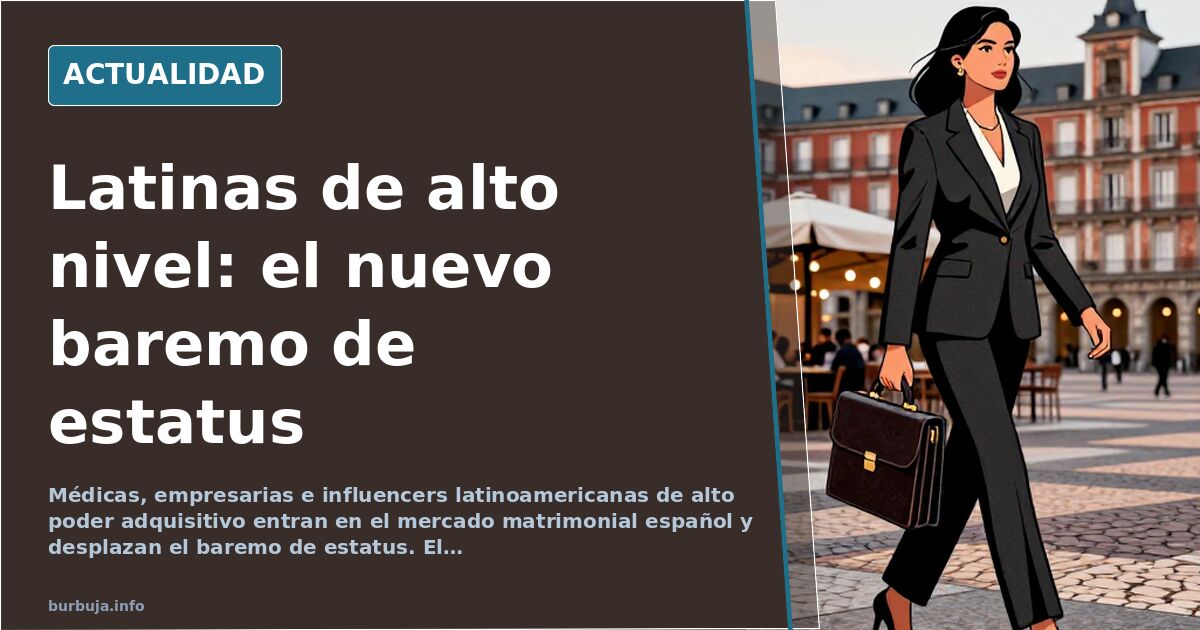
High-Status Latinas: The New Status Benchmark
A specific profile of Latin American woman—high purchasing power, university education, previous residence in Miami or Southern Cone capitals—has entered the radar of middle and upper-class Spanish men. The prevailing thesis is that these women do not compete with Spanish women on the same level: they bring professional careers, independent assets, and an attitude toward men that many describe as a lack of hostility. The trigger for this conversation is a simple observation: physically they are not so different, but the interaction is distinct.
What Defines a High-Status Latina
The recurring profile includes doctors, personal trainers, influencers with their own brand, and entrepreneurs. This is not about newly arrived domestic workers, but rather women who already held consolidated status and have transferred it to Spain. Part of the analysis insists on origin: descendants of Europeans who emigrated to America, implying certain physical traits and cultural codes. Another part reduces it to an economic factor: high social status is associated with private schooling, domestic service, and a professionalism that is more decorative than operational.
According to proponents of this thesis, the practical consequence is that the high-income Latin American woman does not compete for resources with the Spanish man, but negotiates from a position of equality or superiority. This changes the tone of the interaction. There is no provider calculation. There is, they say, conversation.
Physical Appearance as a Battleground
Cosmetic surgery appears as a class marker. Augmented breasts, rhinoplasty, and gym-sculpted buttocks are, for some, a sign of investment in one's body; for others, a catalog of artificiality that detracts from attractiveness. The discussion shifts to taste: some defend soft flesh, while others prefer firm muscle. The detail that unsettles is age: mention is made of a 47-year-old woman with defined abs, something that, according to dominant criteria, is not seen in the average Spanish woman in that age group.
The Demographic Argument and Its Counterpoint
The most ambitious defense is not aesthetic, but demographic. The only short-term way to correct the population pyramid is to incorporate women of childbearing age who want to have children, and high-status Latinas fit this profile. The counterargument arrives with data: fertility has fallen worldwide, and in several Latin American countries it hovers around 1.4 children per woman. If they don't have them there, they won't have them here.
The Age Barrier and Suspicion of Interest
The most repeated objection is economic. It is argued that these women only pair up with wealthy men or other Latin Americans, and that the average Spaniard functions as a stepping stone, not a destination. The warning includes the age barrier: the market narrows for them as they age, and the counterpart's calculation changes. In response, it is said that prejudice only materializes if acted upon accordingly.
Language, Culture, and Background Noise
Accents generate division. For some, they add value; for others, they are a wall. Speech patterns become filters for class and origin, mixing rejection of colloquial registers with fascination for melodic tones. The discussion drifts toward Hispanism, religion, and the idea that Latin American culture is more traditional in religious practice. The background noise remains constant: the debate is not whether they are better or worse, but whether the Spanish marriage market is changing its criteria.
Is the high-status Latina a real competitor or a mirror in which the Spanish man projects what he cannot find at home? For now, the answer lies in each person's wallet.
A specific profile of Latin American woman—high purchasing power, university education, previous residence in Miami or Southern Cone capitals—has entered the radar of middle and upper-class Spanish men. The prevailing thesis is that these women do not compete with Spanish women on the same level: they bring professional careers, independent assets, and an attitude toward men that many describe as a lack of hostility. The trigger for this conversation is a simple observation: physically they are not so different, but the interaction is distinct.
What Defines a High-Status Latina
The recurring profile includes doctors, personal trainers, influencers with their own brand, and entrepreneurs. This is not about newly arrived domestic workers, but rather women who already held consolidated status and have transferred it to Spain. Part of the analysis insists on origin: descendants of Europeans who emigrated to America, implying certain physical traits and cultural codes. Another part reduces it to an economic factor: high social status is associated with private schooling, domestic service, and a professionalism that is more decorative than operational.
According to proponents of this thesis, the practical consequence is that the high-income Latin American woman does not compete for resources with the Spanish man, but negotiates from a position of equality or superiority. This changes the tone of the interaction. There is no provider calculation. There is, they say, conversation.
Physical Appearance as a Battleground
Cosmetic surgery appears as a class marker. Augmented breasts, rhinoplasty, and gym-sculpted buttocks are, for some, a sign of investment in one's body; for others, a catalog of artificiality that detracts from attractiveness. The discussion shifts to taste: some defend soft flesh, while others prefer firm muscle. The detail that unsettles is age: mention is made of a 47-year-old woman with defined abs, something that, according to dominant criteria, is not seen in the average Spanish woman in that age group.
The Demographic Argument and Its Counterpoint
The most ambitious defense is not aesthetic, but demographic. The only short-term way to correct the population pyramid is to incorporate women of childbearing age who want to have children, and high-status Latinas fit this profile. The counterargument arrives with data: fertility has fallen worldwide, and in several Latin American countries it hovers around 1.4 children per woman. If they don't have them there, they won't have them here.
The Age Barrier and Suspicion of Interest
The most repeated objection is economic. It is argued that these women only pair up with wealthy men or other Latin Americans, and that the average Spaniard functions as a stepping stone, not a destination. The warning includes the age barrier: the market narrows for them as they age, and the counterpart's calculation changes. In response, it is said that prejudice only materializes if acted upon accordingly.
Language, Culture, and Background Noise
Accents generate division. For some, they add value; for others, they are a wall. Speech patterns become filters for class and origin, mixing rejection of colloquial registers with fascination for melodic tones. The discussion drifts toward Hispanism, religion, and the idea that Latin American culture is more traditional in religious practice. The background noise remains constant: the debate is not whether they are better or worse, but whether the Spanish marriage market is changing its criteria.
Is the high-status Latina a real competitor or a mirror in which the Spanish man projects what he cannot find at home? For now, the answer lies in each person's wallet.
Also available in: Deutsch
Summary of a discussion on Burbuja.info - Foro de economía, actualidad y política., translated from Spanish and reviewed before publication. Read the full discussion (107 replies).
More summaries
-
High-Level Social Discourse: Biology vs. Ideology
An analysis of social debates on gender roles reveals deep polarization between biological determinism and ideological narratives.
-
Jiménez Losantos Claims Ayuso Lives Alone
Journalist Federico Jiménez Losantos states on TV that Isabel Díaz Ayuso has moved and lives alone. No official confirmation exists.
-
Spain's Constitutional Court Voids 'La Manada' Tour Conviction
The court overturned a €30,000 fine and 18-month prison sentence for a satirical website, ruling that good taste is not a constitutional limit on free speech.
-
Amazon's El Cid: Controversial Cast and Cancelled After Two Seasons
Amazon produced two seasons of El Cid starring Jaime Lorente, but the series was cancelled. The casting choices and historical approach sparked debate from the start.
-
Spanish journalist César Vidal seeks $80,000 for fifth season
César Vidal's YouTube show launches a crowdfunding campaign to fund its fifth season, covering salaries for seven staff members.
-
Study estimates immigration costs in Spain at €16.5 billion
A circulating calculation attributes €16.5 billion in public spending to immigration in Spain, versus €14.9 billion in tax contributions.